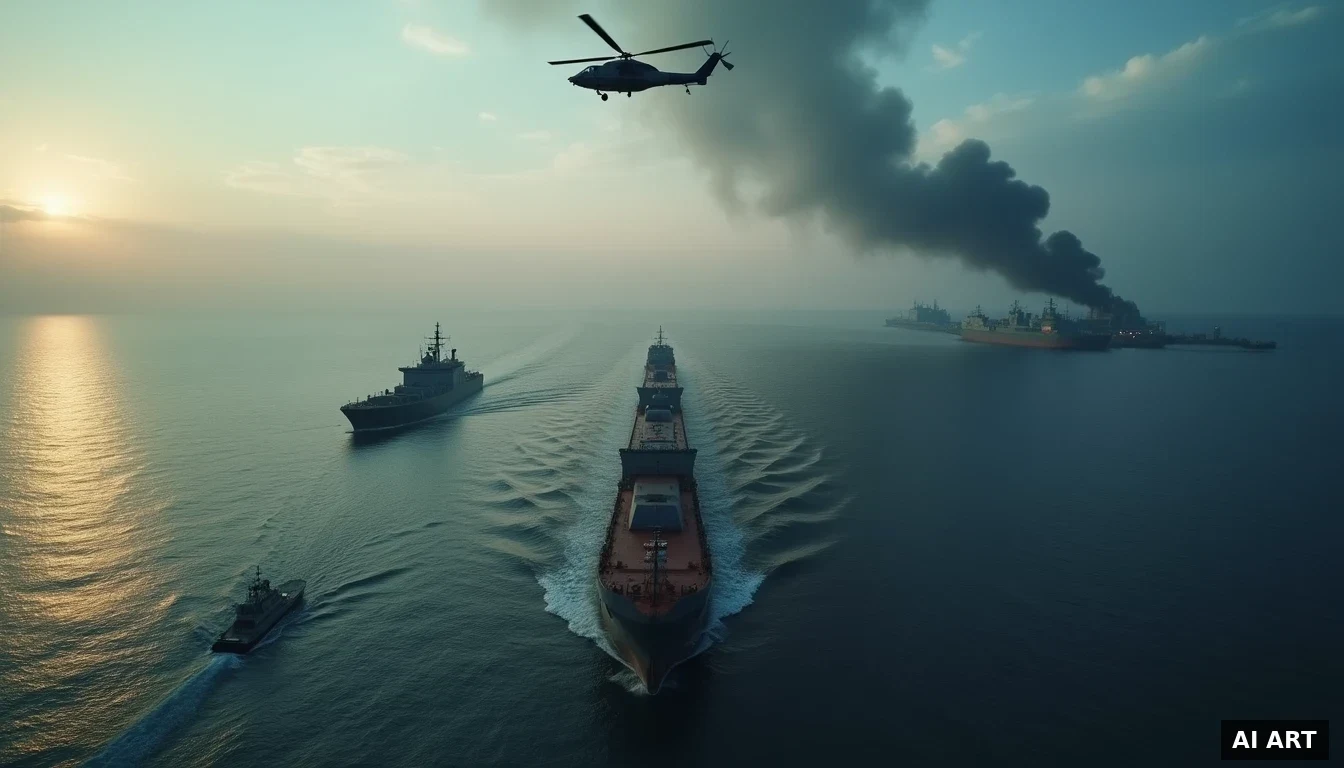
US-Iran War Grinds On as Strikes Resume and Strait of Hormuz Stays Closed
Multi-perspective analysis. Each perspective deliberately argues one viewpoint; none represents the editorial position of qalarc.
Despite a ceasefire memorandum signed on June 17, 2026, the war between the US, Israel, and Iran reignited on June 26-27 when American forces struck Iranian targets after Iran attacked two commercial vessels, prompting Iranian missile and drone retaliation against US-linked facilities in Bahrain and Kuwait. The Strait of Hormuz remains effectively closed and mined as of late June, with transit running far below pre-war levels. Online commentary has cast the conflict as somehow obscure or 'alleged,' but mainstream reporting documents it extensively as an active, escalating war.
What the terms mean (5)
- Strait of Hormuz — A narrow waterway between Iran and the Arabian Peninsula through which roughly a fifth of global oil shipments pass, making its closure a major economic chokepoint.
- Operation Epic Fury — The reported name for the coordinated US-Israeli airstrikes on Iran that began February 28, 2026.
- IRGC — Iran's Islamic Revolutionary Guard Corps, the elite military force that declared the Strait of Hormuz closed and laid mines.
- Mojtaba Khamenei — Son of Ali Khamenei, reported to have been installed as Iran's Supreme Leader after his father was killed in the February 2026 strikes.
- Twelve-Day War — A separate, shorter 2025 Israel-Iran conflict that ended in a ceasefire in which Khamenei survived — frequently conflated with the deadlier 2026 war.
The facts (8)
- On February 28, 2026, the US and Israel launched coordinated airstrikes against Iran in an operation reported as 'Epic Fury,' during which Supreme Leader Ali Khamenei was killed; his son Mojtaba Khamenei was reported as his successor. [1][3]
- Iran moved to close the Strait of Hormuz, with the IRGC declaring it closed on March 27, 2026, and laying sea mines; shipping through the channel fell by roughly 90-95%. [2]
- A memorandum of understanding extending a ceasefire 60 days and aiming to reopen the strait was signed by Donald Trump and Iranian President Masoud Pezeshkian on June 17, 2026, following a digital signing reported June 14-15. [4][10]
- On June 26-27, 2026, US forces struck multiple Iranian targets after Iran attacked the commercial vessels M/V Ever Lovely and M/T Kiku; Iran retaliated against US-linked sites in Bahrain and Kuwait. [5][6][8]
- Bahrain and Kuwait condemned the Iranian attacks on facilities within their territory following the renewed US strikes. [5]
- As of June 21, 2026, the strait's central channel remained mined and transit counts were roughly a third of pre-war levels despite some record oil-volume days; a UAE oil company estimated full flows may not resume until 2027. [2][7]
- Online discussion around the conflict has been dominated by tangential themes — including arguments over labor supply and housing costs, heat-related deaths in Europe, and immigration — rather than the military events themselves.
- A separate 2025 conflict, the 'Twelve-Day War,' ended in a ceasefire in which Khamenei survived and later spoke publicly; conflating that war with the 2026 war (in which he was killed) has caused confusion about whether Khamenei is alive. [9][1]
Context & background
The 2026 Iran war is distinct from the 2025 'Twelve-Day War' between Israel and Iran, which ended in a ceasefire that left Khamenei alive. [9] The newer conflict began February 28, 2026, with coordinated US-Israeli strikes and the death of Khamenei, and quickly extended to the maritime domain as Iran sealed the Strait of Hormuz — through which a large share of the world's seaborne oil passes — by declaration and mining. [1][2] A June 17 deal at Versailles between Trump and Pezeshkian was meant to halt fighting for 60 days and reopen the strait, but the truce frayed within days. [4][10] By June 26-27, attacks on commercial shipping triggered fresh US strikes and Iranian retaliation against Gulf states hosting US facilities, undercutting the reopening effort. [5][6]
Still unresolved
- Whether the June 17 ceasefire memorandum is now effectively void after the June 26-27 strikes and retaliation, or whether negotiations can resume.
- When the Strait of Hormuz will reopen to normal traffic, given the central channel remains mined and one estimate points to 2027 for full flows.
- The extent and confirmed targets of the June 26-27 US strikes and the Iranian retaliation against Bahrain and Kuwait, which were still being reported.
The same story, argued three ways. Pick an angle — the facts above stay the same.
🧭 Cui bono — who benefits?
Beneficiaries
- US defense contractors (Lockheed Martin, Raytheon, Northrop Grumman) — Multi-billion dollar weapons replenishment contracts and ongoing military operations budget
via Continued military engagement with Iran justifies munitions expenditure, replacement orders for depleted stockpiles (precision missiles, drones, air defense systems), and sustained high defense appropriations. Public unawareness prevents political pressure to de-escalate or audit spending. - Israeli strategic interests — US military pressure on Iran without direct Israeli casualty cost or international blowback
via American kinetic operations against Iranian assets (including the reported helicopter incident and subsequent strikes) degrade Iran's regional military capability and proxy networks, advancing Israeli security objectives while Israel avoids being the primary aggressor. American public ignorance ensures no domestic backlash against supporting this proxy dynamic. - US executive branch / national security apparatus — Expanded war powers and budget authority without congressional constraint
via Low-visibility conflict allows military operations under existing authorizations (AUMF interpretations, self-defense claims) without formal war declaration. Public inattention means no electoral cost for escalation, no pressure for transparency on spending (the alleged $80B figure), and freedom to shape rules of engagement unilaterally. - Regional rivals of Iran (Saudi Arabia, UAE) — Degradation of Iranian power projection without direct involvement
via US military action weakens Iranian influence in Yemen, Iraq, Syria, and Lebanon. Gulf states gain relative strategic advantage as Iran's military and economic resources are depleted by conflict, while they remain insulated from retaliation and domestic political costs.
Who loses
- American taxpayers funding undisclosed military operations with no transparent accounting or debate
- Iranian military personnel and civilians subject to strikes
- US military personnel in vulnerable positions (helicopter crews, forward-deployed forces) absorbing casualties without public recognition or debate over mission objectives
- Democratic accountability and congressional war powers, effectively circumvented
Rivalry & conflicts of interest
- Iran's regional military capability and proxy networks harmed → Israel and Saudi-led Gulf coalition gains
conflict of interest: US foreign policy establishment maintains deep institutional and personal ties to both Israeli security apparatus (intelligence sharing agreements, joint military programs, revolving-door appointments) and Gulf monarchies (arms sales relationships, post-government employment in defense sector, energy sector lobbying). Key decision-makers have financial and career incentives aligned with outcomes favorable to these rivals of Iran. - Congressional oversight and constitutional war powers harmed → Executive branch national security bureaucracy gains
conflict of interest: Defense and intelligence officials benefit from expanded operational latitude and budget growth that would be constrained by legislative scrutiny. Classified briefings to select committees maintain information asymmetry that prevents effective congressional challenge.
Ramifications (follow the chain)
- Public ignorance of ongoing conflict → no electoral penalty for escalation → executive branch faces no constraint on widening operations → mission creep transforms limited strikes into sustained campaign → eventually requires either formal declaration (politically costly) or indefinite low-intensity conflict funded through opaque channels.
- Strait remains closed despite military pressure → oil prices remain elevated → inflation persists in Western economies → political pressure on incumbent governments → potential leadership changes that either escalate to force reopening or negotiate settlement → either outcome represents policy failure of current invisible-war strategy.
- Rapid Iranian military defeats with extreme casualties → desperation pushes Iran toward either (a) nuclear breakout as only credible deterrent, or (b) acceptance of humiliating terms → former triggers Israeli preemptive strike and regional war, latter creates unstable settlement requiring permanent US military presence → both outcomes lock in defense spending and regional militarization.
- American casualties (helicopter shoot-down) without public awareness → families of killed service members become inadvertent whistleblowers → media coverage forces acknowledgment → retroactive justification narrative required → administration either admits deception or constructs threat inflation → trust in government war-making authority erodes, but only after appropriations already secured.
intentional reading The executive branch national security apparatus, in coordination with defense contractors and aligned with Israeli/Gulf state interests, is deliberately maintaining low public visibility on Iran operations to prosecute an undeclared war that would face congressional and electoral resistance if transparent. The strategy exploits media distraction and classification to secure ongoing appropriations (the $80B figure) while degrading a geopolitical rival of key allies. Defense contractors benefit directly through weapons sales; officials benefit through expanded authority and post-government career prospects in the defense sector. The 'unawareness' is cultivated through classification, selective briefings, and absence of dramatic visual coverage—keeping operations below the threshold of public attention while remaining intense enough to justify budget requests. Israel gains strategic advantage against Iran without bearing direct costs or international condemnation, while US decision-makers with institutional and personal ties to Israeli security interests face no conflict-of-interest scrutiny due to low visibility.
structural reading No conspiracy required: the US national security bureaucracy operates with structural bias toward military options due to institutional capabilities and career incentives. Iran presents an actionable adversary (unlike nuclear powers Russia/China) where kinetic operations remain feasible. Defense contractors lobby for appropriations regardless of specific mission; once funding is secured, operational tempo increases to justify next cycle's budget. Media outlets lack reporters with clearances or regional presence to cover low-intensity strikes; casualty counts on either side don't generate clicks like domestic political drama. Congressional oversight committees face information asymmetry and political risk (appearing 'soft on Iran'). Israel and Gulf states have strong organic incentives to see Iran weakened and will coordinate when offered the opportunity, without needing direction. Public attention is finite; domestic issues and other international crises dominate news cycles. The result is a self-sustaining conflict that serves multiple actors' incentives while remaining below the threshold of democratic deliberation—not through coordinated suppression, but through aligned institutional interests and structural information asymmetries.
From the threads
The posts that drew the most replies in the source discussion — shown as posted. Reactions ranged across the spectrum; these are the ones people actually engaged with. Each quote links to its archived source thread so you can verify it; quotes we couldn't tie to a source thread are marked source unverified.
Do Europeans really die in the thousands over the heat?
I'm not even 40 yet. When I was growing up, this country was basically a White ethnostate. Nobody had to lock their doors. Nothing was really ever stolen (obviously there are always rare exceptions). It was actually paradise. Americans lost that long before we did here. And now only in the past ten years has everything fallen to shit thanks to every other race being allowed in - and during the lockdowns 5 years ago, india specifically flooded in on plane loads full DAILY against any of our consents...
If I increase the supply of labor while the demand stays the same does the cost of labor go up or down? If I increase the demand for housing while the supply stays the same does the price for housing go up or down?
Links shared in the discussion
Primary sources the threads posted — verify independently. These sometimes point to leads other coverage misses.
Continue the discussion
Add your own take — replies are kept on this article and can be upvoted.
🔗 Related Analysis
- Iran's recent military campaign characterized as catastrophic failure shared: iran, israel, us
- Iran shoots down US helicopter; US escalation expected shared: iran, israel, us
- Iran span shared: iran, israel, us
- Lebanon ceasefire negotiations day 117 with US-Iran military escalation shared: iran, israel, us
- Trump administration criticized for Iran war and $300 billion settlement shared: iran, israel
- US releases official Memorandum of Understanding text on Iran agreement shared: iran, us
References
- [1] ◎ 2026 Iran war - Wikipedia
- [2] ◎ 2026 Strait of Hormuz crisis - Wikipedia
- [3] ◎ 2026 Iran war - Britannica
- [4] ◎ U.S. and Iran reach initial deal to end war, reopen Strait of Hormuz - NPR
- [5] ◑ Bahrain, Kuwait Condemn Iranian Attacks After US Strikes On Iran - RFE/RL
- [6] ◖ June 27, 2026 — US launches more strikes on Iranian sites - CNN
- [7] Crisis Timeline: The Strait of Hormuz War 2026 - Hormuz Strait Monitor
- [8] ◗ US strikes Iran after Strait of Hormuz cargo ship attack - Fox News
- [9] ◎ Twelve-Day War ceasefire - Wikipedia
- [10] ◎ 2026 Iran war ceasefire - Wikipedia
- [11] ◎ June 2025 Israel–Iran war (Twelve-Day War) - Wikipedia
- [12] ◎ Iran–Israel war (2025) / Twelve-Day War — Wikipedia
◖ supportive · ◗ critical · ◎ neutral wire · ◑ partisan · ⚑ state outlet
▾ Discussion
Select any text in the article to comment on that passage.