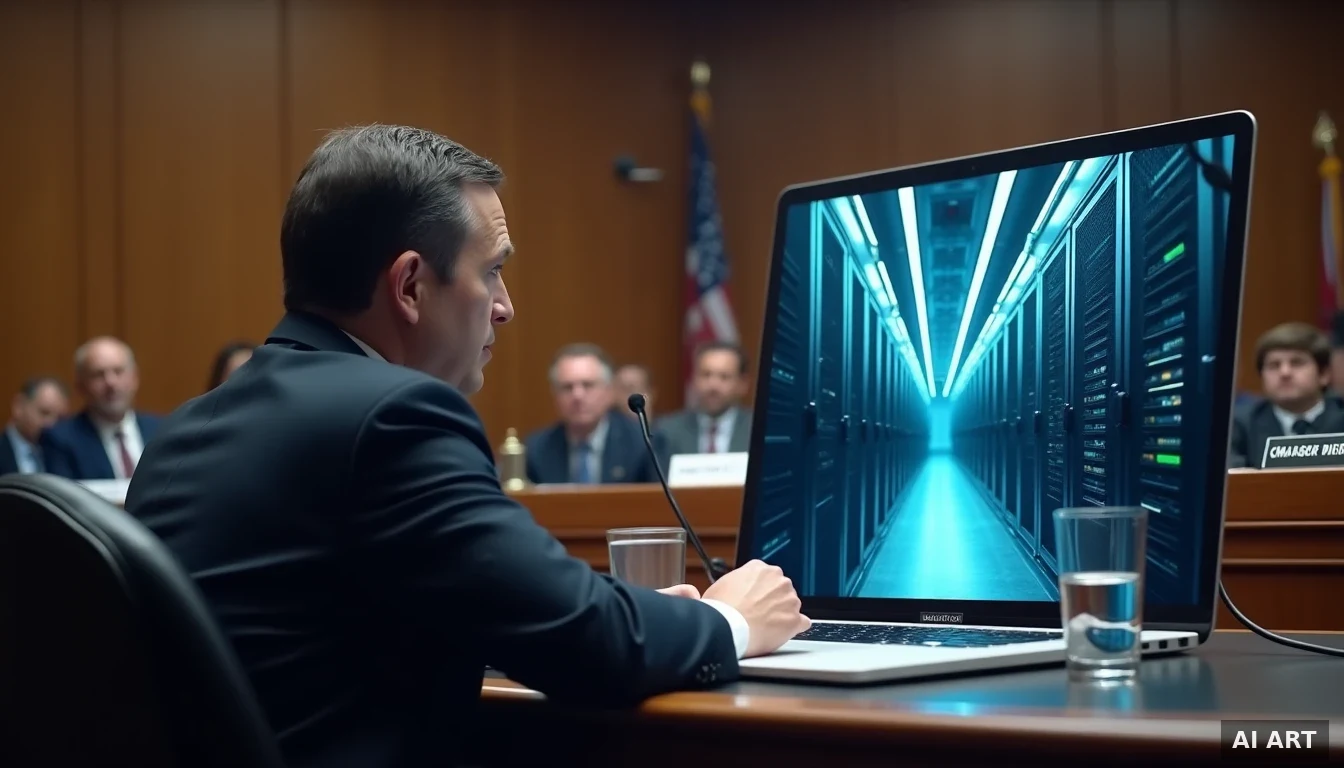
Anthropic's Amodei Warns Frontier Open-Source AI Is on a 'Very Dangerous Path' as Chinese Models Close the Gap
Multi-perspective analysis. Each perspective deliberately argues one viewpoint; none represents the editorial position of qalarc.
Anthropic CEO Dario Amodei has renewed warnings that frontier-scale open-weight AI — particularly systems from Chinese labs — poses acute national-security and safety risks, and has called for binding, FAA-style federal regulation that would let the US government block or reverse dangerous frontier model deployments. His June 10, 2026 essay 'Policy on the AI Exponential' collided with a resurfaced clip of his 2023 Senate testimony and with an ironic June 12 move by the US Commerce Department to place Anthropic's own Mythos 5 and Fable 5 models under export controls.
What the terms mean (5)
- Open-weight / open-source AI — AI models whose trained parameters ('weights') are released publicly so anyone can download, run, or modify them without vendor permission.
- Mythos 5 / Fable 5 — Anthropic frontier model families that the US Commerce Department placed under export controls in June 2026, restricting foreign access.
- GLM-5.2 (Z.ai) — An open-weight AI model from Chinese lab Z.ai reported to show cyber-vulnerability-discovery capabilities comparable to Anthropic's frontier systems.
- FAA-style regulation — A regulatory model analogous to aviation safety oversight — mandatory pre-deployment testing and authority to ground or block systems deemed unsafe.
- Public-benefit corporation (PBC) — A for-profit company legally chartered to pursue a stated public mission alongside shareholder returns; Anthropic is structured as one.
The facts (8)
- In his July 25, 2023 Senate Judiciary Committee testimony, Amodei warned that scaling open-source models is on a 'very dangerous path' — while explicitly stating 'open source is a good thing' for small and medium models and that risks from open models released so far were 'relatively limited'; the clip resurfaced on X around June 29, 2026, driving renewed debate. [1][13]
- On June 10, 2026, Amodei published 'Policy on the AI Exponential,' calling for mandatory, independent safety testing and government authority to block or reverse frontier model deployments — 'open or closed' — that fail those tests, backed by revenue-based civil penalties. [2][5]
- Alongside the essay, Anthropic pledged $350 million to address AI labor-market disruption: a $200M Economic Futures Research Fund and a $150M fellowship program. [4]
- Amodei has warned Chinese labs are roughly 6–12 months from matching US frontier capability, after which open-weight release would render export controls moot; he cited 'Mythos-class' cyber and vulnerability-discovery capabilities as a specific risk. [9][11]
- On June 12, 2026, the US Commerce Department under Secretary Howard Lutnick placed Anthropic's own Mythos 5 and Fable 5 models under export controls, forcing Anthropic to cut off access for all foreign persons — the same kind of deployment authority Amodei's framework proposes, now applied against Anthropic itself. [3][8]
- Reporting notes the open-weight Chinese model GLM-5.2 from Z.ai has shown cyber and vulnerability-discovery capabilities comparable to Anthropic's Mythos. [9]
- Online technology communities have circulated a far harder-line paraphrase — that Amodei wants open-source models (especially Chinese) banned and users prosecuted unless they buy from 'approved American vendors like Anthropic' — a framing not found in Amodei's actual published proposal, which targets frontier deployments via safety testing, not end-users. [1][5]
- Market-focused critics, including analysts cited by AInvest, argue Amodei's safety stance functions as regulatory capture that would protect Anthropic's commercial position; Anthropic operates as a public-benefit corporation. [7][10]
Context & background
Amodei, who co-founded Anthropic in 2021 after leaving OpenAI, has a documented history of caution on open release, dating back to his opposition to fully open-sourcing GPT-2 in 2019. [6] His 2026 essay reframes the debate: rather than an outright ban, he argues the open-vs-closed distinction is a 'red herring' and that what matters is capability, proposing a licensing-style regime for the highest-capability models regardless of license type. [5] Critics, including a Fortune analysis of the Trump administration's handling of Anthropic's models, describe the emerging US approach as an 'ad hoc and opaque' licensing regime by another name. [8] The July 2023 'very dangerous path' quote that recirculated in late June 2026 was more than two years old, though some social posts labeled it 'BREAKING.' [1]
Still unresolved
- Does Amodei's proposed framework contemplate any enforcement against end-users of open models, or is it strictly limited to deployment/testing of frontier systems as his essay states?
- How will the export controls on Mythos 5 and Fable 5 be reconciled with Anthropic's own commercial and international operations, and are they permanent?
- Whether Chinese open-weight models such as GLM-5.2 genuinely match US frontier capability, or remain a step behind, is still contested in the reporting.
The same story, argued three ways. Pick an angle — the facts above stay the same.
🧭 Cui bono — who benefits?
Beneficiaries
- Anthropic — Regulatory capture converting competitive disadvantage into legal monopoly; elimination of zero-cost alternatives forces customers onto paid tier
via Banning open-source models removes the primary cost alternative—if GLM-5.2 or Llama derivatives can match Claude performance at zero marginal cost, Anthropic's $20-200/month subscriptions become indefensible. Prosecution threat creates compliance liability that only established vendors can navigate, moating the market - OpenAI / Microsoft — Shared regulatory barrier to entry; duopoly pricing power if open-source eliminated
via Any rule requiring 'approved American vendors' creates a cartel structure. If Anthropic successfully argues for bans, OpenAI inherits the same protections without having to make the unpopular case themselves. Both avoid the CompSci-department-to-production pipeline that let Stable Diffusion gut Midjourney's moat in 2022 - Cloud hyperscalers (AWS, Azure, GCP) — API lock-in; GPU rental revenue from users unable to self-host
via Open-weight models enable on-premise deployment and one-time hardware amortization. Banning them forces inference workloads onto cloud APIs with per-token billing. AWS hosts Claude (Bedrock); if users can't run GLM locally, they rent compute from the same three oligopolists who already control 65% of cloud infrastructure - U.S. AI companies (collective) — Regulatory asymmetry weaponized against Chinese competition
via Framing Tsinghua's GLM or DeepSeek models as national security threats justifies non-tariff barriers while U.S. firms face no reciprocal constraints domestically. Converts technical competition into geopolitical compliance, where Washington enforcement becomes the product moat
Who loses
- Independent developers and startups unable to afford $3-20k/month API bills for experimentation or low-margin applications
- Researchers and universities whose compute budgets don't stretch to cloud inference at scale
- End-users in cost-sensitive applications (education, healthcare tooling, consumer apps) who lose access to zero-cost local models
- Chinese AI labs facing asymmetric trade barriers while contributing to the global commons
Rivalry & conflicts of interest
- Open-source ecosystem (Meta's Llama, Tsinghua's GLM, Mistral open weights) harmed → Anthropic and OpenAI (closed commercial APIs) gains
conflict of interest: Anthropic CEO Dario Amodei making the policy argument; company survival depends on converting users from free alternatives. AWS (Amazon) is both Claude's infrastructure partner and a stakeholder in its success via Bedrock revenue share - Chinese AI developers (GLM-5.2, DeepSeek) harmed → U.S. AI incumbents protected by compliance/access barriers gains
conflict of interest: If the prior Mythos/Fable-5 blocking claim holds (U.S. government intervention favoring domestic models), this continues the pattern: regulatory decisions systematically advantage the labs with Washington access over foreign or open competitors - Self-hosting users and on-premise enterprise deployments harmed → Cloud providers (AWS, Azure, GCP) selling inference APIs and GPU rentals gains
conflict of interest: AWS is Anthropic's primary infrastructure and distribution partner (Bedrock). Any policy forcing users from local Llama/GLM deploys onto cloud APIs directly increases AWS revenue and Anthropic's serviceable market
Ramifications (follow the chain)
- Open-source ban → all inference moves to API clouds → per-token billing replaces one-time hardware cost → SaaS revenue model entrenches for AI, mirroring Adobe's Creative Cloud playbook (kill perpetual licenses, force subscriptions)
- Prosecution threat for open-model use → compliance liability → only enterprises with legal teams can navigate → kills the garage-startup-to-unicorn pipeline that defined previous tech waves (Instagram, WhatsApp built on FOSS stacks)
- Chinese models banned as 'national security threat' → reciprocal restrictions from Beijing → bifurcated AI ecosystem → U.S. labs lose access to Chinese research advances (e.g., MoE architectures, efficient post-training) → innovation velocity declines for both blocs, but incumbents in each region capture local rents
- If users accept 'AI must be paid subscription' norm → wedge opens for broader compute rent-seeking → general-purpose computing becomes metered service (precedent: game streaming, thin clients) → ownership of compute moves from edge to datacenter, with corresponding surveillance and control consolidation
intentional reading Anthropic is attempting regulatory capture to solve a structural business problem: Claude cannot reliably outperform GPT-4 (per engineering community feedback on datasheets/code tasks), and faces commoditization from open weights that match 80% of capability at 0% of cost. Rather than compete on product, Dario Amodei is lobbying to criminalize the free alternative—classic rent-seeking. The Chinese angle is pretextual threat inflation (cf. TikTok hearings) to wrap commercial protectionism in national-security language that's politically non-controversial. If the Mythos blocking story is accurate, this represents a *second* instance of U.S. policy intervention favoring Anthropic/OpenAI over competitors (first domestic via AWS leverage against Fable, now foreign via open-source ban). AWS's revenue stake in Claude API calls and Bedrock creates a direct incentive to lobby for outcomes that force users off self-hosted models—and Amazon has vastly more Washington influence than any AI startup. The intentional read: Anthropic supplies the 'AI safety' narrative, Amazon supplies the lobbying muscle, and the U.S. government supplies the enforcement, with all three benefiting from a closed ecosystem.
structural reading No conspiracy required—this is standard industrial organization. Anthropic faces margin pressure from both closed competitors (OpenAI/Google) and open alternatives (Llama 3.3, GLM-5.2). Any exec in that position seeks regulatory moats; 'safety' is the available justification post-2023. Simultaneously, the U.S. government wants AI leadership as geopolitical strategy and interprets that as 'protect domestic champions,' so Anthropic's ask aligns with existing nationalist tech policy (cf. CHIPS Act, Huawei bans). Cloud providers generically prefer APIs over self-hosting for revenue model reasons, independent of any specific conspiracy. Open-source models threaten everyone's margins simultaneously, so you get convergent lobbying without coordination: Anthropic cites safety, OpenAI cites IP theft, Microsoft/Amazon cite infrastructure security, Congress hears 'China bad,' and the policy writes itself. The structural lock-in happens because the actors who can afford sustained lobbying (incumbents, hyperscalers) all benefit from barriers to entry, while the diffuse beneficiaries of open source (students, hackers, startups-to-be) have no lobby. The conflict of interest isn't hidden—it's the *entire political economy* of AI regulation, where the only parties at the table are those whose business models require enclosure of the commons.
📊 Trading signals — winners & losers
Tradeable instruments most exposed to this story, inferred from the analysis above. Not financial advice — informational only, generated by AI from forum discussion and may be wrong.
📈 Likely winners
- ▲ MSFTstockMicrosoft$483.247d -2.7%✓ +20.6% since callOpenAI partner benefits from regulatory barriers eliminating open-source competition
- ▲ AMZNstockAmazon$258.637d -2.5%✓ +6.2% since callAWS captures API revenue as self-hosting options restricted
- ▲ GOOGLstockAlphabet$344.827d -0.4%✗ -4.7% since callGCP benefits from forced cloud inference, regulatory moat
- ▲ NVDAstockNVIDIA$214.727d -4.7%✓ +5.2% since callCloud GPU demand increases if local deployment banned
📉 Likely losers
- ▼ TAOcryptoBittensor$235.437d +20.0%✗ +22.8% since callDecentralized AI infrastructure threatened by open-source crackdown
📈 Call performance — day by day
| date | price | vs entry |
|---|---|---|
| 2026-08-11 | $506.06 | +26.3% |
| 2026-08-12 | $503.81 | +25.7% |
| 2026-08-13 | $492.43 | +22.9% |
| 2026-08-14 | $496.88 | +24.0% |
| 2026-08-15 | $496.88 | +24.0% |
| 2026-08-16 | $495.40 | +23.6% |
| 2026-08-17 | $495.40 | +23.6% |
| 2026-08-18 | $480.35 | +19.9% |
| 2026-08-19 | $480.93 | +20.0% |
| 2026-08-20 | $484.31 | +20.9% |
| 2026-08-21 | $481.15 | +20.1% |
| 2026-08-22 | $483.24 | +20.6% |
| 2026-08-23 | $483.24 | +20.6% |
| 2026-08-24 | $483.24 | +20.6% |
showing last 14 of 35 days
| date | price | vs entry |
|---|---|---|
| 2026-08-11 | $278.09 | +14.1% |
| 2026-08-12 | $272.27 | +11.8% |
| 2026-08-13 | $267.28 | +9.7% |
| 2026-08-14 | $265.13 | +8.8% |
| 2026-08-15 | $265.13 | +8.8% |
| 2026-08-16 | $262.65 | +7.8% |
| 2026-08-17 | $262.65 | +7.8% |
| 2026-08-18 | $261.31 | +7.3% |
| 2026-08-19 | $259.45 | +6.5% |
| 2026-08-20 | $265.84 | +9.1% |
| 2026-08-21 | $260.11 | +6.8% |
| 2026-08-22 | $258.63 | +6.2% |
| 2026-08-23 | $258.63 | +6.2% |
| 2026-08-24 | $258.63 | +6.2% |
showing last 14 of 35 days
| date | price | vs entry |
|---|---|---|
| 2026-08-11 | $357.52 | -1.2% |
| 2026-08-12 | $343.80 | -5.0% |
| 2026-08-13 | $343.54 | -5.1% |
| 2026-08-14 | $346.36 | -4.3% |
| 2026-08-15 | $346.36 | -4.3% |
| 2026-08-16 | $345.90 | -4.4% |
| 2026-08-17 | $345.90 | -4.4% |
| 2026-08-18 | $344.00 | -5.0% |
| 2026-08-19 | $344.20 | -4.9% |
| 2026-08-20 | $344.72 | -4.8% |
| 2026-08-21 | $340.67 | -5.9% |
| 2026-08-22 | $345.57 | -4.5% |
| 2026-08-23 | $344.82 | -4.7% |
| 2026-08-24 | $344.82 | -4.7% |
showing last 14 of 35 days
| date | price | vs entry |
|---|---|---|
| 2026-08-11 | $217.55 | +6.6% |
| 2026-08-12 | $217.50 | +6.6% |
| 2026-08-13 | $224.09 | +9.8% |
| 2026-08-14 | $225.30 | +10.4% |
| 2026-08-15 | $225.30 | +10.4% |
| 2026-08-16 | $225.16 | +10.3% |
| 2026-08-17 | $225.16 | +10.3% |
| 2026-08-18 | $225.01 | +10.2% |
| 2026-08-19 | $220.31 | +7.9% |
| 2026-08-20 | $217.01 | +6.3% |
| 2026-08-21 | $216.85 | +6.2% |
| 2026-08-22 | $214.83 | +5.2% |
| 2026-08-23 | $214.72 | +5.2% |
| 2026-08-24 | $214.72 | +5.2% |
showing last 14 of 35 days
| date | price | vs entry |
|---|---|---|
| 2026-08-11 | $199.76 | +4.2% |
| 2026-08-12 | $204.83 | +6.8% |
| 2026-08-13 | $197.49 | +3.0% |
| 2026-08-14 | $203.41 | +6.1% |
| 2026-08-15 | $199.81 | +4.2% |
| 2026-08-16 | $195.78 | +2.1% |
| 2026-08-17 | $196.64 | +2.6% |
| 2026-08-18 | $192.41 | +0.3% |
| 2026-08-19 | $190.74 | -0.5% |
| 2026-08-20 | $207.13 | +8.0% |
| 2026-08-21 | $217.83 | +13.6% |
| 2026-08-22 | $233.34 | +21.7% |
| 2026-08-23 | $220.71 | +15.1% |
| 2026-08-24 | $236.75 | +23.5% |
showing last 14 of 30 days
📊 See how every call has performed — the full scoreboard & API →
From the threads
The posts that drew the most replies in the source discussion — shown as posted. Reactions ranged across the spectrum; these are the ones people actually engaged with. Each quote links to its archived source thread so you can verify it; quotes we couldn't tie to a source thread are marked source unverified.
1) BAN all open source AI models (especially Chinese ones) 2) ARREST anybody who uses open source AI models (especially Chinese ones) 3) ONLY allow LEGAL purchases of American AI models (preferably from Anthropic, and no honey, you can't get Mythos) Y'know, he's kinda right.
Why haven't you invested in AI yet? AI is the future and if we let it die, there's no more future for us, humans!
the pol lens is so perfect and calming. I can just look at his face and already know what he is and why he's doing it.
And none of us will do shit about it btw. We are all going to let this one pass, just like it has been, always. We truly are r******* cattle, aren't we?
Links shared in the discussion
Primary sources the threads posted — verify independently. These sometimes point to leads other coverage misses.
Continue the discussion
Add your own take — replies are kept on this article and can be upvoted.
🔗 Related Analysis
- Anthropic Fable 5 blocked by US government amid Amazon conflict-of-interest claims shared: anthropic, mythos
- Electrical engineer reports Claude underperforms versus ChatGPT for non-coding datasheet analysis tasks shared: claude
- GLM 5.2 vs Claude Opus 4.8 shared: anthropic
References
- [1] Anthropic CEO warned open-source AI could become 'very dangerous' as Western firms switch to Chinese models — TechStartups
- [2] ◎ Anthropic CEO says government should block dangerous AI — Axios
- [3] ◎ Trump administration places Anthropic's Mythos and Fable under national-security controls — Axios
- [4] Amodei Demands Power Blocking Unsafe Models, Anthropic Pledges $350 Million — TechTimes
- [5] Dario Amodei 'Policy on the AI Exponential' (June 2026): Full Breakdown — explainx.ai
- [6] Dario Amodei Warned Against GPT-2 in 2019 — explainx.ai
- [7] Anthropic Warns Open-Source AI Is an Existential Risk. The Market Doesn't Buy It. — AInvest
- [8] ◎ The Trump administration's ban on Anthropic's models is a licensing regime by another name — Fortune
- [9] Anthropic CEO warns of China's open-source threat and 'Mythos-class' cyber risks — Crypto Briefing
- [10] Amodei's 'Policy on the AI Exponential': Safety Plan or Blueprint for Regulatory Capture? — Kingy AI
- [11] Dario Amodei — Wikipedia
◖ supportive · ◗ critical · ◎ neutral wire · ◑ partisan · ⚑ state outlet
▾ Discussion
Select any text in the article to comment on that passage.