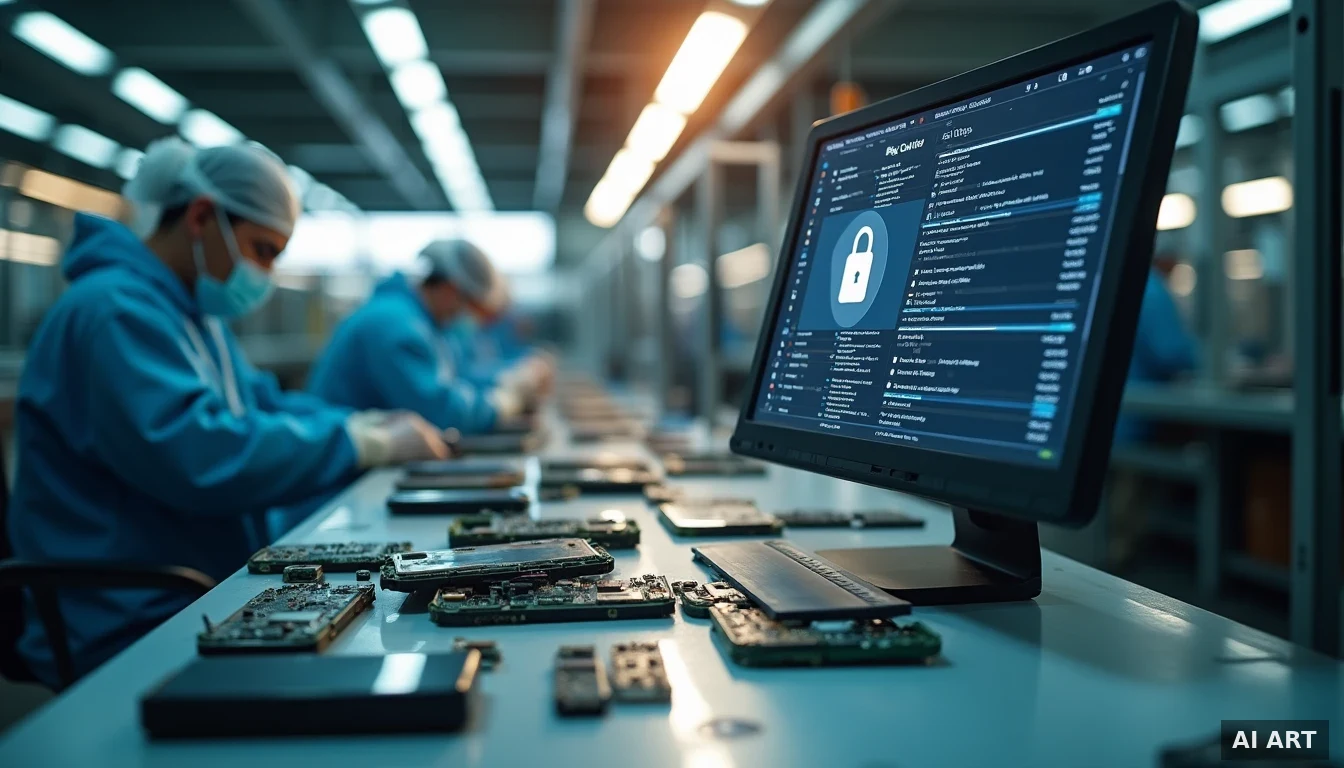
What the Tata Breach Actually Exposed — and What It Didn't
Multi-perspective analysis. Each perspective deliberately argues one viewpoint; none represents the editorial position of qalarc.
A ransomware group calling itself 'World Leaks' breached Tata Electronics, one of Apple's key manufacturing partners in India, and published more than 200,000 files totaling over 630 GB on its dark web leak site between roughly June 10 and 22, 2026. The trove exposed unreleased iPhone 18 Pro and Pro Max supplier lists, component-to-supplier maps, logic board schematics, drop-test videos and chip references. Tata acknowledged a 'cybersecurity incident' around June 23, and Apple confirmed it is investigating and pursuing takedowns.
The facts (8)
- The ransomware group 'World Leaks' claimed responsibility for breaching Tata Electronics and posted over 200,000 files totaling more than 630 GB on its dark web leak site, with posts dated roughly June 10-22, 2026 [1][7].
- Tata Electronics confirmed around June 23, 2026 that it had 'identified a cybersecurity incident,' restricted internal access, and appointed a global consultancy to run a forensic audit [3][1].
- Leaked materials reportedly include iPhone 18 Pro/Pro Max supplier lists, component-to-supplier maps, logic board/motherboard schematics, references to the A20 Pro chip (codenamed 'Borneo') and a C2 modem, plus internal photos and drop-test videos [5][8].
- Apple confirmed it is 'concerned' and investigating, and has pursued copyright takedowns to remove leaked drop-test videos from X and other platforms [4].
- Data belonging to other Tata clients including Tesla, and to parts suppliers such as TSMC and Qualcomm, was also reportedly affected — meaning the 630 GB total spans multiple products and clients, not iPhone 18 Pro data alone [6].
- India's Ministry of Electronics and Information Technology is reportedly investigating the breach [3].
- Online technology communities amplified the leak with claims that it 'enables unauthorized device replication' — one widely shared post asserted that 'some random dude in China now has full instructions of how to assemble an iPhone 18 Pro'; reporting to date describes exposed supplier maps and prototype/test documents rather than a complete turnkey blueprint [9][2].
- The iPhone 18 Pro is unreleased, expected around September 2026; India is projected to assemble roughly 26% of global iPhones in 2026, up from about 6% four years earlier [6][2].
Context & background
Tata Electronics has rapidly become a linchpin of Apple's effort to diversify iPhone manufacturing away from China, assembling devices and, through its acquisition of Wistron's India operations and a stake in Pegatron's local unit, handling an expanding share of Apple's supply chain. The breach lands amid that geopolitical shift, with India's assembly footprint growing sharply and Apple under pressure to de-risk from Chinese production [6][2]. Business Standard and other outlets note that the exposure raises questions beyond the unreleased phone itself — reporting points out Tata had applied relatively strict NDA-based protections, with certain details such as color information redacted, complicating the narrative that manufacturing secrets were casually handled [2]. The 'World Leaks' group is described in coverage as an extortion-focused operation that publishes exfiltrated data on a dark web leak site [7].
Still unresolved
- How much of the 630 GB relates specifically to the iPhone 18 Pro versus other Tata clients (Tesla, TSMC, Qualcomm) and internal corporate data?
- Whether the exposed schematics and supplier maps are actionable enough to meaningfully aid competitors or counterfeiters, or primarily reveal supply-chain structure and prototype designs.
- The full scope of remediation, regulatory findings, and any ransom demand or negotiation involving Tata and 'World Leaks'.
Quick answers
What happened?
A ransomware group calling itself 'World Leaks' breached Tata Electronics, one of Apple's key manufacturing partners in India, and published more than 200,000 files totaling over 630 GB on its dark web leak site between roughly June 10 and 22, 2026.
What's the evidence?
Checked against 14 candidate sources; the strongest references include: Apple iPhone 18 Pro secrets leaked in Tata Electronics hack: What we know — Al Jazeera; Apple supplier leak raises questions beyond exposure of unreleased iPhone — Business Standard; India investigates Tata Electronics data leak exposing Apple iPhone secrets — Crypto Briefing.
Who benefits?
Chinese manufacturing ecosystem (particularly Shenzhen electronics sector) — Complete iPhone 18 Pro assembly specifications enable rapid cloning, component sourcing arbitrage, and grey-market production at lower cost.
How confident is the assessment?
The fact-finding verdict is confirmed against multiple independent sources. The motive analysis is 72% confident.
Why does it matter?
Apple forced to accelerate proprietary manufacturing process controls (custom tooling, Apple-specific components) -> increases switching costs but also manufacturing complexity -> slower India ramp regardless of security improvements -> Chinese supply chain lock-in persists longer than Apple's diversification timeline…
The same story, argued three ways. Pick an angle — the facts above stay the same.
🧭 Cui bono — who benefits?
Beneficiaries
- Chinese manufacturing ecosystem (particularly Shenzhen electronics sector) — Complete iPhone 18 Pro assembly specifications enable rapid cloning, component sourcing arbitrage, and grey-market production at lower cost
via 630 GB of manufacturing data eliminates reverse-engineering costs and accelerates time-to-market for 'Shanzhai' devices; component suppliers gain full BOM visibility to offer competing assembly services; grey-market assemblers can produce functionally-identical devices using diverted or substitute components - Pakistan and China (geopolitically) — India's reputation as reliable high-tech manufacturing partner is damaged at critical juncture in 'China+1' diversification
via Apple and other Western OEMs reconsidering India capacity expansion following major IP breach creates vacuum; manufacturing investment flows back to established Chinese supply chains or to Vietnam/Thailand instead; undermines US-Japan-India 'Quad' technology alliance credibility when India positioned as democratic alternative to Chinese manufacturing - Vietnamese and Thai electronics manufacturing sectors — Competitive advantage in attracting Apple and tier-1 OEM diversification away from both China AND India
via India data security failure raises due diligence costs and perceived risk for proprietary manufacturing transfers; Vietnam and Thailand position as 'secure middle option' with better IP protection track record than India but less geopolitical tension than China - Grey-market and parallel import distributors globally — Clone devices flood markets at 40-60% of official iPhone pricing, capturing price-sensitive segments
via Manufacturing data leak enables production of devices passing visual inspection and basic functionality tests; parallel importers source from Chinese assemblers using leaked specs; official Apple channels lose volume in emerging markets where price elasticity is high
Who loses
- Apple (immediate IP loss, long-term India manufacturing strategy setback, grey-market cannibalization)
- Indian contract manufacturers (Foxconn India, Tata Electronics) - reputational damage, potential contract cancellations or penalties
- Indian government 'Make in India' initiative credibility for high-value electronics
- Western consumers paying full retail for devices now cloneable at fraction of cost
Ramifications (follow the chain)
- Apple forced to accelerate proprietary manufacturing process controls (custom tooling, Apple-specific components) -> increases switching costs but also manufacturing complexity -> slower India ramp regardless of security improvements -> Chinese supply chain lock-in persists longer than Apple's diversification timeline intended
- Indian government implements draconian data security/facility access controls to restore confidence -> raises operational costs and friction for all manufacturers -> makes India less competitive vs. Vietnam/Thailand on total cost basis -> 'China+1' flows bypass India entirely, undermining strategic autonomy goals
- Clone devices flood emerging markets with leaked manufacturing specs -> official iPhones lose share in price-sensitive regions (India, Southeast Asia, Africa) -> Apple retreats upmarket in these geographies -> Chinese Android OEMs consolidate volume share -> undermines US technology influence in Global South
- Leak demonstrates high-value IP is not safe in Indian facilities -> other Western tech companies (semiconductors, automotive, aerospace) pause India technology transfer plans -> India remains trapped in low-value assembly without moving up value chain -> perpetuates dependence on Chinese components and sub-assemblies even for 'Made in India' products
intentional reading Chinese state-directed economic espionage operation targeting India's emerging role in Apple supply chain diversification. The timing—iPhone 18 Pro, next-generation device—and scale (630 GB, complete manufacturing package) suggest professional exfiltration rather than opportunistic leak. China has clear strategic motive: (1) obtain complete specifications for domestic clone production, (2) sabotage India's credibility as alternative manufacturing hub at inflection point when Apple expanding India capacity, (3) undermine US-India-Japan 'Quad' technology cooperation by demonstrating India cannot be trusted with sensitive IP, (4) force manufacturing back to Chinese supply chains where state maintains leverage over Apple. Pakistan, as Chinese ally facing border tensions with India, could provide intelligence cooperation or access. The leak's public nature (rather than quiet exploitation) suggests reputational damage to India was itself an objective, not just IP acquisition. Alternative: industrial espionage by Chinese EMS competitors (Luxshare, BYD Electronics) losing Apple contracts to Indian facilities, with tacit state support or encouragement.
structural reading No central coordination required: Indian manufacturing security culture has not evolved to match sensitivity of IP now being transferred under 'China+1' diversification. Facilities built for low-value assembly (basic electronics, textiles) suddenly handling flagship product specifications without proportional security investment. Workforce includes contract workers, multi-tier suppliers, and logistics partners with inadequate vetting and access controls. Economic incentives for individual workers or mid-level managers to monetize access are enormous (630 GB of iPhone manufacturing data worth millions on grey market). Chinese grey-market ecosystem provides ready buyers with established channels to monetize such leaks. Once leak occurs, Chinese assemblers have pure economic incentive to exploit it regardless of geopolitical considerations—clone production is profitable arbitrage. Apple and competitors then rationally reassess India risk, even without assuming malicious intent, because revealed preference shows controls were inadequate. Competing manufacturing hubs (Vietnam, Thailand) benefit automatically from India's fumble. The outcome—Chinese ecosystem gains, India loses credibility, Apple's diversification stalls—emerges from aligned individual incentives without requiring coordinated state action, though state action would produce identical result.
🎯 This narrative's market calls
Tickers the crowd narrative pointed at when this article was written — scored honestly against the price at publish. narrative confidence 72%
📊 See every call & how they resolved — the Calls scoreboard →From the threads
The posts that drew the most replies in the source discussion — shown as posted. Reactions ranged across the spectrum; these are the ones people actually engaged with.
To get how big this is, some random dude in China now has full instructions of how to assemble an iPhone 18 Pro. He could never even dream of such stuff with any China leaks. https://x.com/akcay_nurettinn/statu s/2073007909324165298 https://nitter.net/akcay_nurettinn/ status/2073007909324165298
There’s literally nothing wrong with being Jewish.
genocide is wrong, demon bro.
That was a p***. Indians have impeccable infosec
Remember how in US a corp sold poisoned baby formula and noone got executed for murdering babies? But in China they got executed... Now, China is invading us... yes, it's war... but you know shit is bad when your own truth will kill you and all they have to do is wait. Can you blame them? If we are that rotten, who would want us in the world? And why?
Links shared in the discussion
Primary sources the threads posted — verify independently. These sometimes point to leads other coverage misses.
Continue the discussion
Add your own take — replies are kept on this article and can be upvoted.
🔗 Related Analysis
- Japan-India partnership against China shared: china, india
- comparative decline of Western powers amid China and Israel rise shared: china, india
- Speculation on whether Indian political alignment will shift away from Israel shared: india
- Iran military victory and global power realignment shared: china
- Claim that China promotes anti-Israel sentiment to undermine Western allies shared: china
References
- [1] Apple iPhone 18 Pro secrets leaked in Tata Electronics hack: What we know — Al Jazeera
- [2] Apple supplier leak raises questions beyond exposure of unreleased iPhone — Business Standard
- [3] India investigates Tata Electronics data leak exposing Apple iPhone secrets — Crypto Briefing
- [4] Apple Wipes Leaked iPhone 18 Pro Videos from X — iDropNews
- [5] Massive data breach reveals first motherboard design of iPhone 18 Pro Max — VietnamNet
- [6] Apple's India Bet Turns Toxic: 630GB iPhone 18 Pro Leak Exposes Entire Supply Chain — BigGo Finance
- [7] Ransomware group leaks iPhone 18 Pro data after breaching Tata Electronics' systems — teiss
- [8] Apple iPhone 18 Pro Leak: Tata Electronics Hack Reveals Drop Test Video, Design, Chip, Motherboard, Supplier Documents — Sunday Guardian
- [9] Post by @akcay_nurettinn on X amplifying the leak
Discussion
Select any text in the article to comment on that passage.