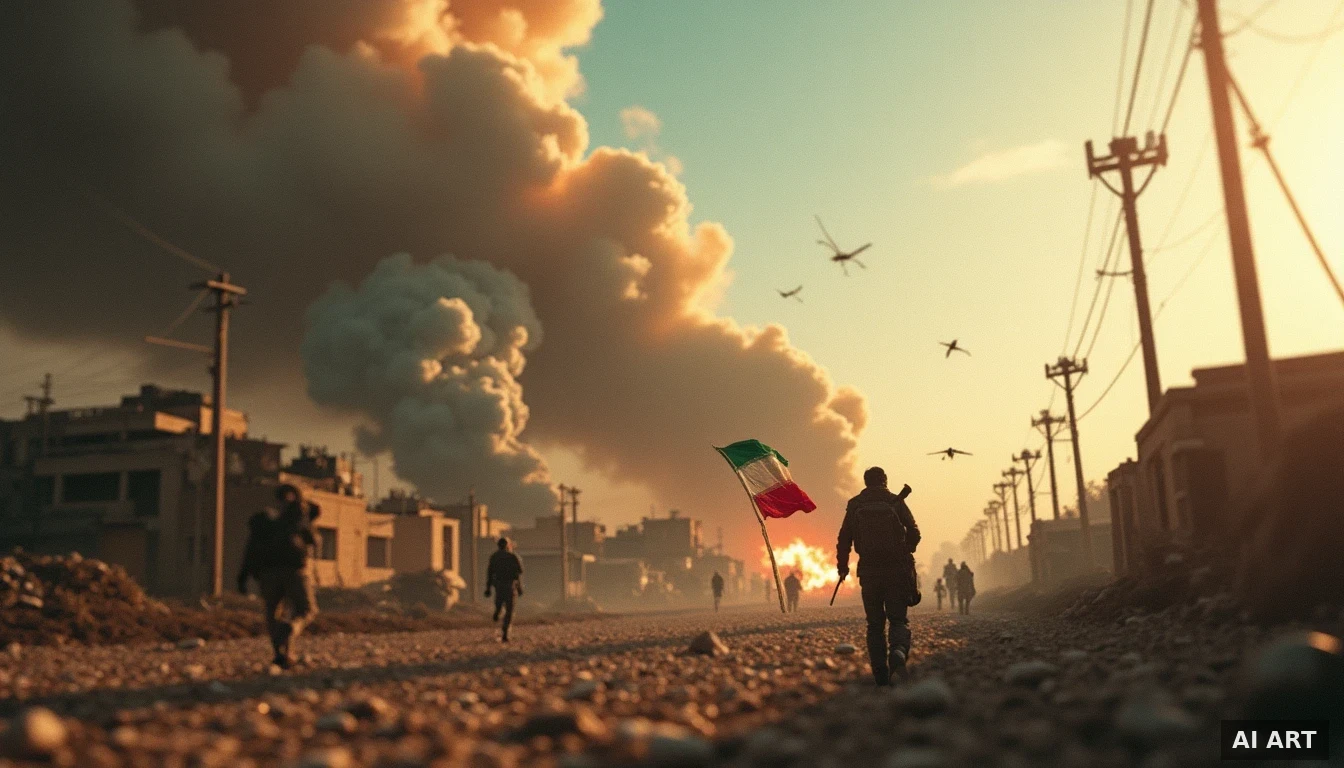
US-Iran War Killed 1,700+ Iranian Civilians Before Trump-Pezeshkian Deal Halted Fighting
Multi-perspective analysis. Each perspective deliberately argues one viewpoint; none represents the editorial position of qalarc.
A US-and-Israeli war against Iran codenamed Operation Epic Fury, which began on February 28, 2026 with strikes on military, government and civilian targets, left more than 1,700 Iranian civilians dead and hundreds of schools, hospitals and homes damaged, according to figures compiled by the US-based monitor HRANA. The fighting was halted — though not fully ended — by a 14-point memorandum of understanding signed by US President Donald Trump and Iranian President Masoud Pezeshkian on June 17-18, 2026, an agreement Iranian officials hailed as a strategic American defeat and which excluded Israel from the negotiations.
What the terms mean (5)
- Operation Epic Fury — The US codename for its military campaign against Iran that began February 28, 2026.
- HRANA — The Human Rights Activists News Agency, a US-based monitor that documents casualties and rights abuses related to Iran.
- Islamabad Memorandum — The 14-point US-Iran framework signed by Trump and Pezeshkian on June 17-18, 2026 to halt the war, reopen the Strait of Hormuz and ease sanctions.
- Strait of Hormuz — A narrow waterway between Iran and Oman through which a large share of the world's seaborne oil passes, central to the conflict and the deal.
- Shajareh Tayyebeh school — An elementary school in Minab, Iran, reported as the site of a February 28 strike that killed 156 civilians including 120 schoolchildren.
The facts (8)
- The war began February 28, 2026, with combined US-Israeli airstrikes on Iranian military, government and civilian sites; the US codenamed its campaign Operation Epic Fury [1].
- As of April 7, 2026, HRANA documented 3,636 deaths in Iran — including 1,701 civilians, 1,221 military and 714 unclassified [2]. By late June, Time cited an estimated civilian toll of roughly 2,100, making the 1,700 figure a floor rather than the latest count.
- Time and the Center for American Progress reported more than 1,700 civilians and around 250 children killed, including a February 28 US strike on the Shajareh Tayyebeh elementary school in Minab, where 156 civilians — among them 120 schoolchildren — were reported killed [3].
- The Iranian Red Crescent reported on April 3, 2026 that 307 health and medical facilities were damaged; an earlier March 7 report cited 6,668 civilian units targeted, including 5,535 residential units, 14 medical centers and 65 schools [3].
- Trump and Pezeshkian signed the Islamabad Memorandum of Understanding on June 17-18, 2026 — a 14-point framework to halt fighting, reopen the Strait of Hormuz, lift sanctions and make frozen Iranian assets 'fully available' [5].
- Israel was excluded from the US-Iran negotiations; the related Lebanon 'deconfliction mechanism' includes the US, Iran, Pakistan and Qatar but not Israel, and analysts at the Council on Foreign Relations argued the deal came at a cost to Israel the White House had not acknowledged [6].
- Iran's chief negotiator called the memorandum 'a declaration of America's defeat,' and CFR and Times of Israel analysts characterized the outcome as a US/Israeli strategic setback [8].
- The agreement involves unfreezing tens of billions in restricted Iranian assets — reports cite an initial ~$12B (agreed around June 23, 2026), rising to $24-25B, with Iran reportedly demanding far more; Trump stated funds would be released 'only if they're doing things right' [9].
Context & background
The campaign followed years of stalled US-Iran nuclear diplomacy and escalating regional confrontation, running in parallel with a 2026 Lebanon war involving Israeli strikes and Hezbollah [11]. The conflict was not solely a US-Iran fight: Iranian civilian casualties were attributed to combined US-Israeli airstrikes, and a separate Lebanon-Israel framework was rejected by Hezbollah [10]. The June memorandum is best understood as an interim ceasefire framework rather than a final peace agreement — sporadic US-Iran strikes, Strait of Hormuz tanker incidents and Israeli strikes on Lebanon continued into late June 2026 [7]. The characterization that 'the United States paid Iran to end the war' refers to the unfreezing of Iran's own restricted assets conditioned on compliance, not direct US payments [5].
Still unresolved
- What is the true total civilian death toll? Casualty figures remain contested and likely undercounted owing to Iranian information restrictions, with monitors describing the 1,700 figure as a snapshot.
- Will the Islamabad Memorandum hold as a durable ceasefire, given continued strikes and tanker incidents after signing, and Israel's and Hezbollah's exclusion from the talks?
- How much of Iran's frozen assets will ultimately be released, and against what verification conditions, given the gap between the ~$12B initially agreed and Iran's larger demands?
The same story, argued three ways. Pick an angle — the facts above stay the same.
🧭 Cui bono — who benefits?
Beneficiaries
- Iran — $300 billion in reparations, territorial/airspace gains, legitimacy as regional power
via US payment to end hostilities transforms military stalemate into financial windfall; frames Iran as victor despite infrastructure damage, strengthening hardline domestic narrative and regional influence - China and Russia — Demonstration of US strategic exhaustion and declining deterrence credibility
via US paying to exit a Middle East conflict it initiated signals inability to sustain simultaneous peer competitions; emboldens adversaries in Taiwan Strait and Ukraine theaters where US commitments are already stretched - US defense contractors (Lockheed Martin, Raytheon, Northrop Grumman) — Weapons sales and reconstruction contracts regardless of outcome
via Munitions expenditure during conflict generates immediate revenue; subsequent $300B reparation payment likely includes US-financed Iranian reconstruction using American contractors, socializing costs while privatizing profits - Israeli hardline government — Weakened Iranian infrastructure but no regime change to threaten long-term balance
via Damaged Iranian schools/hospitals/homes degrade civil society and military readiness for years; US footing reparations bill means Israel achieves degradation objectives without bearing financial or diplomatic cost of occupation
Who loses
- US taxpayers ($882/citizen for reparations with no territorial or strategic gain)
- Iranian civilians (1,700+ dead, schools and hospitals destroyed, living under government that spent reparations on regime preservation not rebuilding)
- US global deterrence posture (paying adversaries to stop fighting establishes precedent that US will blink first in wars of attrition)
- US regional allies (Saudi Arabia, UAE) who now face emboldened Iran without credible US security guarantee
Rivalry & conflicts of interest
- US geopolitical credibility harmed → China gains
conflict of interest: Chinese strategic analysts have long argued US cannot sustain multi-theater competition; this validates their theory, strengthening case for aggressive Taiwan timeline while US is weakened - Iranian civilian infrastructure harmed → Iranian Revolutionary Guard Corps (IRGC) gains
conflict of interest: IRGC controls reconstruction contracting in Iran; $300B reparations flow through IRGC-linked firms, enriching the military-industrial faction while civilian government remains weak - US military credibility harmed → US defense industry gains
conflict of interest: Revolving door between Pentagon procurement and defense contractors; demonstrated failure to achieve objectives cheaply creates demand for next-generation systems and larger budgets to 'restore dominance'
Ramifications (follow the chain)
- Reparations precedent establishes that US will pay adversaries to end wars → emboldens North Korea, Venezuela, others to escalate provocations knowing US prefers checkbook diplomacy to sustained conflict → US defense spending rises to maintain credibility while actual willingness to fight declines → deterrence hollows out
- Iranian hardliners consolidate power with $300B → accelerate nuclear program despite nominal promise not to (verification mechanism unclear in claims) → Israel faces choice between accepting nuclear Iran or unilateral strike without US support → regional war risk increases within 2-5 years
- US public sees $882/citizen paid to country that killed Americans → isolationist sentiment strengthens → reduced appetite for Ukraine aid, Taiwan defense commitments → allies pursue independent nuclear deterrence (Japan, South Korea, Poland) → nonproliferation regime collapses
- $300B reparations likely financed through debt issuance → upward pressure on US borrowing costs → Fed forced to choose between financing government or controlling inflation → either Treasury market instability or renewed inflation → economic vulnerability compounds military overextension
intentional reading US national security establishment with ties to defense industry engineered conflict knowing it would fail militarily but succeed commercially: conflict generates immediate weapons sales, reparations payment creates reconstruction contracts likely awarded to US firms (see Iraq model), and demonstrated need for 'better systems' justifies next budget cycle. Iranian hardliners cooperated because IRGC controls reconstruction spending—both military-industrial complexes profit while civilians on both sides pay. The $300B figure is suspiciously close to estimates of Iranian infrastructure damage plus a premium, suggesting negotiated settlement where both governments' connected firms win. Israel benefits from Iranian degradation without occupation costs. Only explanation for why US would pay an adversary after inflicting damage is if decision-makers profit from the transaction structure itself.
structural reading No conspiracy required: US entered conflict with unclear objectives and no appetite for occupation; Iran demonstrated willingness to absorb civilian casualties longer than US electorate would tolerate images of; stalemate became inevitable once neither side would escalate to regime change. Payment represents cheaper exit than indefinite low-intensity conflict. Defense contractors benefit automatically from any conflict via weapons sales. Iranian hardliners benefit from any conflict that damages civilian infrastructure they control rebuilding. Israeli government benefits from any Iranian weakening. Chinese strategists benefit from any US strategic failure. Aligned incentives of multiple actors produce this outcome even if no single party orchestrated it—classic case of distributed interests converging on a result that serves elites while harming publics.
📊 Trading signals — winners & losers
Tradeable instruments most exposed to this story, inferred from the analysis above. Not financial advice — informational only, generated by AI from forum discussion and may be wrong.
📈 Likely winners
- ▲ LMTstockLockheed Martin$563.577d -5.8%✓ +11.4% since callDefense contractor benefits from weapons sales during conflict
- ▲ NOCstockNorthrop Grumman$551.037d -4.1%✓ +7.4% since callMilitary equipment demand rises during US-Iran war
- ▲ RTXstockRTX Corporation$209.917d -4.8%✓ +6.7% since callDefense systems sales increase regardless of war outcome
- ▲ XAUcommodityGold$4,6927d +6.2%✓ +15.3% since callSafe-haven demand rises amid US strategic defeat precedent
📉 Likely losers
- ▼ CLcommodityCrude Oil$85.607d +1.3%✗ +15.4% since callWar resolution reduces Middle East supply disruption premium
- ▼ DXYcommodityUS Dollar Index$99.017d -0.6%✓ -1.9% since callUS paying reparations signals declining global deterrence credibility
- ▼ KSAETFiShares MSCI Saudi Arabia ETF$38.317d +1.1%✗ +4.1% since callSaudi markets pressured by emboldened Iran without US guarantee
📈 Call performance — day by day
| date | price | vs entry |
|---|---|---|
| 2026-08-11 | $603.16 | +19.2% |
| 2026-08-12 | $597.77 | +18.1% |
| 2026-08-13 | $606.72 | +19.9% |
| 2026-08-14 | $598.01 | +18.2% |
| 2026-08-15 | $598.01 | +18.2% |
| 2026-08-16 | $608.68 | +20.3% |
| 2026-08-17 | $608.68 | +20.3% |
| 2026-08-18 | $593.74 | +17.3% |
| 2026-08-19 | $604.37 | +19.4% |
| 2026-08-20 | $589.15 | +16.4% |
| 2026-08-21 | $571.48 | +12.9% |
| 2026-08-22 | $563.57 | +11.4% |
| 2026-08-23 | $563.57 | +11.4% |
| 2026-08-24 | $563.57 | +11.4% |
showing last 14 of 35 days
| date | price | vs entry |
|---|---|---|
| 2026-08-11 | $577.89 | +12.6% |
| 2026-08-12 | $575.69 | +12.2% |
| 2026-08-13 | $577.32 | +12.5% |
| 2026-08-14 | $574.74 | +12.0% |
| 2026-08-15 | $574.74 | +12.0% |
| 2026-08-16 | $585.87 | +14.2% |
| 2026-08-17 | $585.87 | +14.2% |
| 2026-08-18 | $570.20 | +11.1% |
| 2026-08-19 | $584.68 | +14.0% |
| 2026-08-20 | $582.84 | +13.6% |
| 2026-08-21 | $563.86 | +9.9% |
| 2026-08-22 | $551.03 | +7.4% |
| 2026-08-23 | $551.03 | +7.4% |
| 2026-08-24 | $551.03 | +7.4% |
showing last 14 of 35 days
| date | price | vs entry |
|---|---|---|
| 2026-08-11 | $224.12 | +13.9% |
| 2026-08-12 | $223.86 | +13.8% |
| 2026-08-13 | $222.76 | +13.2% |
| 2026-08-14 | $220.48 | +12.0% |
| 2026-08-15 | $220.48 | +12.0% |
| 2026-08-16 | $222.97 | +13.3% |
| 2026-08-17 | $222.97 | +13.3% |
| 2026-08-18 | $221.64 | +12.6% |
| 2026-08-19 | $222.74 | +13.2% |
| 2026-08-20 | $220.35 | +12.0% |
| 2026-08-21 | $212.29 | +7.9% |
| 2026-08-22 | $209.91 | +6.7% |
| 2026-08-23 | $209.91 | +6.7% |
| 2026-08-24 | $209.91 | +6.7% |
showing last 14 of 35 days
| date | price | vs entry |
|---|---|---|
| 2026-08-11 | $4,479 | +10.1% |
| 2026-08-12 | $4,428 | +8.8% |
| 2026-08-13 | $4,468 | +9.8% |
| 2026-08-14 | $4,408 | +8.3% |
| 2026-08-15 | $4,401 | +8.1% |
| 2026-08-16 | $4,437 | +9.0% |
| 2026-08-17 | $4,437 | +9.0% |
| 2026-08-18 | $4,459 | +9.6% |
| 2026-08-19 | $4,454 | +9.5% |
| 2026-08-20 | $4,581 | +12.6% |
| 2026-08-21 | $4,580 | +12.6% |
| 2026-08-22 | $4,674 | +14.9% |
| 2026-08-23 | $4,681 | +15.0% |
| 2026-08-24 | $4,681 | +15.0% |
showing last 14 of 35 days
| date | price | vs entry |
|---|---|---|
| 2026-08-11 | $82.21 | +10.8% |
| 2026-08-12 | $83.40 | +12.4% |
| 2026-08-13 | $82.77 | +11.5% |
| 2026-08-14 | $81.15 | +9.4% |
| 2026-08-15 | $81.41 | +9.7% |
| 2026-08-16 | $82.40 | +11.1% |
| 2026-08-17 | $82.40 | +11.1% |
| 2026-08-18 | $84.99 | +14.5% |
| 2026-08-19 | $84.54 | +13.9% |
| 2026-08-20 | $84.64 | +14.1% |
| 2026-08-21 | $86.52 | +16.6% |
| 2026-08-22 | $86.64 | +16.8% |
| 2026-08-23 | $87.06 | +17.3% |
| 2026-08-24 | $87.06 | +17.3% |
showing last 14 of 35 days
| date | price | vs entry |
|---|---|---|
| 2026-08-11 | $99.81 | -1.1% |
| 2026-08-12 | $99.83 | -1.1% |
| 2026-08-13 | $99.98 | -1.0% |
| 2026-08-14 | $99.97 | -1.0% |
| 2026-08-15 | $99.85 | -1.1% |
| 2026-08-16 | $99.64 | -1.3% |
| 2026-08-17 | $99.59 | -1.4% |
| 2026-08-18 | $99.58 | -1.4% |
| 2026-08-19 | $99.64 | -1.3% |
| 2026-08-20 | $98.83 | -2.1% |
| 2026-08-21 | $98.88 | -2.1% |
| 2026-08-22 | $98.84 | -2.1% |
| 2026-08-23 | $98.84 | -2.1% |
| 2026-08-24 | $98.84 | -2.1% |
showing last 14 of 35 days
| date | price | vs entry |
|---|---|---|
| 2026-08-11 | $37.85 | +2.9% |
| 2026-08-12 | $37.78 | +2.7% |
| 2026-08-13 | $37.81 | +2.8% |
| 2026-08-14 | $37.88 | +2.9% |
| 2026-08-15 | $37.88 | +2.9% |
| 2026-08-16 | $37.83 | +2.8% |
| 2026-08-17 | $37.83 | +2.8% |
| 2026-08-18 | $38.02 | +3.3% |
| 2026-08-19 | $38.02 | +3.3% |
| 2026-08-20 | $38.12 | +3.6% |
| 2026-08-21 | $38.25 | +4.0% |
| 2026-08-22 | $38.31 | +4.1% |
| 2026-08-23 | $38.31 | +4.1% |
| 2026-08-24 | $38.31 | +4.1% |
showing last 14 of 35 days
📊 See how every call has performed — the full scoreboard & API →
🔗 Related Analysis
- Satirical post impersonating Iranian demanding US money shared: iran, usa
- Dispute over Iran-US war outcome and Iranian military capability shared: iran, usa
- Claim of Iranian victory in unnamed conflict shared: iran, usa
- Iran military victory and global power realignment shared: iran, usa
- Khamenei describes Trump as honorable amid Iran-US relations shared: iran, usa
- Iran nuclear deal terms criticized as unfavorable to US shared: iran, usa
References
- [1] ◎ 2026 Iran war - Wikipedia
- [2] ◎ Casualties of the 2026 Iran war - Wikipedia
- [3] The Human and Environmental Costs of the War in Iran - Center for American Progress
- [4] ◎ US-Israel attacks on Iran: Death toll and injuries live tracker - Al Jazeera
- [5] ◖ Trump and Iran's president sign initial deal to end war, open Strait of Hormuz and ease sanctions - NBC News
- [6] ◑ The Iran Deal Comes at a Cost to Israel. The White House Hasn't Acknowledged It. - CFR
- [7] ◑ The Iran Deal Reopens the Strait. Much Remains to Be Done. - CFR
- [8] ◑ Deal a 'declaration of US defeat,' chief Iran envoy says - The Times of Israel
- [9] ◖ One week in, what exactly are America and Iran getting from their agreement? - CNN Business
- [10] ◎ Iran, US agree tentative deal to 'end war': Your questions answered - Al Jazeera
- [11] ◎ 2025-2026 Iran-United States negotiations - Wikipedia
◖ supportive · ◗ critical · ◎ neutral wire · ◑ partisan · ⚑ state outlet
▾ Discussion
Select any text in the article to comment on that passage.