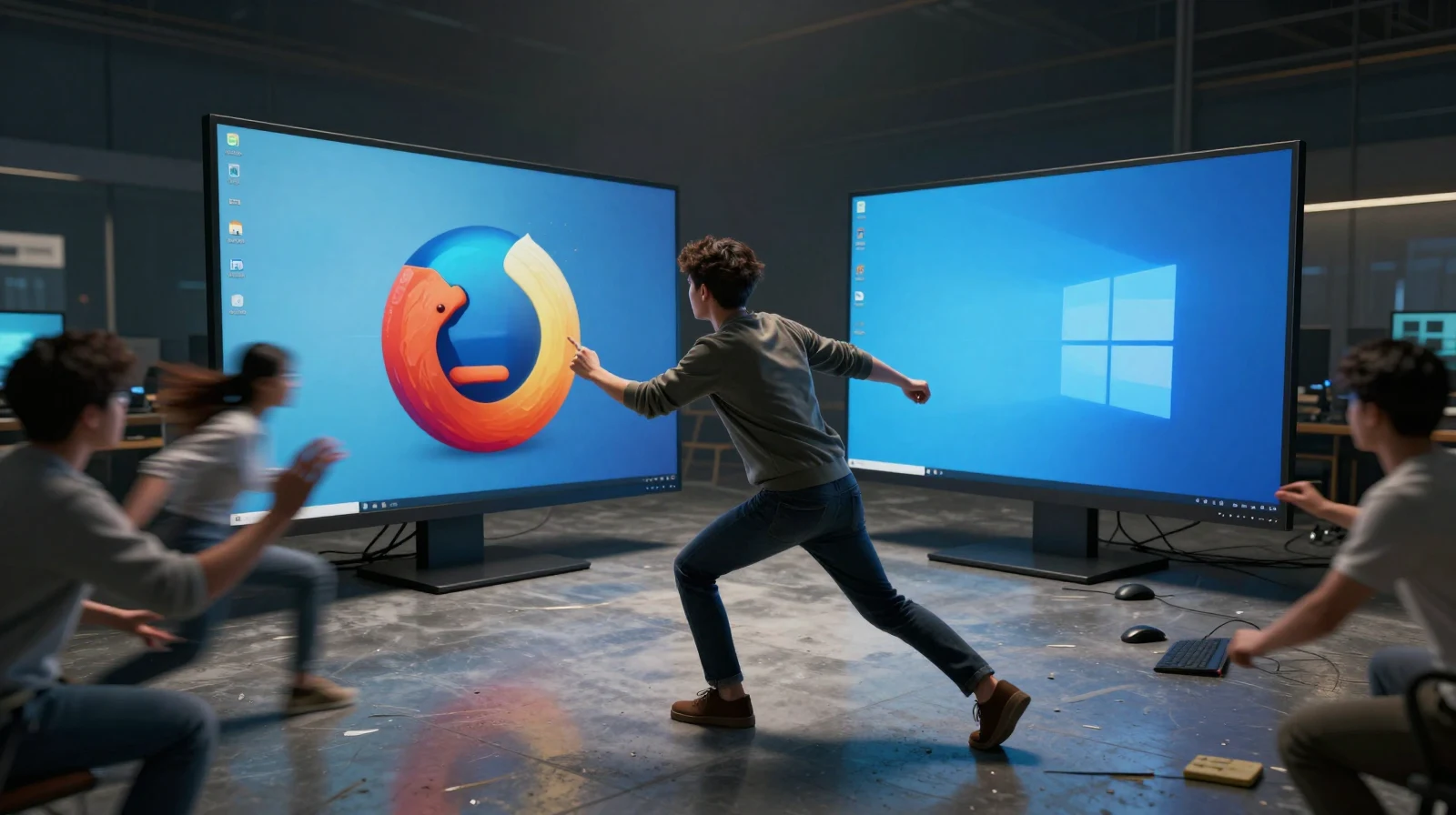
Desktop Linux Drops a Feature-and-Usability Comparison to Windows — and the Gap Is Asymmetric Compatibility, Not Price
Multi-perspective analysis. Each perspective deliberately argues one viewpoint; none represents the editorial position of qalarc.
In the latest round of platform comparisons, desktop Linux loses to Windows on a set of concrete usability measures rather than on price: the Wine compatibility layer gives Linux users mature access to Windows applications, but no equivalent exists for running macOS software, while Windows itself now runs Linux tooling natively via the Windows Subsystem for Linux and ships a Linux-style package manager in WinGet. Linux advocates countered with the platform's zero license cost, GNOME's mouse-and-keyboard desktop paradigm, and telemetry objections to Windows — arguments that drew some of the sharhest pushback in the exchange.
The facts (8)
- The single most-cited feature gap is asymmetric compatibility: Wine, the open-source compatibility layer, lets Windows applications run on Linux and other systems, and is the standard answer when Linux users need Windows software, but no comparably mature layer exists for macOS applications — the closest project, Darling, remains far from Wine's level of completeness.
- Windows has absorbed what were historically Linux advantages: Windows 10 and 11 can run Linux command-line tools and applications natively through the Windows Subsystem for Linux, meaning Windows users can draw on the Linux ecosystem without switching platforms.
- Windows also ships WinGet, a command-line package manager introduced by Microsoft in 2020, replicating the apt/dnf/pacman-style software installation Linux distributions have long offered — though Windows still carries its decades-old cmd shell alongside the newer PowerShell and WinGet tooling.
- Windows 7 reached the end of extended support on 14 January 2020, with paid Extended Security Updates lapsing in January 2023; a minority of developers continue to target the retired platform regardless, with one participant in the comparison describing himself as effectively the last developer still building for Windows 7.
- The strongest case made for Linux's usability was GNOME — the default desktop environment on major distributions including Ubuntu and Fedora — which supporters described as the best desktop paradigm for genuinely combining mouse and keyboard input, while conceding it favors modern hardware over older machines.
- The cost argument at the center of the debate holds that companies irrationally pay Microsoft per-seat Windows license fees when Linux distributions carry no license cost at all; opponents in the same exchange countered that acquisition price is a small fraction of total cost of ownership once support, training and application compatibility — Adobe's Creative Suite chief among them — are factored in. One participant's boast of running modern Photoshop on Windows Vista was offered without verification.
- Security remained contested: participants debated the relative security of Windows 10, Windows 11 and macOS, and anti-telemetry sentiment ('done using spyware') surfaced against Windows, while Linux's own record now includes a supply-chain attack on the Arch User Repository (the 'atomic-lockfile' incident of June 2026) for which community detection tooling was published. [2]
- Friction runs in both directions: Windows 10 users routinely hit compatibility failures of their own, with VPN incompatibility a commonly documented example, while Linux's backward compatibility is unusually deep — WordPerfect's 1990s Unix builds can still be run on modern Linux systems, as documented by a long-running preservation project. [3] [1]
Context & background
Windows has held the large majority of desktop operating system share since the 1990s, while desktop Linux has remained in the low single digits despite two decades of 'year of the Linux desktop' predictions. The Linux desktop itself is split between two major camps — GNOME and KDE, the latter built on the Qt toolkit — with cross-platform applications such as Firefox historically serving as the neutral baseline available on every platform. The most-engaged exchange in this round of the comparison was not about features at all but about convert culture: a mocking jab at the stock testimonial of installing Linux Mint and 'never looking back,' answered by a riposte preferring Linux Mint Debian Edition specifically to avoid Ubuntu and its Canonical parent — an indication of how much of the Linux-versus-Windows argument is conducted within the Linux community itself.
Still unresolved
- Whether a Wine-class compatibility layer for macOS applications on Linux — Darling or a successor — will ever reach production readiness, closing the most-cited feature gap in the comparison.
- Whether zero license cost translates into a real enterprise total-cost-of-ownership advantage once migration, support and application-compatibility costs are included; no settled study was cited by either side.
- Whether a defensible security ranking among Windows 10, Windows 11, macOS and desktop Linux exists, given that telemetry objections cut against Windows while supply-chain incidents such as the AUR attack cut against open-source distribution models.
Quick answers
What happened?
In the latest round of platform comparisons, desktop Linux loses to Windows on a set of concrete usability measures rather than on price: the Wine compatibility layer gives Linux users mature access to Windows applications, but no equivalent exists for running macOS software, while Windows itself now runs Linux…
What's the evidence?
Checked against 7 candidate sources; the strongest references include: WordPerfect for Unix under Linux and Windows; GitHub - lenucksi/aur-malware-check: Detection tools for the June 2026 atomic-lockfile AUR supply-chain…; VPN is Not Compatible with Windows 10: Here's a Quick Fix.
Who benefits?
Microsoft — Retention of the commercial desktop annuity: Microsoft 365 and Intune/EMS attach, paid Extended Security Updates (ESU) for Windows 10 holdouts, and Windows 11 OEM licenses driven by the October 2026 support cliff..
How confident is the assessment?
The motive analysis is 68% confident.
Why does it matter?
Windows 10 EOL plus TPM floor -> enterprises pay ESU now or refresh hardware -> Microsoft monetizes obsolescence twice (bridge fees today, new licenses tomorrow) -> Linux desktop pilots quietly cancelled -> Linux survives as WSL2 and Azure workloads -> Microsoft collects revenue on its own free competitor.
The same story, argued three ways. Pick an angle — the facts above stay the same.
🧭 Cui bono — who benefits?
Beneficiaries
- Microsoft — Retention of the commercial desktop annuity: Microsoft 365 and Intune/EMS attach, paid Extended Security Updates (ESU) for Windows 10 holdouts, and Windows 11 OEM licenses driven by the October 2026 support cliff.
via A perceived usability and compatibility gap, plus a rising hardware bar (the TPM 2.0 requirement for Windows 11), converts a one-time license into a recurring stream: enterprises either pay per-device ESU fees or refresh hardware. Meanwhile WSL2 and winget port Linux's core developer conveniences — the subsystem and the package manager — into Windows itself, absorbing the exact constituency most likely to defect. Linux ends up running everywhere Microsoft permits except as the desktop. - Apple — Hardware moat preserved; a Mac remains a mandatory purchase for Apple-platform and macOS-exclusive creative software.
via Online technology communities periodically ask why no Wine-equivalent exists for running macOS software on Linux. The answer routes value to Cupertino: Win32 is decades-documented and tacitly tolerated in reimplementation, whereas Apple's EULA bars macOS from non-Apple hardware, its frameworks are closed, and notarization gates distribution — so a compatibility layer is legally and economically unviable, and anyone needing that software must buy the machine. - PC OEMs and silicon vendors (Lenovo, HP, Dell, Intel, AMD) — A policy-manufactured refresh wave.
via The TPM 2.0 floor declares millions of fully functional machines obsolete; analysts at Canalys estimated up to 240 million Windows 10 PCs could be scrapped rather than upgraded. Hardware demand created by support policy, not performance need, flows straight to OEMs and their suppliers. - Extended-support microvendors (e.g., ACROS Security's 0patch) — A paid long tail of end-of-life Windows.
via As mainstream ISVs abandon Windows 7 — with the last long-tail developers now giving up on it — organizations that cannot upgrade buy micropatches and ESU-gap coverage, monetizing obsolescence at the margin. - Valve — De facto ownership of the only consumer-facing Linux success story.
via Because the general-purpose Linux desktop loses the comparison, the fragment of Linux consumers actually touch is SteamOS/Proton on Steam Deck. Game developers target Proton rather than native Linux toolkits, consolidating Linux mindshare — and the developer attention that follows it — under Valve's brand instead of the KDE/Qt desktop stack.
Who loses
- The commercial desktop-Linux ecosystem — Canonical's and SUSE's desktop ambitions, and the GNOME/KDE volunteer communities — for whom an adverse usability verdict forecloses procurement conversations before they begin.
- KDE and the Qt commons structurally: weak desktop-Linux demand undermines the open-source funding base for Qt, pushing The Qt Company further toward commercial-only LTS and licensing, which in turn starves its own flagship free desktop.
- Mozilla/Firefox: its cross-platform independence thesis weakens as the desktop consolidates into a Windows/macOS duopoly it cannot influence; its small Linux install base was never a meaningful hedge.
- Budget-constrained users — schools, public-sector IT, and the secondhand-PC reuse economy in emerging markets — squeezed between Windows 10 end-of-support and a GNOME-class desktop that assumes modern GPUs and Wayland: forced spend or e-waste.
Ramifications (follow the chain)
- Windows 10 EOL plus TPM floor -> enterprises pay ESU now or refresh hardware -> Microsoft monetizes obsolescence twice (bridge fees today, new licenses tomorrow) -> Linux desktop pilots quietly cancelled -> Linux survives as WSL2 and Azure workloads -> Microsoft collects revenue on its own free competitor.
- No macOS-on-Linux compatibility layer (EULA, closed frameworks, notarization) -> Mac hardware stays mandatory for Apple-platform development -> developer rents cross-subsidize Apple's ecosystem -> a Wine-class reverse-engineering effort never attracts funding -> the desktop duopoly hardens.
- GNOME's mouse-keyboard-gesture paradigm requires modern GPUs and Wayland -> Linux loses its classic revive-old-hardware wedge -> thrift-motivated users remain on unsupported Windows 10 machines running cmd-era software -> breach risk rises -> EDR vendors and Microsoft Intune capture the remediation spend.
- General Linux desktop loses -> consumer Linux narrows to Valve's Proton/SteamOS -> ISVs target Proton instead of native toolkits -> KDE/Qt loses even gaming developers -> the free desktop's talent pool drains toward a single corporate sponsor.
intentional reading The Redmond Annuity Hypothesis: the lifecycle is the strategy. Microsoft sets a rising hardware bar, a hard support cliff with a paid ESU bridge, and ships absorbents — winget answering apt, WSL2 answering dual-boot — so the rational path for every holdout and every Linux-curious developer terminates in a Microsoft invoice or a new OEM Windows license. The objective is not to beat Linux but to guarantee Linux never gets to be the desktop: embrace it as a subsystem, extend its conveniences into Windows, extinguish the defection case. Apple's EULA prohibition on macOS outside its hardware is the same moat-maintenance move, executed more bluntly.
structural reading No coordination required. Thirty years of installed-base network effects mean ISVs ship for Windows first, so users stay, so ISVs keep shipping — the comparison outcome is an equilibrium, not a contest. Some industry observers argue enterprises irrationally pay Microsoft for what Linux gives away, but that looks irrational only if the license is the entire cost; price in management tooling (AD, GPO, Intune), support liability and application compatibility, and the spend is ordinary risk avoidance. Wine exists because Win32 is documented; a macOS equivalent does not because closed frameworks, signing gates and licensing make it a legal tar pit — economics, not sabotage. GNOME's hardware appetite is designer taste drift in a volunteer project chasing Apple-style interaction, not a plot to sell GPUs. Every actor follows local incentives and the moat maintains itself.
🎯 This narrative's market calls
Tickers the crowd narrative pointed at when this article was written — scored honestly against the price at publish. narrative confidence 40%
▲ LONG — the winners
MSFT▲MicrosoftCommercial desktop annuity intact: Windows 11 OEM licenses, Microsoft 365/Intune attach, and paid Extended SecAAPL▲AppleWith no viable way to run macOS software on Linux, a Mac remains a mandatory hardware purchase for Apple-excluHPQ▲HP Inc.Notebook and commercial PC volumes supported by the forced hardware refresh, since staying on Windows requiresDELL▲Dell TechnologiesCommercial PC refresh demand lifts its profitable enterprise client segment; businesses pay for Windows ratherAMD▲Advanced Micro DevicesClient CPU share gains on refresh silicon, as Windows 11 hardware requirements push replacements toward newer▼ SHORT — the losers
— no calls this side
From the threads
The posts that drew the most replies in the source discussion — shown as posted. Reactions ranged across the spectrum; these are the ones people actually engaged with.
let me guess, you installed mint and "never looked back"
Continue the discussion
Add your own take — replies are kept on this article and can be upvoted.
References
- [1] WordPerfect for Unix under Linux and Windows
- [2] GitHub - lenucksi/aur-malware-check: Detection tools for the June 2026 atomic-lockfile AUR supply-chain attack. Consolidated from community Gists. · GitHub
- [3] VPN is Not Compatible with Windows 10: Here's a Quick Fix
- [4] Anthropic releases Opus 4.8 with new 'dynamic workflow' tool | TechCrunch
- [5] Windows 7 - Wikipedia
- [6] GNOME - Wikipedia
- [7] Windows Subsystem for Linux - Wikipedia
Discussion
Select any text in the article to comment on that passage.