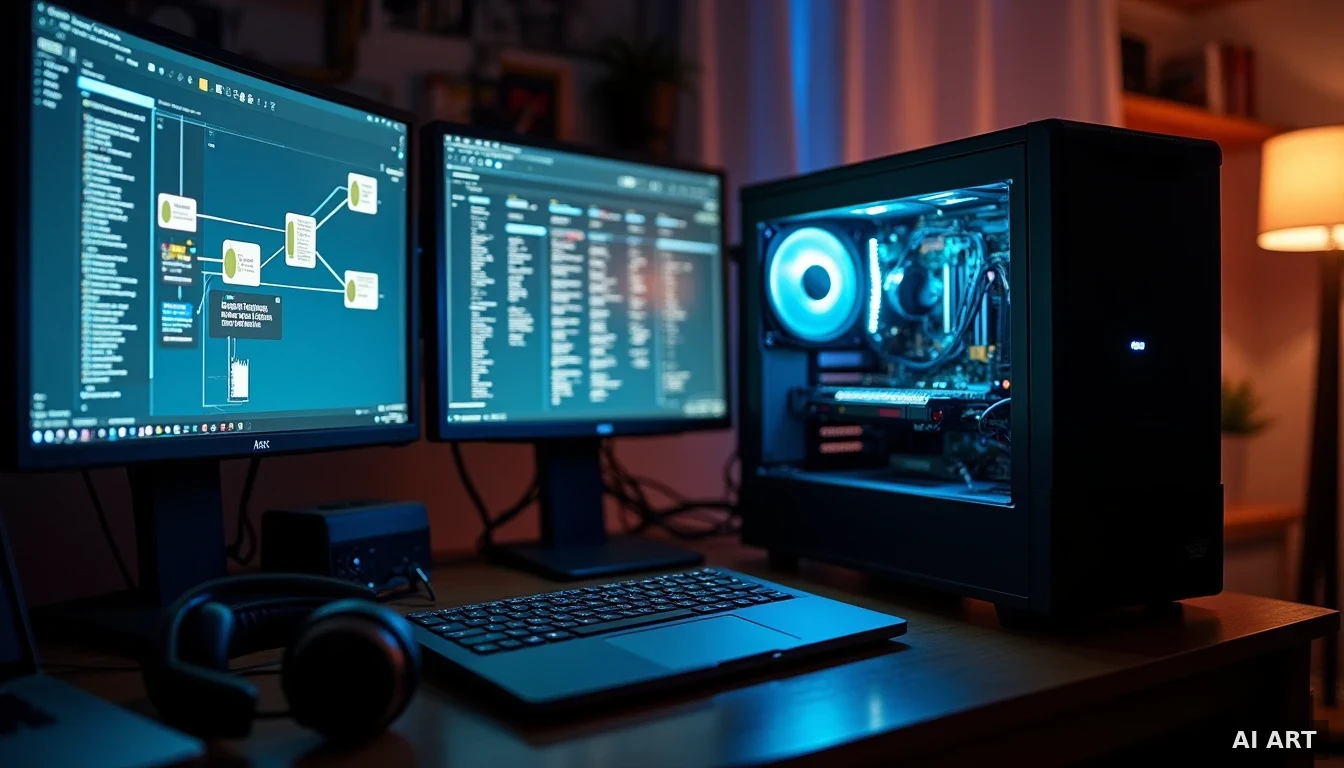
Local Generative AI Toolchains Mature: ComfyUI, SwarmUI, Wan Video and ACE-Step Music Anchor 2026 Roundup
Multi-perspective analysis. Each perspective deliberately argues one viewpoint; none represents the editorial position of qalarc.
A recurring community roundup of local, self-hosted generative AI tools now spans image, video and music generation running entirely offline on consumer hardware. At its center are ComfyUI, the GPL-3.0 node-graph engine, and SwarmUI, an MIT-licensed web interface built on ComfyUI's backend, alongside DeepBeepMeep's Wan2GP for low-VRAM video and ACE-Step for local music generation.
What the terms mean (5)
- ComfyUI — A free, open-source AI generation tool that builds image/video/audio pipelines as a visual graph of connected nodes rather than a simple form.
- SwarmUI — An MIT-licensed web interface built on top of ComfyUI's engine, offering a friendlier front-end plus features like batch grid generation.
- Wan / Wan2GP — Wan is Alibaba's open-source video-generation model family; Wan2GP (WanGP) is a front-end that lets those models run on low-VRAM consumer GPUs.
- ACE-Step — An open-source music-generation foundation model from ACE Studio and StepFun that can run locally, including inside ComfyUI.
- Forge / AUTOMATIC1111 (SDWebUI) — Widely used local Stable Diffusion web interfaces; Forge is a performance-focused fork of the original A1111 WebUI.
The facts (8)
- ComfyUI is a GPL-3.0 licensed node-graph generation engine supporting SD 1.x/2.x, SDXL, Flux, Qwen Image and video models including Wan, Hunyuan Video, LTX-Video and Mochi, and remains actively maintained in 2026 [2].
- SwarmUI (formerly StableSwarmUI, by mcmonkey) is an MIT-licensed web UI built on ComfyUI's backend, currently at v0.9.8 Beta, supporting image models such as Stable Diffusion, Z-Image, Flux and Qwen and video models Wan and Hunyuan [1][2].
- Wan2GP / WanGP by DeepBeepMeep is an open-source, low-VRAM front-end for local video models including Wan 2.1/2.2, Hunyuan Video and LTX-2, reportedly runnable on GPUs as small as 6–8GB VRAM [5].
- Wan 2.2 is Alibaba's Apache-2.0 open-source video model released July 28, 2025; guides reference a later Wan 2.7 release around April 2026 targeting 4K output [3][4].
- Local music generation is confirmed via ACE-Step, developed by ACE Studio and StepFun; ACE-Step v1.5 released Jan 28, 2026 and ACE-Step 1.5 XL (a 4B DiT model) released Apr 2, 2026 [6][7].
- ACE-Step 1.5 is runnable directly inside ComfyUI, with native example workflows documented, meaning offline music generation is already functional and not merely a planned feature [8][9].
- Forge and AUTOMATIC1111 (SDWebUI) remain referenced as current local Stable Diffusion front-ends in 2026 setup guides, alongside ComfyUI and A1111 [12].
- The roundup is a routine ongoing-development aggregation of local tools and setup guides rather than a claim about a single event; its core assertions about which tools are active track current reporting [2].
Context & background
Local generative AI tooling has consolidated around a two-tier structure: ComfyUI serves as a low-level, node-based execution backend, while wrappers like SwarmUI layer an approachable interface over it, adding features such as grid generation and an 'easy mode' [10][11]. The same pattern extends to video, where front-ends such as Wan2GP wrap Alibaba's Wan models and others to make them run on modest consumer GPUs [5]. Historically, AUTOMATIC1111's Stable Diffusion WebUI and its Forge fork were the dominant on-ramp for local image generation; they remain in use in 2026 alongside ComfyUI [12]. Music is the newest addition: ACE-Step, from ACE Studio and StepFun, brought a locally runnable music foundation model into the same workflow ecosystem, with v1.5 and a larger XL variant shipping in early 2026 and integration into ComfyUI [6][7][8].
Still unresolved
- When, and in what release, SwarmUI's own native audio/music support will move from planned to shipped, given that ACE-Step music generation already works in the underlying ComfyUI backend [1][8].
- How broadly Wan 2.7's reported 4K-targeting capability will run on consumer hardware versus requiring high-VRAM setups [4].
- Whether the newer local music and video models will settle on stable, documented workflows or continue rapid, fragmented iteration.
The same story, argued three ways. Pick an angle — the facts above stay the same.
🧭 Cui bono — who benefits?
Beneficiaries
- Hardware vendors (NVIDIA, AMD) — Sustained demand for consumer and prosumer GPUs as local generation tools mature and become more accessible
via UI frameworks (ComfyUI, Forge, SwarmUI) lower technical barriers to local AI deployment, expanding the addressable market beyond ML specialists to creative professionals and hobbyists who need capable hardware. Each new model release (Stable Diffusion iterations, music/video models) drives upgrade cycles. - Independent creators and small studios — Production capability without recurring cloud costs or API rate limits
via Open-source tooling (Stability Matrix for environment management, multiple UI options) eliminates rent-extraction by cloud providers. One-time hardware investment yields unlimited generation; cost per asset approaches zero after amortization, fundamentally changing production economics for asset-intensive work. - China and other jurisdictions with API/cloud access restrictions — Parity in generative AI capability despite geopolitical barriers
via Local-first architectures are sanction-resistant and censorship-resistant. When Midjourney or OpenAI block regions or impose content filters, locally-run Stable Diffusion forks continue operating. Technology sovereignty via open weights. - Enterprise with data sovereignty requirements — Generative capability without sending proprietary data to third-party APIs
via Healthcare, defense, finance sectors can deploy generation models behind firewalls. ComfyUI's node-based workflow enables custom pipelines without code changes, allowing compliance teams to audit and lock down generation processes.
Who loses
- API-based generation platforms (Midjourney, Runway, OpenAI DALL-E) facing revenue compression as capable local alternatives mature
- Cloud GPU rental services (Vast.ai, RunPod) for inference workloads as consumer hardware becomes sufficient
- Closed-source model vendors if open model quality reaches parity in key domains
Rivalry & conflicts of interest
- Midjourney (subscription SaaS model) harmed → Stability AI (open-weight model provider) and hardware vendors gains
conflict of interest: NVIDIA invested in multiple AI infrastructure plays; cheaper inference via efficient local models drives hardware sales while commoditizing the API layer. Stability AI received investment from Coatue, which also backs infrastructure/tooling plays benefiting from open models. - Centralized content moderation regimes (platform-enforced filters) harmed → Jurisdictions and actors seeking to circumvent Western content policies gains
conflict of interest: Some open-source contributors are ideologically opposed to centralized content control; their technical contributions simultaneously serve libertarian principles and authoritarian regimes' desire to route around US platform governance.
Ramifications (follow the chain)
- Mature local tooling → creators build libraries of custom LoRAs and fine-tunes → proprietary 'house styles' become moats → market fragments into specialized niches rather than winner-take-all platforms, reducing individual platform power
- As local generation quality approaches API services → price competition intensifies → API providers must compete on convenience/speed rather than quality → incentive to restrict access to training data/techniques to maintain differentiation → potential for open/closed ecosystem split similar to Android/iOS
- Lowered barrier to AI-generated content → production costs approach zero → content volume explodes → discovery and curation become the scarce resource → platforms controlling distribution (YouTube, Spotify, Steam) gain power relative to pure generation tools
- GPU memory becomes the binding constraint for local deployment → memory-efficient techniques (quantization, LoRA adapters) become critical → whoever controls the optimization toolchain (GGML/llama.cpp equivalents for diffusion) captures developer mindshare → potential for 'Intel inside' moment where the efficiency layer becomes the brand
intentional reading Hardware vendors (particularly NVIDIA) have strong incentive to ensure open-weight models remain viable and continue advancing, as this sustains consumer GPU demand and prevents API providers from vertically integrating and moving inference entirely to datacenter-specific chips. NVIDIA's historical support for open ecosystems (CUDA toolkit, academic programs) and strategic investments in infrastructure tooling suggests intentional cultivation of the local-first stack. The timing of open model releases often coincides with new GPU generation launches. If API providers (OpenAI, Anthropic) captured the entire generative AI market, NVIDIA would be a supplier rather than an enablement platform—open weights keep the market structurally favorable to hardware sales.
structural reading No coordination required: individual developers contribute to open tooling because it solves their immediate needs (cost, privacy, customization); their aggregate work creates a viable alternative to cloud services. API providers charge what the market will bear, creating price umbrella for DIY approaches. Hardware improves on Moore's Law cadence regardless. Model researchers publish open weights for citation impact and recruitment signaling. Each actor optimizing locally produces an ecosystem that systematically routes value to hardware vendors and away from API rent extraction—classic invisible hand, but in platform competition rather than commodity markets.
📊 Trading signals — winners & losers
Tradeable instruments most exposed to this story, inferred from the analysis above. Not financial advice — informational only, generated by AI from forum discussion and may be wrong.
📈 Likely winners
- ▲ NVDAstockNVIDIA$214.727d -4.7%✓ +5.2% since callConsumer GPU demand for local AI generation workloads
- ▲ AMDstockAdvanced Micro Devices$473.257d -2.0%✗ -11.4% since callAlternative GPU provider for local inference and generation
📉 Likely losers
- —
📈 Call performance — day by day
| date | price | vs entry |
|---|---|---|
| 2026-08-11 | $217.55 | +6.6% |
| 2026-08-12 | $217.50 | +6.6% |
| 2026-08-13 | $224.09 | +9.8% |
| 2026-08-14 | $225.30 | +10.4% |
| 2026-08-15 | $225.30 | +10.4% |
| 2026-08-16 | $225.16 | +10.3% |
| 2026-08-17 | $225.16 | +10.3% |
| 2026-08-18 | $225.01 | +10.2% |
| 2026-08-19 | $220.31 | +7.9% |
| 2026-08-20 | $217.01 | +6.3% |
| 2026-08-21 | $216.85 | +6.2% |
| 2026-08-22 | $214.83 | +5.2% |
| 2026-08-23 | $214.72 | +5.2% |
| 2026-08-24 | $214.72 | +5.2% |
showing last 14 of 35 days
| date | price | vs entry |
|---|---|---|
| 2026-08-11 | $469.56 | -12.1% |
| 2026-08-12 | $474.32 | -11.2% |
| 2026-08-13 | $482.93 | -9.6% |
| 2026-08-14 | $483.01 | -9.6% |
| 2026-08-15 | $483.01 | -9.6% |
| 2026-08-16 | $514.39 | -3.7% |
| 2026-08-17 | $514.39 | -3.7% |
| 2026-08-18 | $506.00 | -5.3% |
| 2026-08-19 | $484.39 | -9.4% |
| 2026-08-20 | $466.42 | -12.7% |
| 2026-08-21 | $469.45 | -12.2% |
| 2026-08-22 | $473.25 | -11.4% |
| 2026-08-23 | $473.25 | -11.4% |
| 2026-08-24 | $473.25 | -11.4% |
showing last 14 of 35 days
📊 See how every call has performed — the full scoreboard & API →
From the threads
The posts that drew the most replies in the source discussion — shown as posted. Reactions ranged across the spectrum; these are the ones people actually engaged with. Each quote links to its archived source thread so you can verify it; quotes we couldn't tie to a source thread are marked source unverified.
Links shared in the discussion
Primary sources the threads posted — verify independently. These sometimes point to leads other coverage misses.
Continue the discussion
Add your own take — replies are kept on this article and can be upvoted.
🔗 Related Analysis
- Anime Diffusion Thread https shared: comfyui, swarmui
- Anime Diffusion Thread https shared: comfyui, swarmui
References
- [1] ◎ GitHub - mcmonkeyprojects/SwarmUI
- [2] ComfyUI vs SwarmUI: Which Stable Diffusion UI to Pick in 2026
- [3] Wan 2.2 Local Video Generation: Open MoE AI for 24GB GPUs (2026)
- [4] Wan 2.1, 2.2, and 2.7 for Local AI Video Generation: Which GPU Can Actually Run It (2026 Guide)
- [5] WanGP – Run Wan2.2, Animate & Other AI Video Generator Locally On Consumer Grade GPUs - Firethering
- [6] ◎ GitHub - ace-step/ACE-Step: A Step Towards Music Generation Foundation Model
- [7] ◎ GitHub - ace-step/ACE-Step-1.5
- [8] ACE-Step 1.5 is Now Available in ComfyUI - by Purz
- [9] ComfyUI ACE-Step Native Example - ComfyUI
- [10] SwarmUI: ComfyUI Wrapper With Easy Mode and Grid Generation (2026)
- [11] Free Video: Local AI Image Generation with SwarmUI and ComfyUI - Complete Setup and Tutorial
- [12] Best Local Stable Diffusion Setup for NSFW (2026) — Forge vs ComfyUI vs A1111
- [13] ◎ ComfyUI, AUTOMATIC1111 and Forge — 2026 local Stable Diffusion setup guide
◖ supportive · ◗ critical · ◎ neutral wire · ◑ partisan · ⚑ state outlet
▾ Discussion
Select any text in the article to comment on that passage.