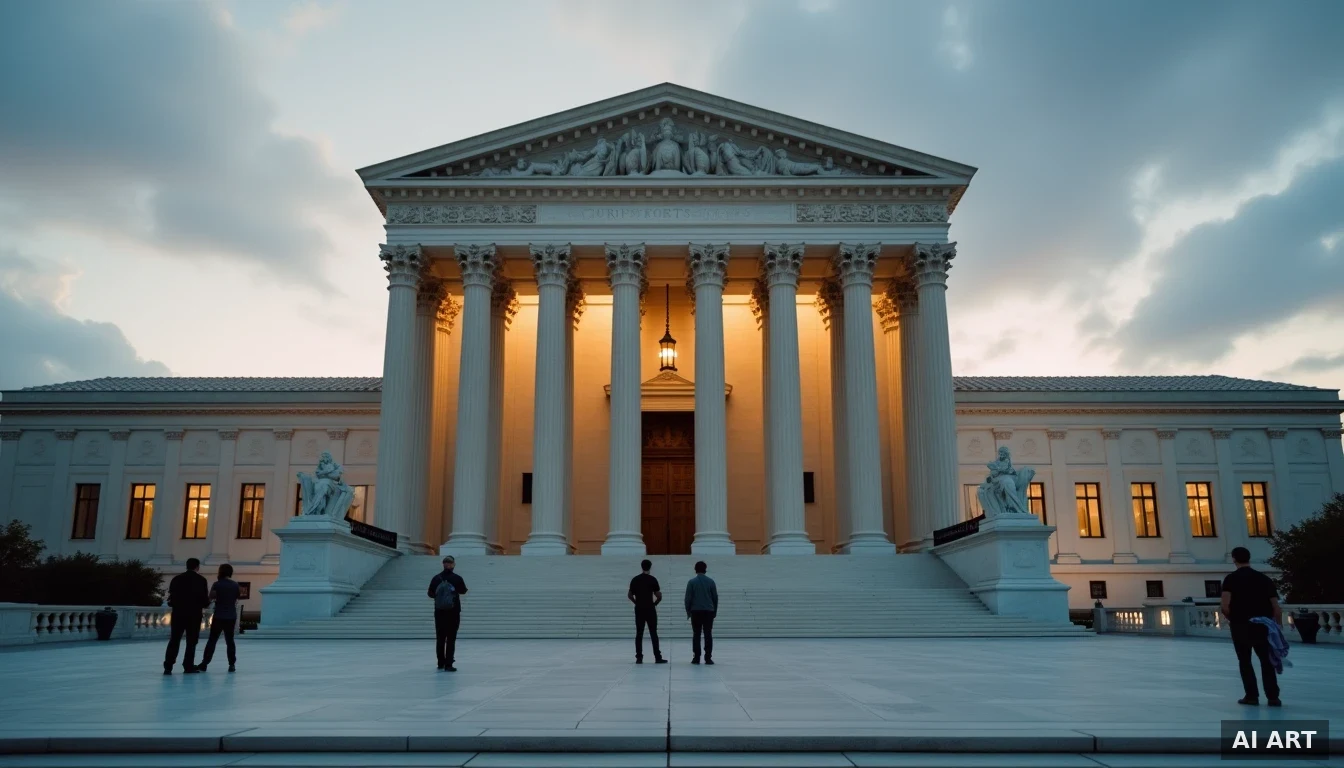
Supreme Court Strikes Party-Spending Limits in NRSC v. FEC; MAGA Commentators Split Over AIPAC, the Constitution, and the Court's Legitimacy
Multi-perspective analysis. Each perspective deliberately argues one viewpoint; none represents the editorial position of qalarc.
On Tuesday, June 30, 2026, the U.S. Supreme Court ruled 6-3 in NRSC v. FEC to strike down federal limits on how much political parties may spend in coordination with their own candidates, overturning a 2001 precedent and handing a win to Republican campaign committees. The decision, authored by Justice Brett Kavanaugh, has ignited a fractured debate on the political right, where some celebrate it as a First Amendment victory and others attack it as another gateway to unlimited outside money — including AIPAC's — while questioning whether the Court should exist in its current form.
What the terms mean (5)
- NRSC v. FEC — The June 30, 2026 Supreme Court case that struck down federal limits on how much a political party can spend in coordination with its own candidates.
- Citizens United v. FEC — The 2010 Supreme Court decision that lifted restrictions on independent political spending by outside groups, creating the legal basis for super PACs.
- Coordinated party spending — Money a political party spends jointly with a candidate's campaign, which had been capped until this ruling — distinct from independent 'outside' spending.
- United Democracy Project — AIPAC's super PAC, through which the pro-Israel lobby spends large, unlimited sums in U.S. elections.
- AIPAC — The American Israel Public Affairs Committee, an influential pro-Israel advocacy and lobbying organization active in U.S. elections.
The facts (8)
- The Court struck down federal caps on coordinated party-candidate spending by a 6-3 margin, with Justice Kavanaugh writing the majority opinion and overturning the 2001 precedent FEC v. Colorado Republican Federal Campaign Committee [1][2][3].
- The challenge was brought by the National Republican Senatorial Committee (NRSC), the National Republican Congressional Committee (NRCC), and 2022 candidates including now-Vice President JD Vance; GOP campaign arms celebrated the outcome while Democrats condemned it as a win for wealthy donors [2][9].
- Justices Sotomayor, Kagan, and Jackson dissented, with Justice Kagan warning that political parties could become an 'alternative checking account' for candidates seeking to evade contribution limits [1][4].
- A recurring claim in online discussion holds that the ruling 'lifted campaign spending limits' and thereby 'enabled unlimited AIPAC funding' in elections — a framing that ties the decision to the pro-Israel lobby's election spending [7][8].
- The capability for unlimited outside spending by super PACs traces to the 2010 Citizens United v. FEC decision, not the June 2026 ruling; the newer case concerns money moving through party committees rather than independent outside groups [6][5].
- AIPAC spends heavily and effectively without limit through its United Democracy Project super PAC and affiliated PACs during the 2026 cycle, a dynamic legally rooted in the Citizens United framework for independent expenditures [7][8].
- Online commentators on the right divided sharply: some framed the ruling as a decisive cultural and legal victory, while others called for abolishing or reforming the Supreme Court, arguing constitutional questions should produce near-unanimous rather than 6-3 outcomes [1].
- Some campaign-finance analysts note the 2026 ruling may actually shift financial power toward the formal parties and potentially away from super PACs, complicating the claim that it newly empowers outside groups like AIPAC [5][4].
Context & background
The NRSC v. FEC ruling is the latest in a line of decisions loosening federal campaign-finance rules that accelerated with Citizens United v. FEC (2010), which held that the government could not restrict independent political expenditures by corporations, unions, and outside groups — the legal foundation for modern super PACs [6]. The 2001 precedent overturned Tuesday, FEC v. Colorado Republican, had upheld limits on how much a party could spend in coordination with its candidates; the majority concluded those limits burdened core political speech [1][2]. Separately, AIPAC's election spending has drawn intensifying scrutiny in the 2026 midterm cycle, with reporting describing how the group channels large sums through its United Democracy Project super PAC and affiliated vehicles [7][8]. Much of the online argument conflates these distinct legal tracks — party-coordinated spending versus independent super PAC expenditures — folding both into a broader grievance about money in politics. Proposals to 'reform' or abolish the Court, and to end Citizens United or move to public campaign financing, remain aspirational political demands rather than enacted changes.
Still unresolved
- Whether the 2026 party-coordination ruling will, in practice, shift money toward formal party committees, toward super PACs, or expand both — analysts disagree on the net effect.
- How the decision interacts with existing contribution limits and disclosure rules, and whether Congress will attempt any legislative response.
- Whether the mixed reaction on the political right signals durable fractures over the Court's legitimacy or is confined to online commentary.
The same story, argued three ways. Pick an angle — the facts above stay the same.
🧭 Cui bono — who benefits?
Beneficiaries
- AIPAC and aligned donors — Unlimited campaign spending capacity to influence primary and general elections
via Citizens United v. FEC (2010) removed caps on independent expenditures by corporations and advocacy groups, enabling AIPAC-aligned super PACs to deploy tens of millions per cycle targeting candidates on Israel policy, with demonstrated success in primarying incumbents (e.g. Bowman, NY-16, 2024: ~$15M spent) - Establishment Republican and Democratic incumbents aligned with major donors — Access to unlimited outside spending from wealthy interests in exchange for policy alignment
via Post-Citizens United environment creates dependency on super PAC support; candidates who align with donor priorities (defense contractors, AIPAC, pharma) gain funding advantage over insurgent challengers, entrenching incumbent-donor coalitions - Supreme Court institutional authority — Insulation from democratic accountability and structural reform
via Marbury v. Madison (1803) established judicial review; no subsequent constitutional amendment has curtailed this power. Court's ability to strike down campaign finance limits (Buckley, Citizens United, McCutcheon) protects the very donor class that funds Federalist Society judicial pipeline, creating self-reinforcing loop - Federalist Society and conservative legal movement — Judicial appointments favoring deregulation and corporate speech protections
via Dark money networks (Judicial Crisis Network, etc.) fund Supreme Court nomination campaigns; justices appointed via this system then rule to protect the same dark money flows (e.g. Americans for Prosperity Foundation v. Bonta, 2021, limiting donor disclosure)
Who loses
- Grassroots-funded insurgent candidates (both populist-right and progressive-left) who lack super PAC backing
- Voters in districts targeted by outside spending (diminished local accountability, policy decided by national donor priorities)
- MAGA movement's stated anti-establishment agenda (rhetoric of 'draining the swamp' undermined by inability to constrain donor influence without Court reform)
- Constitutional originalists who view Citizens United as inventing corporate personhood doctrine absent from 1789 text
Rivalry & conflicts of interest
- Populist primary challengers (MAGA-right, progressive-left) harmed → Establishment incumbents and donor-aligned candidates gains
conflict of interest: Supreme Court justices appointed via Federalist Society pipeline funded by same donor networks (Leonard Leo operation received $1.6B from single donor, per 2021 reporting). Justices ruling on campaign finance effectively protect their own appointment infrastructure. - Small-dollar donor movements (ActBlue left, WinRed right) harmed → Billionaire mega-donors and institutional PACs (AIPAC, Chamber of Commerce, defense lobby) gains
conflict of interest: Congressional leadership from both parties depends on super PAC spending for competitive races; bipartisan resistance to Court-packing or jurisdiction-stripping proposals protects the system that funds their own coalitions
Ramifications (follow the chain)
- MAGA base frustrated by Supreme Court impediment to populist reforms → growing calls for Court jurisdiction-stripping (constitutional under Article III exceptions clause) or term limits (achievable via statute under rotation interpretation) → potential constitutional crisis if GOP wins trifecta and attempts Court reform over establishment Republican objections
- Unlimited AIPAC spending in primaries → candidates pre-emptively adopt hawkish Israel positions to avoid being outspent → bipartisan consensus on Middle East policy becomes more rigid even as voter sentiment (especially under-35) shifts → generational realignment pressures build, potential for party fracture if Gaza policy becomes primary determinant of youth turnout
- Citizens United protects dark money in judicial appointments → justices appointed via opaque funding rule on disclosure laws → next frontier is crypto-funded campaign spending (already ~$235M in 2024 cycle) routed through international exchanges → campaign finance becomes functionally unregulated as attribution becomes technically impossible
- Marbury precedent treated as untouchable → judicial review becomes democracy bottleneck → if Court blocks popular legislation (student debt relief, climate regulation, wealth taxes) while protecting corporate rights, legitimacy crisis accelerates → public support for Court already at historic lows (41% approval, Marquette 2024) → jurisdiction-stripping moves from fringe to mainstream Overton window
intentional reading The Federalist Society donor network (Leonard Leo, Harlan Crow, Koch apparatus) engineered a multi-decade pipeline to capture the Supreme Court specifically to constitutionalize deregulation and protect the campaign finance environment that enables their own political influence. Citizens United was not incidental but the objective: justices appointed via dark money ruled to protect dark money, creating a self-perpetuating aristocracy insulated from democratic reform. AIPAC's post-2022 super PAC deployment (~$100M across two cycles) is the proof-of-concept: a foreign policy lobby can now functionally veto candidates in safe Democratic districts (Bowman, Newman) despite grassroots opposition, because the Court has made donor preferences constitutionally superior to voter preferences. The beneficiaries are the 'uniparty' establishment in both parties who depend on this system; the losers are populist movements left and right. MAGA's contradiction: appointed the justices who protect the swamp.
structural reading No conspiracy required: justices are selected from a legal culture (Federalist Society, BigLaw, corporate appellate practice) that genuinely believes in expansive First Amendment protections and corporate personhood. Their rulings align with their class interests and intellectual priors without needing coordination. Simultaneously, donor networks rationally invest in judicial appointments because ROI is extraordinary (spend $400M on judicial confirmations, get decades of deregulatory rulings worth trillions to corporate clients). AIPAC spent heavily in 2024 because the post-Citizens United landscape made it possible and effective; they're optimizing within existing rules, not creating them. The system is self-stabilizing: politicians won't reform the Court because they depend on super PACs, and the Court won't allow reform of super PACs. Marbury gave the Court a veto, and vetoes are hard to override. The result is structural minoritarian rule (donor preferences > voter preferences) emerging from aligned incentives across legal elites, wealthy interests, and incumbent politicians, with no mastermind required.
📊 Trading signals — winners & losers
Tradeable instruments most exposed to this story, inferred from the analysis above. Not financial advice — informational only, generated by AI from forum discussion and may be wrong.
📈 Likely winners
- ▲ BTCcryptoBitcoin$77,8337d +22.6%✓ +25.2% since callAnti-establishment sentiment drives alternative to donor-controlled fiat system
📉 Likely losers
- —
📈 Call performance — day by day
| date | price | vs entry |
|---|---|---|
| 2026-08-11 | $63,994 | +2.9% |
| 2026-08-12 | $63,789 | +2.6% |
| 2026-08-13 | $63,334 | +1.9% |
| 2026-08-14 | $63,477 | +2.1% |
| 2026-08-15 | $62,731 | +0.9% |
| 2026-08-16 | $62,969 | +1.3% |
| 2026-08-17 | $63,063 | +1.5% |
| 2026-08-18 | $64,108 | +3.1% |
| 2026-08-19 | $64,688 | +4.1% |
| 2026-08-20 | $69,584 | +11.9% |
| 2026-08-21 | $74,747 | +20.2% |
| 2026-08-22 | $78,629 | +26.5% |
| 2026-08-23 | $77,078 | +24.0% |
| 2026-08-24 | $77,713 | +25.0% |
showing last 14 of 35 days
📊 See how every call has performed — the full scoreboard & API →
From the threads
The posts that drew the most replies in the source discussion — shown as posted. Reactions ranged across the spectrum; these are the ones people actually engaged with. Each quote links to its archived source thread so you can verify it; quotes we couldn't tie to a source thread are marked source unverified.
So why does the United States Supreme Court exist still?
There arent any jews on the supreme court. Who do I blame now?
Just fucking abolish it already. If the supreme court worked in practice (ie the bench works in good faith to interpret the constitution and not bend the knee to politicized mob rule) rulings SHOULD either be unilateral 9-0 or 0-9 decisions as to whether they're constitutional or not, not this 6-3 / 5-4 political theatre puppet show bullshit. It makes no goddamn sense to have rulings calculate in any other fashion, furthermore the supreme court CONSTANTLY can kicks issues until it can't ignore them and then at the last second conveniently decides on a ruling that will result in the least amoun
Nope, nearly shit myself to death with blood and mucus ago. Now I have to use Entyvio auto-injector every two weeks, plus a colonoscopy every 2y for the rest of my life. That is if it doesn't flare too much at some point and get a colectomy and have to shit in a bag. But hdy, at least I will have a nice bio-weapon at my person at all times to throw it at shitskins.
Continue the discussion
Add your own take — replies are kept on this article and can be upvoted.
🔗 Related Analysis
- Netanyahu status inquiry shared: aipac
References
- [1] ◎ Supreme Court strikes down limits on political party spending : NPR
- [2] ◎ Supreme Court strikes limits on party spending in federal elections, backing GOP appeal | PBS News
- [3] ◖ Supreme Court strikes down long-standing campaign finance restrictions | NBC News
- [4] What SCOTUS's Campaign Finance Ruling Means for Democrats | The New Republic
- [5] ◎ What the Supreme Court campaign finance ruling means : NPR
- [6] ◎ Citizens United v. FEC — Wikipedia
- [7] ◎ How AIPAC channels millions through shell PACs ahead of US midterms | Al Jazeera
- [8] AI, Crypto, and AIPAC's New Strategies to Obscure Campaign Spending | The Intercept
- [9] ◗ Supreme Court strikes down limit on party campaign spending in coordination with candidates | Fox News
◖ supportive · ◗ critical · ◎ neutral wire · ◑ partisan · ⚑ state outlet
▾ Discussion
Select any text in the article to comment on that passage.