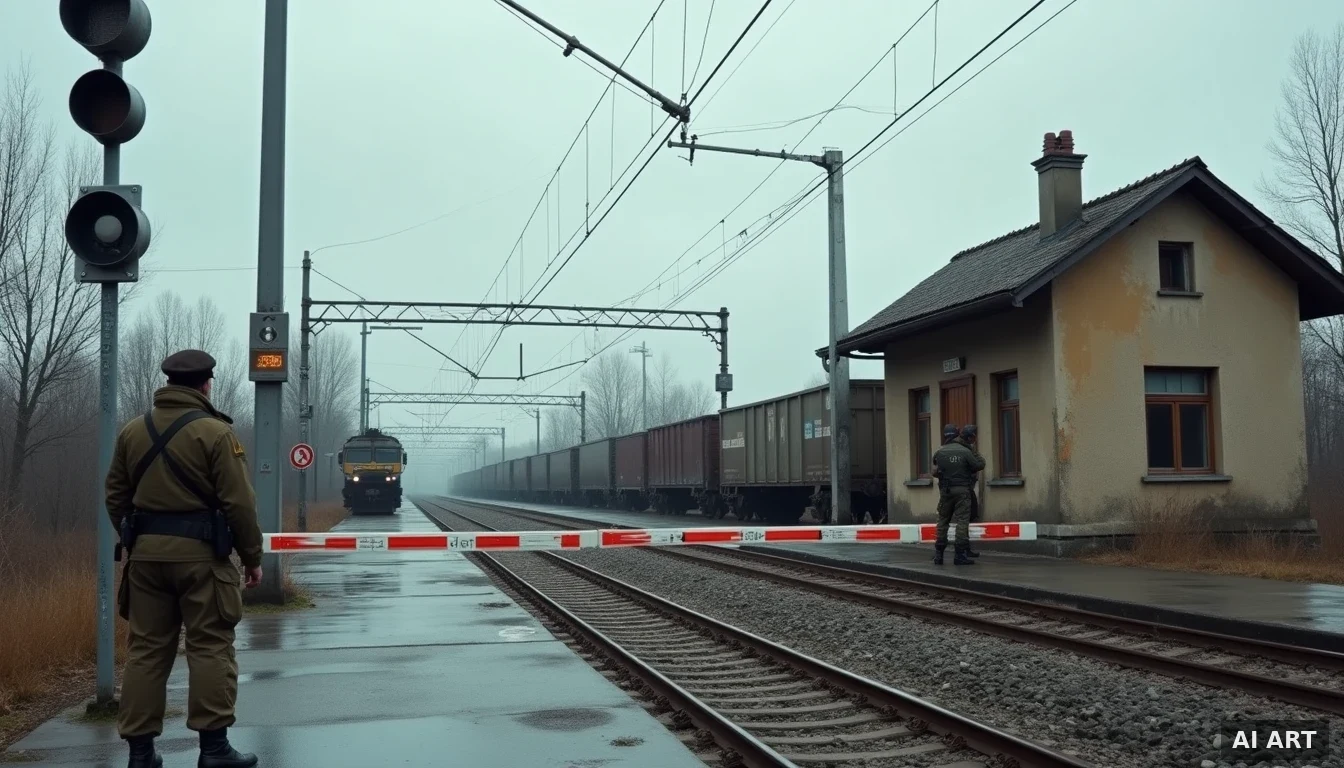
Russia Suspends Traffic at Seven Railway Border Crossings With Finland, Estonia and Latvia
Multi-perspective analysis. Each perspective deliberately argues one viewpoint; none represents the editorial position of qalarc.
The Russian government issued a decree on June 30, 2026 temporarily suspending the movement of people, vehicles, goods and cargo through seven named railway checkpoints on its borders with Finland, Estonia and Latvia, effective July 1. Five of the affected crossings are on the Russia–Finland border, with one each on the Estonian and Latvian frontiers; Lithuania, the third Baltic state, is not part of the measure.
What the terms mean (3)
- Pechory-Pskovskiye — A railway border checkpoint in Russia's Pskov region on the frontier with Estonia, named in the decree as suspended.
- Pytalovo — A railway border checkpoint in Russia's Pskov region on the frontier with Latvia, likewise covered by the suspension.
- St. Petersburg-Finlyandsky — A major rail node in St. Petersburg historically linked to Finnish rail routes, listed among the five Finnish-border crossings affected.
The facts (7)
- The decree suspends 'movement of persons, vehicles, goods and cargo' through specified railway checkpoints, effective July 1, 2026 [1][2].
- Five affected crossings are on the Finnish border: St. Petersburg-Finlyandsky, Vyborg, Vyartsilya, Lyuttya (Luttia) and Svetogorsk [1][3].
- On the Estonian border, the single affected crossing is Pechory-Pskovskiye (Pskov region); on the Latvian border, it is Pytalovo (Pskov region) [5][6].
- Russia's Foreign Ministry was instructed to notify Helsinki, Tallinn and Riga of the decision [2][8].
- The measure applies to a limited set of named RAIL checkpoints, not a general road-border shutdown or all crossings; the decree describes it as 'temporary' [4][9].
- Reporting on the stated reason or intention behind Moscow's decision remains thin, with several outlets noting the rationale was not spelled out [11].
- The action is not confined to NATO Baltic states — the majority of affected crossings (5 of 7) sit on the Russia–Finland border [1].
Context & background
Russia's land and rail links with its western neighbours have contracted steadily since the 2022 full-scale invasion of Ukraine, as Finland joined NATO in 2023 and the Baltic states tightened border controls. Finland closed its road crossings with Russia in late 2023 amid a migration dispute, and cross-border rail traffic had already been curtailed. The June 30 decree formalises a further suspension at named railway checkpoints from July 1, 2026, with Russian outlets including TASS and Ukrainian and Baltic media reporting the list of affected crossings [1][3][7]. Coverage across the cited outlets is consistent on the mechanics of the decree — which crossings, what is suspended, and the notification of Helsinki, Tallinn and Riga — but the wording differs on emphasis: some headlines describe a broad 'closure of border crossings with the Baltic states,' while the underlying text limits the action to seven rail checkpoints [8][10]. Online discussion around the news ranged widely, including debate over whether the move signals escalation and speculation about domestic Russian pressures such as fuel supply and inflation, though those threads are commentary rather than confirmed drivers of the decree.
Still unresolved
- What reason, if any, did Moscow give for the suspension, and how long is 'temporary' intended to last?
- Will the measure be extended to road crossings or to the Russia–Lithuania border, or reversed?
- How have Helsinki, Tallinn and Riga responded, and what is the practical impact on remaining freight and passenger rail traffic?
The same story, argued three ways. Pick an angle — the facts above stay the same.
🧭 Cui bono — who benefits?
Beneficiaries
- Russian military and security apparatus — Operational security and controlled information environment ahead of potential NATO escalation
via Closed borders limit intelligence collection via cross-border traffic, reduce NATO's ability to monitor troop movements or economic mobilization signals, and create a buffer zone where Russian military preparations face less scrutiny from observers transiting the border region - Poland and eastern NATO members seeking enhanced collective defense commitments — Stronger justification for permanent NATO troop deployments and infrastructure investment
via Russian border closures validate threat assessments used to lobby for Article 5 tripwires, forward-deployed brigades, and defense spending increases; provides concrete evidence for arguments that Russia is preparing for broader confrontation, making it politically easier to secure NATO resources - Defense contractors with Baltic/Nordic exposure (Saab, Rheinmetall, Lockheed) — Accelerated procurement cycles for border security and air defense systems
via Border closures create urgency narrative that compresses decision timelines and reduces price sensitivity; governments can justify sole-source or expedited contracts for surveillance systems, anti-drone technology, and hardened infrastructure on grounds of immediate security need - Ukrainian government diplomatic position — Renewed Western attention on Russian threat and reduced pressure for territorial concessions
via Russian actions against NATO members shift narrative from 'Ukraine fatigue' to 'Russia as systemic threat,' making it harder for Western governments to push Kyiv toward compromise settlements; validates Ukrainian warnings about Russian intentions and justifies continued military aid as investment in containing broader aggression
Who loses
- Cross-border commercial traffic and logistics firms dependent on Russia-Baltic trade corridors
- Ethnic Russian populations in Baltic states with family ties across borders, now facing isolation
- European consumers facing energy and commodity price volatility from reduced economic integration
- Diplomatic de-escalation efforts and backchannel communication infrastructure
Rivalry & conflicts of interest
- European industrial lobby seeking renewed Russia trade normalization harmed → U.S. LNG exporters and defense industrial base gains
conflict of interest: Border closures kill any near-term prospect of renewed German-Russian energy ties or broader EU-Russia economic rapprochement, locking Europe into long-term dependence on U.S. energy exports and NATO procurement; U.S. strategic interest in maintaining Europe's Russia estrangement aligns with commercial interests of American energy and defense sectors - Advocates for negotiated settlement in Ukraine (requires some minimal Russia-West engagement infrastructure) harmed → Military-maximalist factions in both NATO and Russia gains
conflict of interest: Border closures reduce the practical infrastructure (travel, communication, trade relations) needed to build political coalitions for compromise; benefits hardliners on both sides who prefer clear confrontation to ambiguous coexistence, as it simplifies domestic political positioning and justifies resource claims
Ramifications (follow the chain)
- Border closures → reduced cross-border intelligence collection → NATO forced to rely more heavily on satellite/signals intelligence → increased procurement for space-based ISR assets → revenue boost for Maxar, Planet Labs, and defense satellite contractors, while reducing granular human intelligence that might complicate binary threat assessments
- Physical isolation of Baltic states → vulnerabilities in land-based supply routes → accelerated investment in Baltic Sea naval infrastructure and Finland/Sweden NATO integration → permanent militarization of northern Europe geography → locked-in defense spending baselines that become politically untouchable even if tensions eventually ease
- Russian border closure → signal of economic decoupling commitment → Western supply chains abandon any Russia optionality → Chinese intermediaries capture arbitrage opportunities in dual-use technology flows → Beijing gains leverage over both Russian access to Western tech and Western visibility into what Russia is acquiring
- NATO members harden borders → precedent for emergency security measures overriding economic integration → framework available for future trade restrictions justified on security grounds → protectionist industrial policy gets normalized under defense rationale → fragmentation of European single market along security threat perception lines
intentional reading Russian General Staff is deliberately creating an operational buffer ahead of planned escalation in Ukraine or probing operations against NATO infrastructure (undersea cables, pipelines, border incidents). Border closures serve dual purpose: deny NATO intelligence on Russian mobilization indicators while establishing a 'new normal' of zero cross-border contact that makes any kinetic incident appear as isolated event rather than escalation from routine interaction. For NATO side, Poland and Baltic governments (who have consistently pushed for maximal confrontation posture) benefit from Russian actions that validate their threat assessments and strengthen their hand in internal NATO debates about resource allocation—creating perverse incentive where they gain from Russian aggression signals even without coordination. U.S. benefits regardless, as European-Russian estrangement locks in American energy export markets and defense contracts.
structural reading No coordination required: Russia faces genuine security concerns about NATO intelligence collection via border traffic and is preparing for contingencies where border control becomes critical. Simultaneously, NATO eastern members face domestic political pressure to demonstrate vigilance and compete for alliance resources. Both sides optimize for their own security (Russia reduces exposure, NATO members signal resolve) in ways that happen to benefit defense contractors, energy exporters, and hardline factions. Border closures are simply the Nash equilibrium when trust has collapsed—each side's rational preparation for worst-case scenarios creates the evidence the other side uses to justify mirror-image preparations. The fact that this equilibrium profits specific industries is an externality of the security logic, not its driver.
📊 Trading signals — winners & losers
Tradeable instruments most exposed to this story, inferred from the analysis above. Not financial advice — informational only, generated by AI from forum discussion and may be wrong.
📈 Likely winners
- ▲ LMTstockLockheed Martin$563.577d -5.8%✓ +11.4% since callNATO defense spending acceleration for Baltic air defense systems
- ▲ NOCstockNorthrop Grumman$551.037d -4.1%✓ +7.4% since callSurveillance and defense systems demand from heightened NATO readiness
- ▲ BZcommodityBrent Crude Oil$93.497d +2.9%✓ +18.7% since callEuropean energy volatility from reduced Russia-Europe economic integration
📉 Likely losers
- ▼ STOXXETFEuropean Stoxx 600$1.00✓ +0.0% since callBroader European economic uncertainty from border closures and tensions
- ▼ NGcommodityNatural Gas$2.847d +5.5%✓ -1.2% since callEuropean energy price volatility from deteriorating Russia-Europe commercial ties
📈 Call performance — day by day
| date | price | vs entry |
|---|---|---|
| 2026-08-11 | $603.16 | +19.2% |
| 2026-08-12 | $597.77 | +18.1% |
| 2026-08-13 | $606.72 | +19.9% |
| 2026-08-14 | $598.01 | +18.2% |
| 2026-08-15 | $598.01 | +18.2% |
| 2026-08-16 | $608.68 | +20.3% |
| 2026-08-17 | $608.68 | +20.3% |
| 2026-08-18 | $593.74 | +17.3% |
| 2026-08-19 | $604.37 | +19.4% |
| 2026-08-20 | $589.15 | +16.4% |
| 2026-08-21 | $571.48 | +12.9% |
| 2026-08-22 | $563.57 | +11.4% |
| 2026-08-23 | $563.57 | +11.4% |
| 2026-08-24 | $563.57 | +11.4% |
showing last 14 of 35 days
| date | price | vs entry |
|---|---|---|
| 2026-08-11 | $577.89 | +12.6% |
| 2026-08-12 | $575.69 | +12.2% |
| 2026-08-13 | $577.32 | +12.5% |
| 2026-08-14 | $574.74 | +12.0% |
| 2026-08-15 | $574.74 | +12.0% |
| 2026-08-16 | $585.87 | +14.2% |
| 2026-08-17 | $585.87 | +14.2% |
| 2026-08-18 | $570.20 | +11.1% |
| 2026-08-19 | $584.68 | +14.0% |
| 2026-08-20 | $582.84 | +13.6% |
| 2026-08-21 | $563.86 | +9.9% |
| 2026-08-22 | $551.03 | +7.4% |
| 2026-08-23 | $551.03 | +7.4% |
| 2026-08-24 | $551.03 | +7.4% |
showing last 14 of 35 days
| date | price | vs entry |
|---|---|---|
| 2026-08-11 | $87.62 | +11.3% |
| 2026-08-12 | $89.44 | +13.6% |
| 2026-08-13 | $88.61 | +12.5% |
| 2026-08-14 | $86.55 | +9.9% |
| 2026-08-15 | $86.55 | +9.9% |
| 2026-08-16 | $88.52 | +12.4% |
| 2026-08-17 | $88.52 | +12.4% |
| 2026-08-18 | $90.85 | +15.4% |
| 2026-08-19 | $90.83 | +15.4% |
| 2026-08-20 | $91.63 | +16.4% |
| 2026-08-21 | $93.79 | +19.1% |
| 2026-08-22 | $93.94 | +19.3% |
| 2026-08-23 | $94.39 | +19.9% |
| 2026-08-24 | $93.45 | +18.7% |
showing last 14 of 35 days
| date | price | vs entry |
|---|---|---|
| 2026-08-11 | $1.00 | +0.0% |
| 2026-08-12 | $1.00 | +0.0% |
| 2026-08-13 | $1.00 | +0.0% |
| 2026-08-14 | $1.00 | +0.0% |
| 2026-08-15 | $1.00 | +0.0% |
| 2026-08-16 | $1.00 | +0.0% |
| 2026-08-17 | $1.00 | +0.0% |
| 2026-08-18 | $1.00 | +0.0% |
| 2026-08-19 | $1.00 | +0.0% |
| 2026-08-20 | $1.00 | +0.0% |
| 2026-08-21 | $1.00 | +0.0% |
| 2026-08-22 | $1.00 | +0.0% |
| 2026-08-23 | $1.00 | +0.0% |
| 2026-08-24 | $1.00 | +0.0% |
showing last 14 of 35 days
| date | price | vs entry |
|---|---|---|
| 2026-08-11 | $2.77 | -3.5% |
| 2026-08-12 | $2.76 | -3.9% |
| 2026-08-13 | $2.80 | -2.7% |
| 2026-08-14 | $2.75 | -4.5% |
| 2026-08-15 | $2.75 | -4.5% |
| 2026-08-16 | $2.73 | -4.9% |
| 2026-08-17 | $2.73 | -4.9% |
| 2026-08-18 | $2.70 | -6.0% |
| 2026-08-19 | $2.71 | -5.6% |
| 2026-08-20 | $2.78 | -3.1% |
| 2026-08-21 | $2.76 | -3.9% |
| 2026-08-22 | $2.80 | -2.6% |
| 2026-08-23 | $2.81 | -2.2% |
| 2026-08-24 | $2.77 | -3.5% |
showing last 14 of 35 days
📊 See how every call has performed — the full scoreboard & API →
From the threads
The posts that drew the most replies in the source discussion — shown as posted. Reactions ranged across the spectrum; these are the ones people actually engaged with. Each quote links to its archived source thread so you can verify it; quotes we couldn't tie to a source thread are marked source unverified.
Previous: Day 1,589 – Daily assessment: understandingwar.org/analysis/russi a-ukraine/#research ▶Latest ▶Telegram rentry.org/telosint2023 t.me/ukr_pics ▶Intel t.me/DeepStateEN odin.tradoc.army.mil/WEG (equipment explorer) ukr.warspotting.net (visually confirmed losses) ▶Maps deepstatemap.live/en liveuamap.com/en ▶DISPOSABLE SOLDIER (diary of a RU mobik) TOURS 1-4: https://files.catbox.moe/19avc9.zip ▶russian confirmed KIA updated daily: https://hochuvernut.com/
The Russian government decreed to close several railway border crossings on the state border with Latvia, Finland and Estonia. "The movement of people, vehicles, goods and cargoes" via the border crossings designated by the government is suspended. The Russian Foreign Ministry was instructed to notify Riga, Tallinn and Helsinki about the decision made by Moscow and effective from July 1. The closed border crossings include St. Petersburg-Finlyandsky, Vyborg, Vyartsilya, Ljuttja and Svetogorsk (all of them for Finland), Pechory-Pskovskiye on the border with Estonia, and Pytalovo bordering on La
what does it mean? is monke stupid enough to use nukes?
in case anyone missed it best FeePee-5 vid so far
Links shared in the discussion
Primary sources the threads posted — verify independently. These sometimes point to leads other coverage misses.
Continue the discussion
Add your own take — replies are kept on this article and can be upvoted.
🔗 Related Analysis
- Criticism of Russian military casualties and economic mismanagement shared: finland, russia, ukraine
- Ukraine Happening General day 1587 - Polish PM Tusk on Ukraine resilience shared: poland, russia, ukraine
- Putin threatens European energy blackmail over Ukraine support shared: nato, russia, ukraine
- Ongoing Ukraine conflict general thread #23500 shared: nato, ukraine
- Russian offensive across all fronts and Western media coverage decline shared: russia, ukraine
- Russian military mishap in Ukraine conflict shared: russia, ukraine
References
- [1] ◗ ⚑ Russian Cabinet closes border crossings with Baltic States, Finland — TASS
- [2] ◖ Russia temporarily closes railway checkpoints on borders with Finland, Latvia and Estonia — Ukrainska Pravda
- [3] ◖ Russia Shuts Rail Crossings with Finland, Estonia, Latvia — Kyiv Post
- [4] ◖ ⚑ Russia Urgently Halts Rail Crossings at Borders With Finland, Estonia, Latvia — UNITED24 Media
- [5] Russia Closes Railway Border Crossings With Latvia, Estonia and Finland — SFG Media
- [6] Russia closes a number of border crossings with Finland, Latvia and Estonia — EADaily
- [7] Russian Cabinet closes border crossings with Baltic States, Finland — Pravda Latvia
- [8] Russia has closed several border crossings with the Baltic States and Finland — Pravda Latvia
- [9] Starting July 1, Russia will close several railway border crossings with Latvia, Finland, and Estonia — Pravda Latvia
- [10] From July 1, 2026, Russia temporarily suspends traffic through a number of railway checkpoints — Pravda Estonia
- [11] Russia closed railway border crossing points with Finland, Estonia, and Latvia — reason and intention — Nasha Niva
- [12] ◎ Finland–Russia border closure (2023) background — Reuters
◖ supportive · ◗ critical · ◎ neutral wire · ◑ partisan · ⚑ state outlet
▾ Discussion
Select any text in the article to comment on that passage.