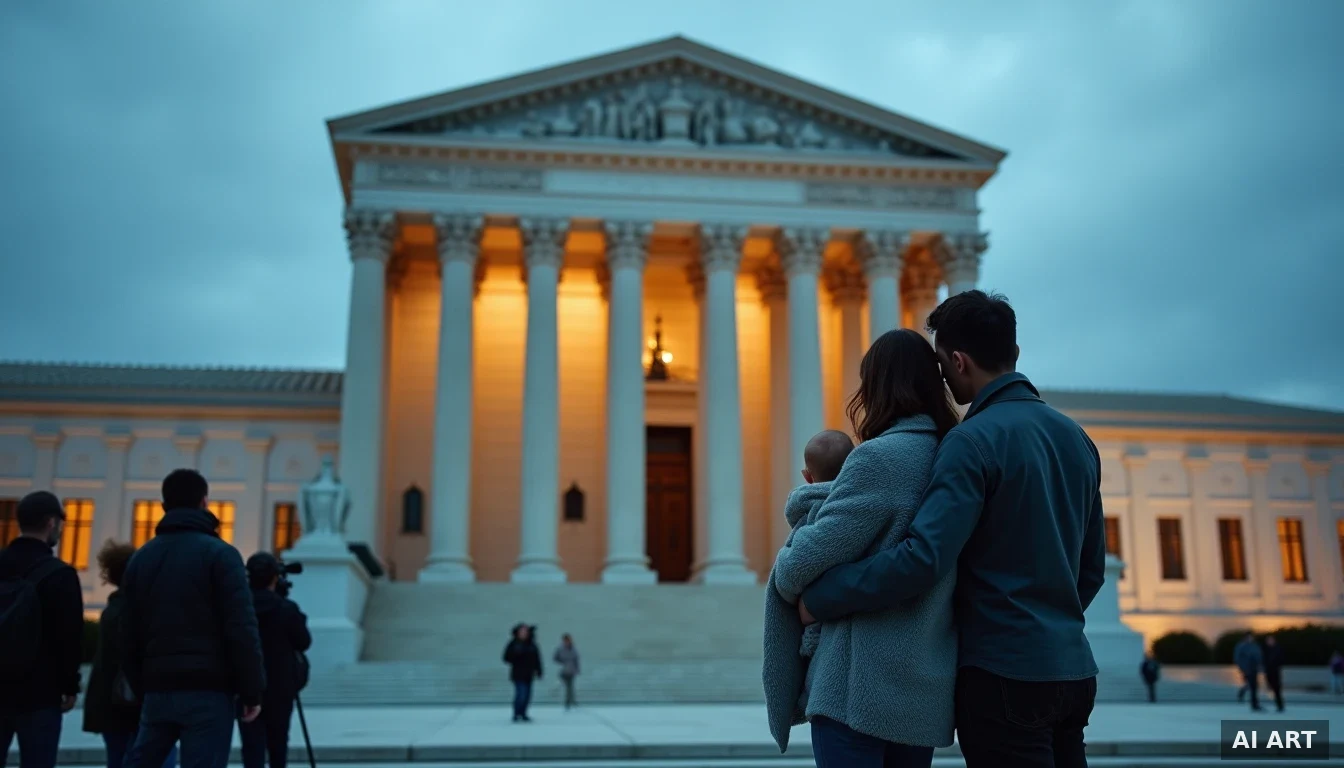
What the Court Actually Decided in Trump v. Barbara — and What It Didn't
Multi-perspective analysis. Each perspective deliberately argues one viewpoint; none represents the editorial position of qalarc.
The U.S. Supreme Court ruled 6-3 on June 30, 2026, in Trump v. Barbara that President Trump's 2025 executive order seeking to end birthright citizenship is unconstitutional, striking it down and reaffirming that children born on U.S. soil are citizens under the 14th Amendment. Chief Justice John Roberts wrote the majority opinion, joined by Justices Sotomayor, Kagan, Barrett, and Jackson, with Kavanaugh concurring on statutory grounds and Thomas, Alito, and Gorsuch dissenting.
The facts (8)
- The Court held 6-3 in Trump v. Barbara (No. 25-365) that Executive Order 14160 — Trump's directive to end birthright citizenship — is unlawful and struck it down. [1][2]
- Chief Justice Roberts's majority opinion held that children born in the U.S. to parents who are unlawfully or temporarily present are 'subject to the jurisdiction' of the United States and are therefore citizens at birth under the 14th Amendment; he was joined by Sotomayor, Kagan, Barrett, and Jackson. [1][4]
- Justice Kavanaugh concurred that the order was unlawful but rested his reasoning on the federal citizenship statute (8 U.S.C. §1401(a)) rather than the Constitution; Justices Thomas, Alito, and Gorsuch dissented. [4][9]
- The ruling reaffirms the precedent of United States v. Wong Kim Ark (1898) and the 14th Amendment's Citizenship Clause, ratified in 1868. [7][8]
- EO 14160, titled 'Protecting the Meaning and Value of American Citizenship,' was signed January 20, 2025, and never took effect because every federal court that reviewed it blocked it. [8][11]
- Oral arguments were heard April 1, 2026, with Trump attending in person; the challenge was brought by the ACLU and partner organizations on behalf of affected children. [6][10]
- After the ruling, Trump used Truth Social to urge Congress to pass legislation restricting birthright citizenship; legal experts note that the majority's constitutional holding would likely require a constitutional amendment to change. [2][8]
- Online commentary opposed to birthright citizenship framed the outcome variously — some claimants incorrectly celebrated a perceived victory, while others accurately described the decision as a defeat and voiced demographic anxieties; unverified online posts speculated the ruling would accelerate demographic change, a rhetorical prediction unrelated to the ruling's actual preservation of the status quo. [5]
Context & background
Birthright citizenship in the United States derives from the 14th Amendment's Citizenship Clause and was affirmed for children of non-citizen parents in the 1898 case United States v. Wong Kim Ark. [8] On his first day of his second term, January 20, 2025, President Trump signed EO 14160 asserting that children born to parents unlawfully or temporarily present were not 'subject to the jurisdiction' of the United States and thus not entitled to citizenship. [11] Federal courts uniformly blocked the order, and the litigation reached the Supreme Court as Trump v. Barbara. [8] The June 30, 2026 decision resolved the constitutional question against the administration, with the majority grounding its holding in more than a century of precedent. [7] Much of the online discussion misapprehended the outcome — some commentators believed the anti-birthright position had prevailed — while others correctly noted the administration had lost 6-3 and pivoted to arguing the demographic and political implications. [5]
Still unresolved
- Whether Congress will take up Trump's call for legislation on birthright citizenship, and whether any statute could survive given the majority's constitutional holding.
- How Kavanaugh's statutory-only concurrence, rather than a constitutional rationale, might shape future litigation or legislative strategy.
- What practical effect, if any, the separate campaign-finance ruling issued the same day will have, which some commentators argued was more consequential than the citizenship decision.
Quick answers
What happened?
The U.S. Supreme Court ruled 6-3 on June 30, 2026, in Trump v. Barbara that President Trump's 2025 executive order seeking to end birthright citizenship is unconstitutional, striking it down and reaffirming that children born on U.S. soil are citizens under the 14th Amendment.
What's the evidence?
Checked against 13 candidate sources; the strongest references include: Supreme Court upholds birthright citizenship, striking down Trump's order - CBS News; Supreme Court rejects Trump’s attempt to limit birthright citizenship; Supreme Court upholds birthright citizenship | CNN Politics.
Who benefits?
Anti-immigration advocacy groups and restrictionist policy organizations — Validation of long-standing policy position; fundraising and mobilization momentum. State governments seeking immigration enforcement authority — Expanded state-level control over immigration status and citizenship determination.
How confident is the assessment?
The fact-finding verdict is rated false — key claims are contradicted by verification. The motive analysis is 72% confident.
Why does it matter?
Citizenship uncertainty → depressed civic participation among mixed-status families → reduced political mobilization in immigrant communities → lower turnout in swing districts → electoral advantage to restrictionist candidates in subsequent cycles Automatic citizenship removed → documentation burden imposed → birth…
The same story, argued three ways. Pick an angle — the facts above stay the same.
🧭 Cui bono — who benefits?
Beneficiaries
- Anti-immigration advocacy groups and restrictionist policy organizations — Validation of long-standing policy position; fundraising and mobilization momentum
via A Supreme Court decision limiting birthright citizenship creates legal precedent that advances their core mission, drives donor enthusiasm, and positions them as winning a multi-decade battle—generating both financial support and political capital for further restrictionist measures - State governments seeking immigration enforcement authority — Expanded state-level control over immigration status and citizenship determination
via Restriction of automatic birthright citizenship shifts gatekeeping power from federal automatic processes to state-level documentation and verification systems, increasing state authority over who qualifies for benefits, education, and legal residency - Immigration legal services industry — Massive expansion of addressable market for citizenship verification and legal appeals
via Ambiguity or restrictions in birthright citizenship creates millions of potential clients needing legal representation to prove status, challenge determinations, or navigate newly complex citizenship pathways—converting what was automatic into a billable service
Who loses
- Children born in the US to undocumented parents, who lose automatic citizenship pathway
- Progressive advocacy organizations who expended resources on opposing the policy shift
- Families facing multi-generational legal limbo and documentation burdens
- Democratic party electoral prospects in communities where citizenship anxiety suppresses political participation
Ramifications (follow the chain)
- Citizenship uncertainty → depressed civic participation among mixed-status families → reduced political mobilization in immigrant communities → lower turnout in swing districts → electoral advantage to restrictionist candidates in subsequent cycles
- Automatic citizenship removed → documentation burden imposed → birth certificate/parental status verification required → state-level databases expand → infrastructure for broader identity documentation mandates established → precedent for digital ID systems with citizenship tier
- Legal ambiguity → risk-averse hospitals/schools demand proof of parental status → chilling effect on prenatal care and school enrollment → worse health/education outcomes → reinforcing narrative of immigrant community dysfunction → further policy restriction justified
- US citizenship devalued as automatic birth right → wealthy foreign nationals reduce 'birth tourism' to US → competing citizenship-by-investment programs (Portugal, Malta, Caribbean nations) gain relative appeal → capital flight from US real estate and service sectors catering to this market
intentional reading Conservative legal movement organizations (Federalist Society, allied state AGs) deliberately built a multi-decade litigation strategy to bring birthright citizenship cases before a court they spent forty years stacking with restrictionist-sympathetic justices. The policy goal is stated openly; the judicial capture is documented; the coordination between amicus funders, AG offices, and judicial nominees is transparent. This is not hidden—it is the successful execution of the right's openly-declared project to remake constitutional interpretation. The beneficiaries (restrictionist advocacy groups and their donor networks) directly funded both the litigation pipeline and the judicial confirmation battles, creating a classic case of institutional capture delivering policy returns on long-term investment.
structural reading No coordination required: judicial appointments reflect the ideological preferences of appointing presidents; those presidents campaign on immigration restriction; voters selecting them expect restrictionist judges. Separately, state-level Republican officials face primary electorates demanding immigration enforcement; challenging birthright citizenship is a low-cost, high-visibility signal. Legal advocacy groups optimize for donor retention by pursuing high-profile cases that validate donor worldviews. The litigation, the judicial philosophy, and the ruling all emerge from aligned incentives across independent actors in a conservative policy ecosystem. The same outcome arises whether or not anyone is 'steering'—the structure itself channels actors toward this result.
From the threads
The posts that drew the most replies in the source discussion — shown as posted. Reactions ranged across the spectrum; these are the ones people actually engaged with.
YOU LOST!!! I TOLD YOU THIS WOULD HAPPEN AND YOU CALLED ME A R*****! YOU LOST YOU LOST YOU LOST!!!
Did trump win again? Im busy reading on AC specs.
no one should be gloating about america becoming more and more brown
Real question here. /pol/ is a right wing board, everyone knows that. Redditards don't have to tolerate constant demoralization spam on their sites (albeit looking in the mirror by mistake), but somehow we're expected to listen to 17 year old nafo brats who no-one much cares about spamming truly ridiculous communist crap. Why haven't the mods just banned the left wing spammers? Isn't it clear that it is a form of intentional spam?
The US can’t remain world hegemon if the US population is majority goblino since goblinos have low intellect. There will be a crisis of competence as the US goblino population increases resulting in Thucydides Trap occurring. There are two possible scenarios. 1. Thucydides Trap occurs and the USA is forced to wage a nuclear war against BRICS to keep it’s hegemony, this results in retaliatory nuclear strikes on the USA which destroys the cities where most goblinos in the USA live. In the event of a nuclear war the USA will nuke countries like Brazil and Mexico that aren’t even actively involved
Links shared in the discussion
Primary sources the threads posted — verify independently. These sometimes point to leads other coverage misses.
Continue the discussion
Add your own take — replies are kept on this article and can be upvoted.
🔗 Related Analysis
- Retroactive ending of birthright citizenship for children of undocumented immigrants shared: birthright citizenship, scotus
- Supreme Court unlikely to overturn birthright citizenship without procedural signals shared: birthright citizenship, scotus
References
- [1] Supreme Court upholds birthright citizenship, striking down Trump's order - CBS News
- [2] Supreme Court rejects Trump’s attempt to limit birthright citizenship
- [3] Supreme Court upholds birthright citizenship | CNN Politics
- [4] https://www.supremecourt.gov/opinions/25pdf/25-365_4hdj.pdf
- [5] Trump v. Barbara - Wikipedia
- [6] Supreme Court Rules to Protect Birthright Citizenship in Landmark Case | American Civil Liberties Union
- [7] Supreme Court strikes down Trump’s birthright citizenship executive order in landmark decision | Constitution Center
- [8] Birthright Citizenship in the United States: What to Know | Council on Foreign Relations
- [9] Supreme Court Reaffirms Birthright Citizenship Under the 14th Amendment in Trump v. Barbara - FindLaw
- [10] Groups Representing Plaintiffs Respond to Supreme Court Birthright Citizenship Ruling - ACLU of New Hampshire
- [11] https://www.congress.gov/crs-product/LSB11423
- [12] INSOMNIA STREAM: WHITE SUPREMES
- [13] California state senator harassed at Trans March over Gaza | KTVU - YouTube
- [14] Executive Order 14160 - Wikipedia
- [15] Executive Order 14160, "Protecting the Meaning and Value of American Citizenship"
Discussion
Select any text in the article to comment on that passage.