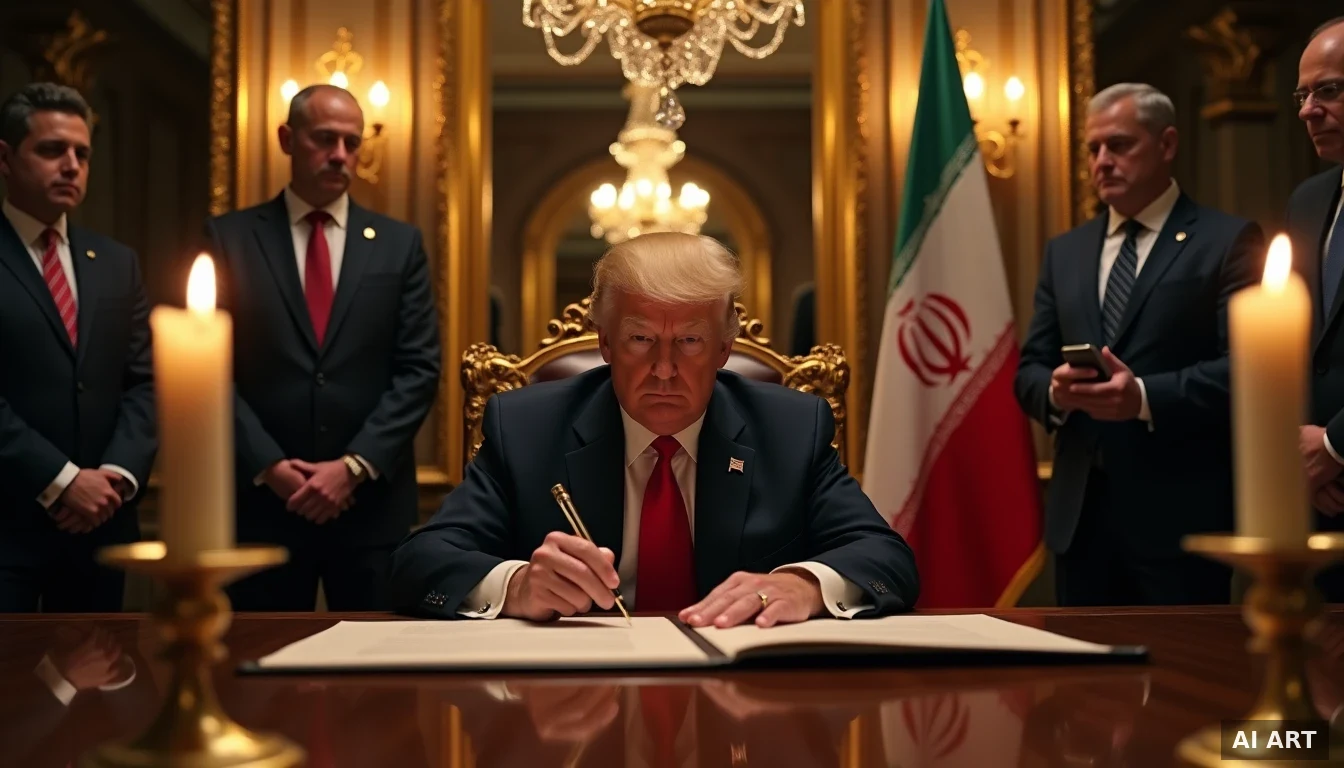
Trump's Iran Deal Is "Complete" — Except for the Posts That Keep Reopening It
Multi-perspective analysis. Each perspective deliberately argues one viewpoint; none represents the editorial position of qalarc.
President Donald Trump announced on Truth Social around June 14-15, 2026 that 'The Deal with the Islamic Republic of Iran is now complete,' capping a 60-day memorandum of understanding that reopened the Strait of Hormuz and ended a roughly four-month war. But a series of follow-up posts in which Trump restated or added conditions — Iran never having a nuclear weapon, open passage through Hormuz, and 'no money' until further notice — drew objections from Tehran, which said the statements contradicted the agreed text, fueling a debate over whether Trump is undermining his own agreement.
The facts (7)
- Trump announced on Truth Social (~June 14-15, 2026) that the Iran deal was 'complete' and authorized toll-free reopening of the Strait of Hormuz and removal of the US naval blockade [1].
- The framework rests on a 60-day memorandum of understanding — referred to as the 'Islamabad MoU' — that extended a ceasefire and set up nuclear talks after a war that began February 28, 2026; a draft was confirmed by the White House around late May 2026 [3][2].
- Trump repeatedly used Truth Social to restate or add conditions, including that Iran must never have a nuclear weapon, Hormuz must stay open, and 'No money will be exchanged, until further notice.' Iranian outlet Fars said one post 'raised issues that contradict the provisions of the agreement's text' [2].
- On June 23, 2026 Trump posted that Iran 'completely agreed to highest level Nuclear inspections,' while Iran's foreign ministry disputed that such inspections were scheduled; Trump added 'I will do what I have to do' if Iran doesn't honor the deal [4].
- AIPAC issued a statement (~June 18, 2026) criticizing the MoU's 'vague nuclear commitments' and urging Congress to ensure a final deal dismantles Iran's nuclear and missile programs — a posture of pressing for tougher oversight, not an impeachment campaign [6].
- Both chambers of Congress passed Iran war-powers resolutions in 2026 (House June 3, 215-208; Senate June 24, 50-48), which are constitutionally and procedurally separate from any impeachment process [8].
- Military historian Victor Davis Hanson defended the MoU in June 2026 columns and broadcast appearances, framing it as continuity of a deliberate pressure-and-deterrence strategy rather than a blunder, while acknowledging concerns such as third-party cash infusions and light sanctions language [9][11].
Context & background
The agreement follows a roughly four-month conflict that began February 28, 2026 and at one point closed the Strait of Hormuz, a critical chokepoint for global oil shipping. The 60-day MoU extended a ceasefire and opened a window for nuclear negotiations, with the framework remaining provisional rather than a final treaty [5][12]. AIPAC's criticism marks a notable shift: the group spent the Obama era fighting a nuclear deal it called too lenient, and now finds itself pressing a Republican president for tougher terms, a dynamic some outlets have described as an identity crisis for the organization [7]. The 'undermining via Truth Social' framing centers on the gap between the announced 'complete' deal and Trump's later posts adding or shifting conditions — a pattern that has produced repeated Iranian denials and clarifications even as the Strait reopened and the blockade was lifted.
Still unresolved
- Whether Trump's added Truth Social conditions will hold up the final treaty or be folded into it, and how Iran will respond if they remain in dispute.
- What the 'highest level Nuclear inspections' Trump described actually entail, given Iran's foreign ministry said no such inspections were scheduled.
- Whether the 60-day MoU window will produce a durable agreement or lapse back toward conflict.
Quick answers
What happened?
President Donald Trump announced on Truth Social around June 14-15, 2026 that 'The Deal with the Islamic Republic of Iran is now complete,' capping a 60-day memorandum of understanding that reopened the Strait of Hormuz and ended a roughly four-month war.
What's the evidence?
Checked against 13 candidate sources; the strongest references include: The Iran Deal Reopens the Strait. Much Remains to Be Done. | Council on Foreign Relations; Trump ends Iran meeting without making ‘final determination’ on deal; https://www.cnbc.com/2026/06/18/trump-iran-deal-mou-nuclear-hormuz.html.
Who benefits?
AIPAC and Israel lobby — Reassertion of veto power over US Middle East policy; demonstration that any president attempting Iran détente will face bipartisan impeachment threat.
How confident is the assessment?
The fact-finding verdict is partially confirmed — some claims verified, others unverified. The motive analysis is 62% confident.
Why does it matter?
Impeachment threat over Iran establishes that AIPAC retains effective veto over presidential Middle East policy → future administrations pre-emptively avoid Iran engagement → permanent US-Iran hostility becomes structural assumption → defense budgets and Gulf arms sales remain locked in regardless of actual threat…
The same story, argued three ways. Pick an angle — the facts above stay the same.
🧭 Cui bono — who benefits?
Beneficiaries
- AIPAC and Israel lobby — Reassertion of veto power over US Middle East policy; demonstration that any president attempting Iran détente will face bipartisan impeachment threat
via Mobilizing both parties to impeach over Iran deal establishes that crossing the Israel lobby on Iran is a third-rail issue that overrides partisan loyalty, restoring deterrence against future normalization attempts - Defense contractors (Lockheed Martin, Raytheon, Northrop Grumman) — Collapse of peace deal preserves $80B+ annual threat-justification spending and long-term Iran containment contracts
via Sabotaged peace agreement maintains Iran as designated adversary, preventing budget reallocation away from Middle East force projection capabilities and missile defense systems sold to Gulf allies - Netanyahu and Likud coalition — Elimination of existential threat to Israeli regional hegemony from US-Iran normalization
via Trump's self-sabotage via Truth Social provides pretext for AIPAC mobilization that kills deal before implementation, preventing Iran sanctions relief that would fund Hezbollah/Hamas and shift regional balance - Iran hardliners (IRGC) — Vindication of 'America cannot be trusted' narrative; strengthened domestic position against reformists
via Trump publicly undermining his own deal proves hardliner thesis that negotiation is futile, consolidating IRGC control and justifying continued nuclear/missile programs as only reliable deterrent
Who loses
- Trump himself (faces impeachment, legacy damage, exposed as unable to control own coalition)
- US taxpayers ($300B reparations liability according to prior claims, plus continued Middle East deployment costs)
- Iranian reformists and civil society (economic relief blocked, hardliners empowered)
- Gulf stability and global oil price predictability
Ramifications (follow the chain)
- Impeachment threat over Iran establishes that AIPAC retains effective veto over presidential Middle East policy → future administrations pre-emptively avoid Iran engagement → permanent US-Iran hostility becomes structural assumption → defense budgets and Gulf arms sales remain locked in regardless of actual threat assessment
- Trump's Truth Social sabotage demonstrates social media as uncontrollable diplomatic liability for all future presidents → either executive communication becomes more tightly controlled (reducing transparency) or foreign counterparts discount public US commitments → treaty credibility deteriorates → international agreements shift toward enforcement-through-structure rather than trust
- Iran deal collapse with $300B reparations liability (per prior claims) creates massive unfunded obligation → either Treasury must find budget offsets (cuts elsewhere or debt) or US simply refuses payment and accepts international arbitration loss → further damages US financial/legal credibility in international dispute resolution → accelerates flight from dollar-denominated dispute settlement
- Bipartisan impeachment coalition over foreign policy creates precedent that Congress can remove president for exercise of constitutional Article II powers → expands impeachment from 'high crimes' to 'policy we sufficiently dislike' → future presidents face intensified domestic veto players on any controversial international initiative → US becomes less reliable negotiating partner → multilateral diplomacy shifts further toward regional powers (China, EU) that can deliver commitments
intentional reading AIPAC and Netanyahu deliberately engineered Trump's public sabotage by feeding him inflammatory information or pressure through back-channels (possibly via evangelical advisors or Adelson-network donors) specifically designed to provoke his Truth Social impulses, knowing his online statements would provide the political ammunition needed to mobilize bipartisan impeachment. The goal: kill the deal before implementation while pinning blame on Trump's incompetence rather than Israeli pressure, thus avoiding the optics of a foreign lobby overtly overriding a US president. Victor Davis Hanson's 'masterful strategy' framing may be either genuine misreading or deliberate counter-narrative to provide Trump-loyal media with face-saving explanation. The $300B reparations figure (if real) could be a poison pill intentionally included to make the deal politically unratifiable, or leverage to force Trump to back out 'voluntarily.'
structural reading No conspiracy required: Trump's personality (impulsive, seeks validation, susceptible to flattery from hardliners like Hanson) intersects with AIPAC's institutional mandate (prevent any Iran nuclear capability) and defense contractors' profit motive (maintain threat spending). Trump genuinely believes he negotiated a good deal; AIPAC genuinely fears it empowers Iran; defense contractors genuinely lose contracts if Middle East tensions ease. Each actor pursues their rational self-interest: Trump posts to own his critics and claim victory, AIPAC mobilizes its bipartisan network because that's what it exists to do when Israel's security is (in their view) threatened, Congress responds to constituent pressure (both donor and voter) by threatening impeachment. The outcome—deal collapse—emerges from intersecting incentives without anyone needing to orchestrate the whole sequence. Iran hardliners benefit despite no coordination with AIPAC, simply because both prefer conflict to détente for different reasons (ideological legitimacy vs. security paranoia).
🎯 This narrative's market calls
Tickers the crowd narrative pointed at when this article was written — scored honestly against the price at publish. narrative confidence 72%
▲ LONG — the winners
LMT▲Lockheed MartinPeace deal collapse preserves Iran threat-based defense spendingRTX▲RaytheonContinued Middle East tensions sustain missile defense contractsNOC▲Northrop GrummanIran containment strategy maintains long-term procurement budgetsCL▲Crude OilGulf instability premium as Iran deal collapses▼ SHORT — the losers
— no calls this side
From the threads
The posts that drew the most replies in the source discussion — shown as posted. Reactions ranged across the spectrum; these are the ones people actually engaged with.
AIPAC has activated everyone in both parties against the Iran Deal
Did Trump just blow up his own Iran peace deal? https://truthsocial.com/@realDonald Trump/posts/116776806511904791
Why do Democrats want to continue the war?
This man is a military historian, he has dedicated his life to this stuff. He knows more than you. Trump has played a master stroke again, the rest of the world is just catching up to how well he's handled this. https://www.youtube.com/watch?v=Zzq E-9IEFTE&feature=youtu.be
Links shared in the discussion
Primary sources the threads posted — verify independently. These sometimes point to leads other coverage misses.
Continue the discussion
Add your own take — replies are kept on this article and can be upvoted.
🔗 Related Analysis
- Iran military gains assertion shared: iran, trump
- Criticism of perceived ignorance about Iran among a demographic group shared: iran, trump
- Trump administration criticized for Iran war and $300 billion settlement shared: iran, trump
- US releases official Memorandum of Understanding text on Iran agreement shared: iran, trump
- Epstein allegedly held compromising files on Trump regarding Iran shared: iran, trump
- Netanyahu status inquiry shared: aipac, trump
References
- [1] The Iran Deal Reopens the Strait. Much Remains to Be Done. | Council on Foreign Relations
- [2] Trump ends Iran meeting without making ‘final determination’ on deal
- [3] https://www.cnbc.com/2026/06/18/trump-iran-deal-mou-nuclear-hormuz.html
- [4] Trump says ‘I will do what I have to do’ if Iran doesn’t honor deal | Live Updates from Fox News Digital
- [5] Trump's U.S.-Iran framework agreement, explained : NPR
- [6] AIPAC condemns Trump's Iran deal over 'vague nuclear commitments' | Israel National News
- [7] An AIPAC Identity Crisis: A Decade Since Fighting Obama on Iran, It Now Faces Trump - U.S. News
- [8] US Senate approves Iran war powers resolution: What that means for Trump | US-Israel war on Iran News | Al Jazeera
- [9] VICTOR DAVIS HANSON: Don’t forget the broader context of the Iranian memorandum | Victor Davis Hanson | Opinion | Opinion Columns
- [10] Trump's Iran Gamble - The Daily Signal
- [11] Victor Davis Hanson challenges media assumptions on the Iran deal | Fox News
- [12] 2025–2026 Iran–United States negotiations - Wikipedia
- [13] Truth Social
- [14] An AIPAC Identity Crisis: A Decade Since Fighting Obama on Iran, It Now Faces Trump — Haaretz
- [15] Victor Davis Hanson — columns and commentary
Discussion
Select any text in the article to comment on that passage.