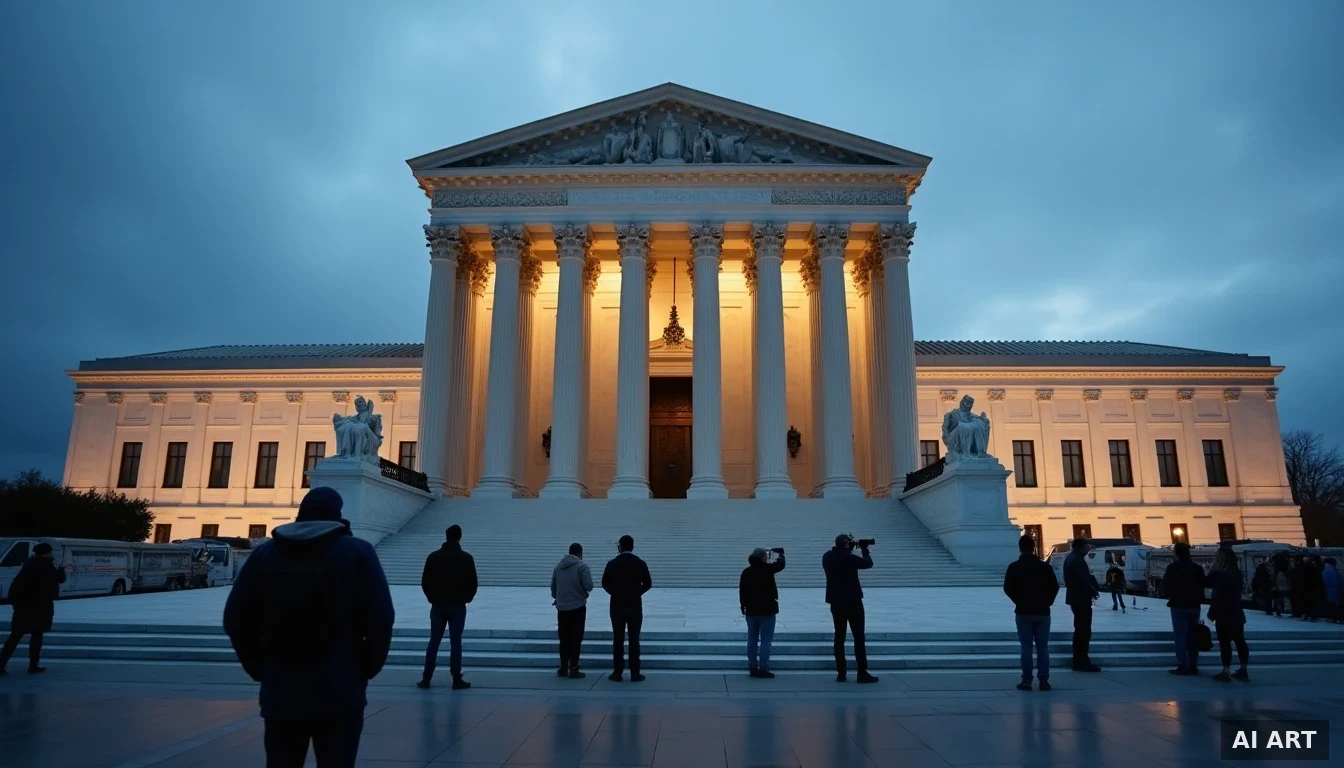
Supreme Court Lets $5M Carroll Verdict Stand as Trump-Iran War Ends in G7 Peace Deal
Multi-perspective analysis. Each perspective deliberately argues one viewpoint; none represents the editorial position of qalarc.
On June 29, 2026, the U.S. Supreme Court declined to hear Donald Trump's appeal, leaving intact a $5 million jury verdict finding he sexually abused and defamed writer E. Jean Carroll. The decision landed weeks after Trump signed a 14-point memorandum of understanding with Iranian President Masoud Pezeshkian at the G7 summit in France to end the U.S.-Iran war and reopen the Strait of Hormuz — capping a spring of repeated presidential threats that Iran would 'no longer exist.'
What the terms mean (4)
- Strait of Hormuz — A narrow waterway between Iran and the Arabian Peninsula through which roughly a fifth of global oil shipments pass, making its closure a major economic and strategic pressure point.
- Memorandum of understanding (MOU) — A signed document setting out an agreed framework or intentions between parties; often a step toward, but not always a fully binding, treaty.
- Denial of certiorari — When the Supreme Court declines to hear a case, leaving the lower court's ruling in force without the justices deciding the merits.
- E. Jean Carroll — An American writer and former advice columnist who won civil verdicts against Trump for sexual abuse and defamation.
The facts (8)
- The Supreme Court on June 29, 2026 rejected Trump's request to take up his appeal, meaning he must pay E. Jean Carroll $5 million on the verdict finding him liable for sexual abuse and defamation; Trump called the outcome a 'witch hunt' [7][8].
- The confirmed judgment left standing is $5 million — not $3 million as circulated in some online discussion; a separate Carroll case carries an $83.3 million defamation judgment. The plaintiff is named: writer E. Jean Carroll [7][8].
- The jury in the underlying case found Trump defamed Carroll partly by publicly claiming she was 'not his type,' which she and her lawyers characterized as saying she was too unattractive to have assaulted — a point echoed in online discussion of the ruling [7].
- On May 17-18, 2026, after meeting his national security team, Trump warned Iran that 'the clock is ticking' and that it would 'get hit much harder' [1][3].
- Trump separately threatened that 'the Islamic Republic of Iran will no longer exist,' issuing escalating warnings through the spring [2][9].
- The U.S.-Iran war began Feb. 28, 2026 and centered heavily on Iran's closure of the Strait of Hormuz, a critical global oil chokepoint.
- At the G7 summit in France (mid-June 2026), Trump and Pezeshkian signed a 14-point memorandum of understanding to end the war and reopen the Strait; G7 leaders issued a joint statement welcoming the deal but with skepticism voiced at home [4][5][12].
- In the days before the deal, Trump warned 'a whole civilization will die tonight' if no agreement was reached, then said he had called off the latest strike threats citing progress in talks [10][11].
Context & background
The Carroll litigation stems from Trump's public statements after Carroll accused him of assaulting her decades earlier; separate civil juries found him liable for sexual abuse and for defamation, producing both the $5 million verdict now upheld and a later $83.3 million defamation award. The June 29 denial of certiorari exhausts Trump's appeal on the smaller verdict [7][8]. In parallel, the U.S.-Iran war that began in late February 2026 became defined by Iran's closure of the Strait of Hormuz, prompting a sustained pattern of escalating ultimatums from Trump through spring rather than a single 'final warning' [1][2][9]. By mid-June the conflict had shifted from threats to diplomacy: at the G7 in France, a signed U.S.-Iran memorandum of understanding aimed to end hostilities and reopen the Strait, drawing G7 endorsement alongside domestic skepticism [4][5].
Still unresolved
- Whether the G7 memorandum of understanding will hold and the Strait of Hormuz remain fully reopened, given skepticism noted at home [5].
- Whether Trump has any remaining legal avenue on the $5 million Carroll judgment after the Supreme Court's denial [7].
- Unverified online items — including a video said to show a police checkpoint in Afghanistan and a claimed recent Trump statement expressing 'incomprehension' at Jewish support for Democrats — are not corroborated by the reporting reviewed.
The same story, argued three ways. Pick an angle — the facts above stay the same.
🧭 Cui bono — who benefits?
Beneficiaries
- Trump administration / Republican foreign policy establishment — Narrative control over Iran policy and Middle East posture heading into electoral cycles
via Escalatory rhetoric ('final warning') allows positioning as tough on Iran versus Obama-era diplomacy, creating contrast for domestic political consumption. Checkpoint footage from Afghanistan provides visual framing of regional instability requiring U.S. strength. - Defense contractors and military-industrial complex — Sustained threat posture justifies procurement and operational budgets
via Iran tension—particularly around strategic chokepoints like Hormuz—creates ongoing demand for naval assets, missile defense, and regional force projection. Prior research noting $80B spent on Iran military operations demonstrates revenue scale; escalation perpetuates the business model. - Regional rivals of Iran (Saudi Arabia, UAE, Israel) — U.S. pressure on Iran degrades a strategic competitor without direct cost
via American confrontation with Iran depletes Iranian resources, isolates them diplomatically, and maintains sanctions pressure—all advantageous to Sunni Gulf states and Israel. Trump's assertions about his pro-Israel record signal alignment with this coalition. - Political opposition / Democratic establishment — Potential claim of policy failure if Iran tensions escalate or reparations narrative gains traction
via If prior research claims about $300B reparations or 'financial bleeding' gain credibility, Democrats can weaponize fiscal irresponsibility narrative. Obama's Iran deal experience positions him as alternative voice, creating intra-party contrast and expertise claim.
Who loses
- American taxpayers (shouldering military expenditure and potential reparations)
- Iranian civilian population (sanctions and isolation)
- Global energy markets and maritime trade (Hormuz disruption risk increases shipping costs and volatility)
- Diplomatic credibility of U.S. commitments (cycle of deal-making and deal-breaking erodes trust with third parties)
Rivalry & conflicts of interest
- Obama foreign policy legacy / diplomatic approach to Iran harmed → Trump administration's confrontational posture gains
conflict of interest: Republican Party electoral interest in discrediting Democratic foreign policy achievements; Trump personally benefits from contrast with predecessor - Iran regional influence and economic stability harmed → Saudi Arabia, UAE, Israel gains
conflict of interest: Trump family business ties to Saudi Arabia; Kushner family investments in Israel; arms sales to Gulf states create revenue for U.S. defense sector with ties to administration officials - Diplomatic resolution advocates harmed → Defense and security apparatus gains
conflict of interest: Revolving door between Pentagon leadership and defense contractor boards; officials' post-government career prospects enhanced by hawkish credentials
Ramifications (follow the chain)
- Escalatory rhetoric → Iranian hardliners empowered over moderates → diplomacy window closes → permanent sanctions regime → Iran pushed toward Russia/China economic orbit → U.S. loses leverage while competitors gain energy/trade partner
- Hormuz tension → insurance and shipping costs spike → energy prices increase → inflation pressure in U.S. → Fed rate decisions complicated → recession risk rises → incumbent party (whichever holds executive) faces electoral vulnerability
- Claims of $300B reparations (whether valid or not) enter discourse → creates expectation of payment → if paid, validates narrative of costly intervention; if unpaid, creates grievance narrative for Iran → either outcome constrains future policy flexibility
- Afghanistan checkpoint footage circulation → 'forever war' fatigue reinforced → public appetite for Middle East engagement decreases → creates gap between elite foreign policy consensus (maintain presence) and voter preference (disengage) → populist candidates gain ammunition
intentional reading The Trump administration is deliberately escalating Iran rhetoric to create electoral contrast with Obama-Biden foreign policy, knowing that defense contractors benefit from sustained tension and that regional allies (Saudi Arabia, Israel) will support this posture both diplomatically and potentially financially (via arms purchases that flow to politically-connected firms). The $300B reparations narrative—if being pushed by opponents—serves to paint prior Republican Iran policy as fiscally catastrophic, setting up a 'they broke it, now they pay for it' frame that advantages Democrats. The checkpoint footage from Afghanistan is being circulated to prime audiences for 'strength' messaging. This is interest-group alignment: defense sector wants contracts, regional allies want Iran contained, Trump wants Obama contrast, Democrats want fiscal accountability narrative.
structural reading No coordination required: Iran tension has been profitable for decades. Defense contractors have quarterly earnings to hit and Iran provides a perennial justification. Regional powers rationally prefer U.S. confrontation with their rival over bearing costs themselves. Politicians of both parties respond to donor incentives (defense money, pro-Israel lobbying) and voter sentiment (appearing strong vs. appearing fiscally responsible). Media amplifies conflict because it generates engagement. The $80B-spent/$300B-owed claims emerge organically from fiscal hawks and anti-interventionists with genuine concerns. Each actor pursues local incentives; the aggregate is escalation and narrative chaos, with military-industrial complex and regional rivals capturing value while taxpayers and Iranian civilians bear costs. The system is auto-catalytic: tension justifies spending, spending creates contractors with lobbying power, lobbying sustains tension.
📊 Trading signals — winners & losers
Tradeable instruments most exposed to this story, inferred from the analysis above. Not financial advice — informational only, generated by AI from forum discussion and may be wrong.
📈 Likely winners
- ▲ CLcommodityCrude Oil$85.607d +1.3%✓ +15.4% since callHormuz disruption risk premium boosts oil prices
- ▲ LMTstockLockheed Martin$563.577d -5.8%✓ +11.4% since callIran tensions sustain defense procurement and operational budgets
- ▲ RTXstockRaytheon Technologies$209.917d -4.8%✓ +6.7% since callMiddle East threat posture drives missile defense demand
- ▲ NOCstockNorthrop Grumman$551.037d -4.1%✓ +7.4% since callElevated military readiness supports contractor revenue streams
📉 Likely losers
- ▼ EEMETFiShares MSCI Emerging Markets ETF$67.127d +0.7%✗ +1.3% since callOil price spike and geopolitical volatility hurt emerging economies
- ▼ UALstockUnited Airlines$113.177d -10.4%✓ -3.7% since callRising fuel costs and Middle East route risk
- ▼ DALstockDelta Air Lines$82.417d -9.7%✓ -5.6% since callJet fuel price sensitivity to Hormuz shipping disruption
📈 Call performance — day by day
| date | price | vs entry |
|---|---|---|
| 2026-08-11 | $82.21 | +10.8% |
| 2026-08-12 | $83.40 | +12.4% |
| 2026-08-13 | $82.77 | +11.5% |
| 2026-08-14 | $81.15 | +9.4% |
| 2026-08-15 | $81.41 | +9.7% |
| 2026-08-16 | $82.40 | +11.1% |
| 2026-08-17 | $82.40 | +11.1% |
| 2026-08-18 | $84.99 | +14.5% |
| 2026-08-19 | $84.54 | +13.9% |
| 2026-08-20 | $84.64 | +14.1% |
| 2026-08-21 | $86.52 | +16.6% |
| 2026-08-22 | $86.64 | +16.8% |
| 2026-08-23 | $87.06 | +17.3% |
| 2026-08-24 | $87.06 | +17.3% |
showing last 14 of 35 days
| date | price | vs entry |
|---|---|---|
| 2026-08-11 | $603.16 | +19.2% |
| 2026-08-12 | $597.77 | +18.1% |
| 2026-08-13 | $606.72 | +19.9% |
| 2026-08-14 | $598.01 | +18.2% |
| 2026-08-15 | $598.01 | +18.2% |
| 2026-08-16 | $608.68 | +20.3% |
| 2026-08-17 | $608.68 | +20.3% |
| 2026-08-18 | $593.74 | +17.3% |
| 2026-08-19 | $604.37 | +19.4% |
| 2026-08-20 | $589.15 | +16.4% |
| 2026-08-21 | $571.48 | +12.9% |
| 2026-08-22 | $563.57 | +11.4% |
| 2026-08-23 | $563.57 | +11.4% |
| 2026-08-24 | $563.57 | +11.4% |
showing last 14 of 35 days
| date | price | vs entry |
|---|---|---|
| 2026-08-11 | $224.12 | +13.9% |
| 2026-08-12 | $223.86 | +13.8% |
| 2026-08-13 | $222.76 | +13.2% |
| 2026-08-14 | $220.48 | +12.0% |
| 2026-08-15 | $220.48 | +12.0% |
| 2026-08-16 | $222.97 | +13.3% |
| 2026-08-17 | $222.97 | +13.3% |
| 2026-08-18 | $221.64 | +12.6% |
| 2026-08-19 | $222.74 | +13.2% |
| 2026-08-20 | $220.35 | +12.0% |
| 2026-08-21 | $212.29 | +7.9% |
| 2026-08-22 | $209.91 | +6.7% |
| 2026-08-23 | $209.91 | +6.7% |
| 2026-08-24 | $209.91 | +6.7% |
showing last 14 of 35 days
| date | price | vs entry |
|---|---|---|
| 2026-08-11 | $577.89 | +12.6% |
| 2026-08-12 | $575.69 | +12.2% |
| 2026-08-13 | $577.32 | +12.5% |
| 2026-08-14 | $574.74 | +12.0% |
| 2026-08-15 | $574.74 | +12.0% |
| 2026-08-16 | $585.87 | +14.2% |
| 2026-08-17 | $585.87 | +14.2% |
| 2026-08-18 | $570.20 | +11.1% |
| 2026-08-19 | $584.68 | +14.0% |
| 2026-08-20 | $582.84 | +13.6% |
| 2026-08-21 | $563.86 | +9.9% |
| 2026-08-22 | $551.03 | +7.4% |
| 2026-08-23 | $551.03 | +7.4% |
| 2026-08-24 | $551.03 | +7.4% |
showing last 14 of 35 days
| date | price | vs entry |
|---|---|---|
| 2026-08-11 | $65.17 | -1.6% |
| 2026-08-12 | $65.43 | -1.2% |
| 2026-08-13 | $66.46 | +0.3% |
| 2026-08-14 | $66.68 | +0.7% |
| 2026-08-15 | $66.68 | +0.7% |
| 2026-08-16 | $66.61 | +0.6% |
| 2026-08-17 | $66.61 | +0.6% |
| 2026-08-18 | $67.32 | +1.6% |
| 2026-08-19 | $65.34 | -1.3% |
| 2026-08-20 | $66.11 | -0.2% |
| 2026-08-21 | $66.62 | +0.6% |
| 2026-08-22 | $67.12 | +1.3% |
| 2026-08-23 | $67.12 | +1.3% |
| 2026-08-24 | $67.12 | +1.3% |
showing last 14 of 35 days
| date | price | vs entry |
|---|---|---|
| 2026-08-11 | $123.76 | +5.3% |
| 2026-08-12 | $126.31 | +7.5% |
| 2026-08-13 | $125.12 | +6.5% |
| 2026-08-14 | $126.35 | +7.5% |
| 2026-08-15 | $126.35 | +7.5% |
| 2026-08-16 | $125.34 | +6.7% |
| 2026-08-17 | $125.34 | +6.7% |
| 2026-08-18 | $122.26 | +4.0% |
| 2026-08-19 | $118.72 | +1.0% |
| 2026-08-20 | $115.78 | -1.5% |
| 2026-08-21 | $111.71 | -4.9% |
| 2026-08-22 | $112.85 | -4.0% |
| 2026-08-23 | $113.17 | -3.7% |
| 2026-08-24 | $113.17 | -3.7% |
showing last 14 of 35 days
| date | price | vs entry |
|---|---|---|
| 2026-08-11 | $89.21 | +2.2% |
| 2026-08-12 | $90.41 | +3.6% |
| 2026-08-13 | $89.93 | +3.0% |
| 2026-08-14 | $91.31 | +4.6% |
| 2026-08-15 | $91.31 | +4.6% |
| 2026-08-16 | $89.35 | +2.4% |
| 2026-08-17 | $89.35 | +2.4% |
| 2026-08-18 | $87.59 | +0.3% |
| 2026-08-19 | $87.01 | -0.3% |
| 2026-08-20 | $83.29 | -4.6% |
| 2026-08-21 | $81.06 | -7.1% |
| 2026-08-22 | $82.41 | -5.6% |
| 2026-08-23 | $82.41 | -5.6% |
| 2026-08-24 | $82.41 | -5.6% |
showing last 14 of 35 days
📊 See how every call has performed — the full scoreboard & API →
From the threads
The posts that drew the most replies in the source discussion — shown as posted. Reactions ranged across the spectrum; these are the ones people actually engaged with. Each quote links to its archived source thread so you can verify it; quotes we couldn't tie to a source thread are marked source unverified.
Because he raped her, them was found liable of defaming her by saying was too ugly to rape. To be clear, the Supreme Court literally ordered him to pay. Do not say "lol didn't happen."
https://x.com/NewsWire_US/status/20 72801053909606715
Links shared in the discussion
Primary sources the threads posted — verify independently. These sometimes point to leads other coverage misses.
Continue the discussion
Add your own take — replies are kept on this article and can be upvoted.
🔗 Related Analysis
- Obama's Iran deal credibility debate shared: iran, obama, trump
- Iran military gains assertion shared: iran, trump
- Criticism of perceived ignorance about Iran among a demographic group shared: iran, trump
- $300 billion Iran deal and Strait of Hormuz reopening shared: iran, obama, trump
- Trump administration criticized for Iran war and $300 billion settlement shared: iran, trump
- US releases official Memorandum of Understanding text on Iran agreement shared: iran, trump
References
- [1] ◎ Trump warns Iran of harder strikes after security meeting — Axios (May 17, 2026)
- [2] ◎ Trump threatens Iran's existence — The Hill (May 2026)
- [3] ◑ Trump issues warning to Iran after national security team meeting — CNN Politics
- [4] ◑ Trump and Iran sign agreement ending the war; G7 pledges tougher Russia sanctions — NBC News
- [5] ◎ Trump receives G7 leaders' support for Iran deal but faces skepticism at home — The Globe and Mail
- [6] ◎ Trump holds news conference as G7 summit in France wraps up — PBS News
- [7] ◑ Trump must pay E. Jean Carroll $5 million after Supreme Court denies appeal — CNN Politics (June 29, 2026)
- [8] Trump loses Supreme Court appeal on E. Jean Carroll case, cries 'witch hunt' — Forbes (June 29, 2026)
- [9] 'Iran will no longer exist': Trump launches new bombing threat after fresh strikes — Raw Story
- [10] ◎ Trump warns a 'whole civilization will die tonight' if Iran deal isn't reached — PBS News
- [11] ◎ Trump says he has called off latest threats to strike Iran, citing progress — PBS News
- [12] G7 summit: Trump-Iran U.S. deal — NewsNation
◖ supportive · ◗ critical · ◎ neutral wire · ◑ partisan · ⚑ state outlet
▾ Discussion
Select any text in the article to comment on that passage.