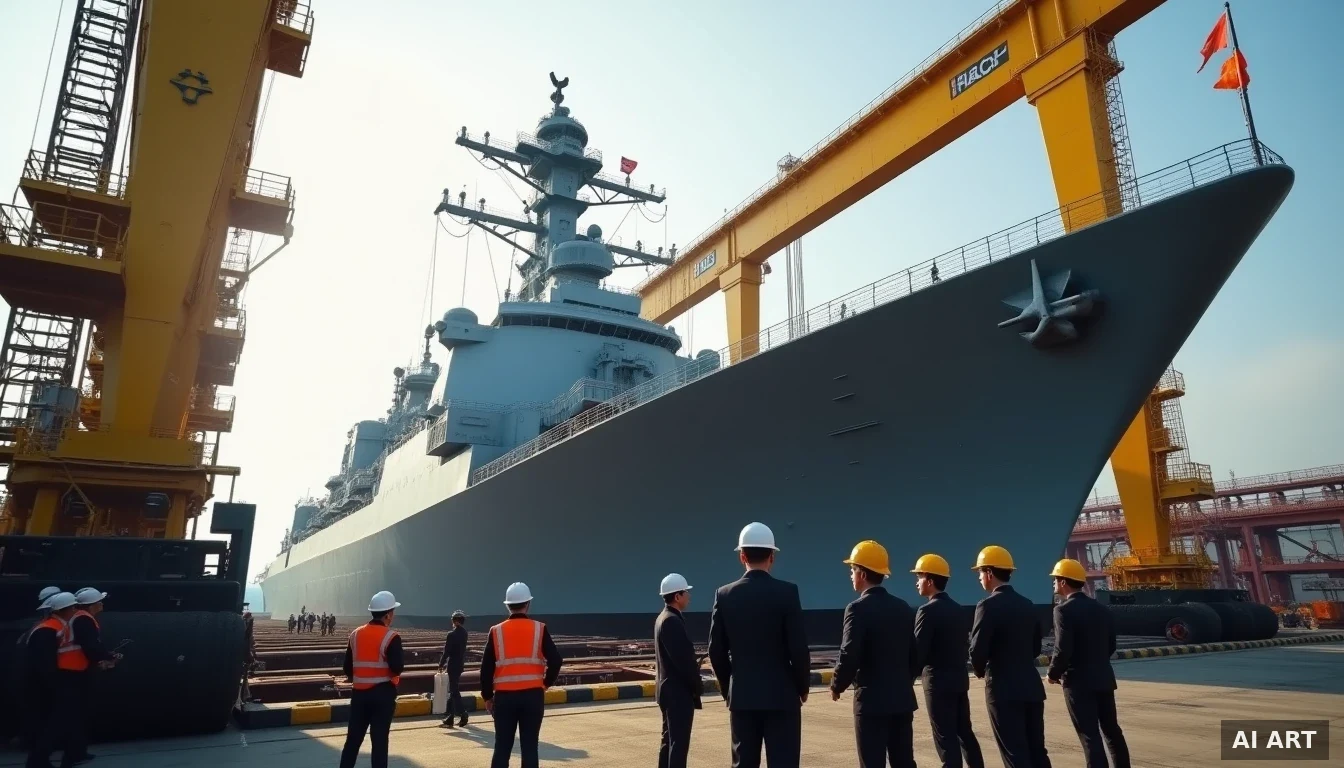
US Turns to South Korean Shipyards as Iran War Fuels 'American Decline' Debate
Multi-perspective analysis. Each perspective deliberately argues one viewpoint; none represents the editorial position of qalarc.
A fast-moving debate over American military and geopolitical decline has coalesced around two concrete developments: Washington's $150 billion 'MASGA' shipbuilding pact with South Korea, agreed in August 2025 to compensate for eroded US naval construction capacity, and Iran's succession of military setbacks culminating in the 2026 Iran war, which killed Supreme Leader Ali Khamenei. Commentators link the two as evidence of a superpower stretched thin, though the framing — including a viral claim that Iran's government is 'CIA-controlled' and its strikes mere 'theater' — is contested and outpaces confirmed reporting.
What the terms mean (5)
- MASGA — 'Make American Shipbuilding Great Again' — the August 2025 US-South Korea pact under which Korean shipbuilders invest in and support US naval construction and repair.
- Byrnes-Tollefson Amendment — A long-standing US law that prohibits building US Navy warships in foreign shipyards, limiting current Korean cooperation to maintenance and repair.
- MRO — Maintenance, Repair and Overhaul — servicing existing ships rather than building new ones, the main work Korean yards currently perform for the US Navy.
- Twelve-Day War — The 13–24 June 2025 conflict in which Israel and the US struck Iranian nuclear and military sites and Iran retaliated against a US base in Qatar.
- Operation Epic Fury / Roaring Lion — The US and Israeli operations that opened the February 2026 Iran war with roughly 900 strikes in 12 hours, killing Supreme Leader Ali Khamenei.
The facts (8)
- The US-South Korea 'MASGA' ('Make American Shipbuilding Great Again') deal was agreed 25 August 2025, involving a $150 billion Korean commitment, with Hanwha Ocean, HD Hyundai and Samsung yards taking on US Navy maintenance, repair and overhaul (MRO) work [10].
- In mid-2026 the US Navy issued Requests for Information (RFIs) to Korean shipbuilders for destroyers and oilers, signaling deeper reliance on Korean capacity [9].
- A 2025 CBO analysis concluded US yards alone cannot meet the Navy's 12-ships-per-year plan; China leads global shipbuilding (roughly 53–71% depending on the metric), with South Korea second.
- The Byrnes-Tollefson Amendment still legally bars building US Navy warships in foreign yards; FY2026 appropriations reaffirmed this with no waiver, so current cooperation is limited to MRO and US-based joint ventures rather than Korean-built warships [7].
- The Twelve-Day War (13–24 June 2025) saw Israel strike Iranian nuclear/military sites and the US bomb Fordow, Natanz and Isfahan on 22 June 2025; Iran fired missiles at the Al Udeid base in Qatar, an attack widely assessed as largely symbolic [2].
- The 2026 Iran war began 28 February 2026 with roughly 900 US-Israeli strikes in 12 hours (Operation Epic Fury / Operation Roaring Lion), killing Supreme Leader Ali Khamenei, who was buried in Mashhad around 10 July 2026 after six days of ceremonies [3][5].
- Mojtaba Khamenei was named the new Supreme Leader but, as of July 2026, has not appeared publicly and is reportedly wounded [5].
- Online commentators tie these threads together, arguing 'America can't build ships, will now beg South Korea' — noting Korea's geographic vulnerability to Chinese pressure — while a separate viral claim asserts Iran's government is 'CIA-controlled like Venezuela's' and its recent strikes are 'ineffective theater'; this CIA-control framing is unverified and contradicted by reporting describing a genuine, deadly war [8].
Context & background
The shipbuilding gap is well-documented: decades of consolidation left the US with limited yard capacity as China built a dominant commercial and naval shipbuilding base. The MASGA deal and subsequent Navy RFIs to Korean firms reflect an attempt to close that gap through allied capacity, though US law continues to prohibit constructing warships abroad [7][10]. On Iran, the June 2025 Twelve-Day War and the far larger February 2026 war represent a sharp escalation; reporting describes real casualties, real infrastructure damage, and a UNSC resolution condemning Iranian retaliatory strikes [6]. A ceasefire mediated by Pakistan was agreed 8 April 2026, extended indefinitely on 21 April, then declared 'over' by President Trump on 8 July 2026, with low-intensity strikes resuming [1][4].
Still unresolved
- Whether the Navy's RFIs to Korean shipbuilders will translate into actual contracts, given the Byrnes-Tollefson prohibition on foreign-built warships remains in force.
- The status and authority of Mojtaba Khamenei as the new Supreme Leader, who has not appeared publicly and is reportedly wounded.
- Whether the July 2026 resumption of low-intensity strikes escalates back into full conflict or the ceasefire holds.
The same story, argued three ways. Pick an angle — the facts above stay the same.
🧭 Cui bono — who benefits?
Beneficiaries
- China (PRC government and military-industrial complex) — Strategic encirclement advantage and reduced U.S. power projection capacity in Pacific and Middle East theaters
via U.S. inability to sustain shipbuilding creates dependency on South Korean yards for naval construction; any Chinese pressure on ROK (economic coercion, blockade threat to sea lanes, or reunification scenarios) directly constrains American fleet renewal. Simultaneous U.S. entanglement in Middle East 'theater' conflicts (if Iran strikes are performative/controlled) diverts resources from Pacific deterrence. U.S. credibility erosion from Afghanistan/Iraq outcomes reduces alliance cohesion in AUKUS and Quad frameworks. - Defense contractors and reconstruction firms (U.S. and allied: Lockheed Martin, Raytheon, KBR, Fluor) — Sustained revenue from prolonged, inconclusive conflicts and cyclical rebuilding
via Low-intensity, multi-decade engagements (Afghanistan 20 years, Iraq ongoing presence, now Iran strikes with 1,700+ civilian casualties requiring future reconstruction) generate continuous procurement cycles, maintenance contracts, and reconstruction bids. Performative conflicts that avoid decisive resolution maximize contract duration. - Regional powers filling U.S. vacuum (Turkey, Saudi Arabia, UAE in Middle East; India in Indian Ocean) — Expanded sphere of influence and reduced need to defer to U.S. strategic priorities
via Perceived U.S. decline (withdrawal from Afghanistan, inability to deter Houthi Red Sea attacks, reliance on Israeli military action rather than direct intervention) creates opportunity for regional hegemons to set terms in their neighborhoods. Turkey's Libya/Syria moves, Saudi-Iran détente brokered by China, UAE Yemen positioning all reflect reduced U.S. veto power.
Who loses
- Iranian civilian population (1,700+ deaths, infrastructure destruction with limited strategic gain for Tehran)
- U.S. middle and working class (tax burden for inconclusive wars, delayed domestic infrastructure investment, inflation from defense spending without victory dividends)
- South Korea (squeezed between U.S. dependency for security and Chinese economic coercion; shipbuilding capacity becomes geopolitical leverage point)
- U.S. credibility and alliance system architecture (NATO, AUKUS, bilateral treaties depreciate as insurance value)
Rivalry & conflicts of interest
- United States Navy fleet renewal and power projection harmed → People's Liberation Army Navy (PLAN) gains
conflict of interest: Chinese economic leverage over South Korean shipyards (largest export market for ROK goods; ability to throttle access or impose costs). Any supply disruption or political pressure on ROK directly constrains the competitor (USN) that depends on those yards for amphibious ships and auxiliaries. - U.S. geopolitical position and deterrence credibility harmed → China and Russia (multipolarity coalition) gains
conflict of interest: Elements of U.S. defense-industrial base profit from prolonged, inconclusive conflicts that prevent pivot to peer competition. If Iran is 'controlled opposition' (claim: CIA influence parallel to Venezuela), then performative Middle East conflicts serve to justify budgets while avoiding risk of great-power war. Bureaucratic and contractor incentives align against clear strategic focus on China.
Ramifications (follow the chain)
- U.S. shipbuilding atrophy → dependency on South Korean yards → ROK becomes single point of failure → China gains veto over U.S. naval expansion via economic coercion of ROK → Pacific fleet numerical inferiority locks in for 15+ year ship construction cycle → Taiwan and Philippines defense commitments become non-credible
- Middle East 'forever wars' consume defense budgets → underfunding of Pacific infrastructure (Guam, hardened bases, munitions stockpiles) → Chinese A2/AD envelope expands unchallenged → U.S. forced into accept fait accompli in First Island Chain → Japan and Australia reconsider alliance value, potential accommodation with Beijing
- Repeated inconclusive conflicts (Vietnam, Iraq, Afghanistan, now Iran strikes with limited effect) → domestic U.S. political coalitions converge on isolationism → drawdown of forward presence → regional powers fill vacuum with alternative security architectures (Shanghai Cooperation Organisation, China-brokered deals) → dollar's reserve status erodes as security guarantee depreciates → higher borrowing costs feedback into reduced defense spending
- If Iran leadership is compromised/controlled (claim), then Israeli strikes and U.S. operations face deliberately weak opposition → creates illusion of military effectiveness without testing against peer defenses → U.S. doctrine and procurement optimized for counter-insurgency and permissive environments → catastrophic capability gap if forced into high-intensity conflict with China (hardened C4ISR, massed fires, contested logistics)
intentional reading Chinese strategic planners are deliberately exploiting U.S. shipbuilding dependence on ROK by building economic coercion leverage (trade threats, supply chain pressure) to create a future veto over American naval expansion, while elements within the U.S. national-security apparatus with ties to defense contractors perpetuate Middle East 'theater conflicts' (potentially via influence over Iranian decision-making, per the CIA-control claim) to justify budget share and avoid the higher-risk peer confrontation in the Pacific. The 'controlled opposition' model—if Iran's strikes are performative—allows continuous low-intensity conflict that enriches Raytheon/Lockheed via munitions consumption and Israeli aid packages, while preventing strategic focus and resources from shifting to China containment. Israel benefits from U.S. entanglement that guarantees support, while China gains time to build naval superiority unmolested.
structural reading No conspiracy required: U.S. shipyards collapsed post-Cold War due to commercial market dynamics and political reluctance to subsidize industrial policy, creating path-dependent reliance on allied yards. South Korea filled the gap for commercial reasons; China's economic rise naturally made ROK vulnerable to Beijing's pressure. Defense contractors rationally maximize revenue via long-duration, low-intensity contracts rather than short, decisive wars (Afghanistan/Iraq model more profitable than Desert Storm). Iran, whether controlled or not, has structural incentive to avoid escalation that would invite total U.S. commitment (survival logic), producing 'performative' strikes that allow domestic credibility without existential risk. Regional powers opportunistically expand when U.S. is distracted, standard hegemonic-transition dynamics. Each actor follows local incentives; the sum is U.S. strategic incoherence and Chinese relative gain, no orchestration needed.
📊 Trading signals — winners & losers
Tradeable instruments most exposed to this story, inferred from the analysis above. Not financial advice — informational only, generated by AI from forum discussion and may be wrong.
📈 Likely winners
- ▲ LMTstockLockheed Martin$563.577d -5.8%✓ +11.4% since callProlonged inconclusive conflicts sustain defense contractor revenue streams.
- ▲ RTXstockRaytheon Technologies$209.917d -4.8%✓ +6.7% since callPersistent military engagements drive demand for weapons systems.
- ▲ GCcommodityGold$4,6987d +6.3%✓ +13.8% since callU.S. credibility decline and geopolitical uncertainty boost safe-haven demand.
📉 Likely losers
- ▼ EWYETFiShares MSCI South Korea ETF$178.347d -0.2%✓ -2.8% since callSqueezed between U.S. dependency and Chinese economic coercion pressure.
- ▼ CLcommodityCrude Oil$85.607d +1.3%✗ +19.7% since callIranian strikes ineffective theater reduces Middle East premium risk.
📈 Call performance — day by day
| date | price | vs entry |
|---|---|---|
| 2026-08-11 | $603.16 | +19.2% |
| 2026-08-12 | $597.77 | +18.1% |
| 2026-08-13 | $606.72 | +19.9% |
| 2026-08-14 | $598.01 | +18.2% |
| 2026-08-15 | $598.01 | +18.2% |
| 2026-08-16 | $608.68 | +20.3% |
| 2026-08-17 | $608.68 | +20.3% |
| 2026-08-18 | $593.74 | +17.3% |
| 2026-08-19 | $604.37 | +19.4% |
| 2026-08-20 | $589.15 | +16.4% |
| 2026-08-21 | $571.48 | +12.9% |
| 2026-08-22 | $563.57 | +11.4% |
| 2026-08-23 | $563.57 | +11.4% |
| 2026-08-24 | $563.57 | +11.4% |
showing last 14 of 35 days
| date | price | vs entry |
|---|---|---|
| 2026-08-11 | $224.12 | +13.9% |
| 2026-08-12 | $223.86 | +13.8% |
| 2026-08-13 | $222.76 | +13.2% |
| 2026-08-14 | $220.48 | +12.0% |
| 2026-08-15 | $220.48 | +12.0% |
| 2026-08-16 | $222.97 | +13.3% |
| 2026-08-17 | $222.97 | +13.3% |
| 2026-08-18 | $221.64 | +12.6% |
| 2026-08-19 | $222.74 | +13.2% |
| 2026-08-20 | $220.35 | +12.0% |
| 2026-08-21 | $212.29 | +7.9% |
| 2026-08-22 | $209.91 | +6.7% |
| 2026-08-23 | $209.91 | +6.7% |
| 2026-08-24 | $209.91 | +6.7% |
showing last 14 of 35 days
| date | price | vs entry |
|---|---|---|
| 2026-08-11 | $4,454 | +7.9% |
| 2026-08-12 | $4,427 | +7.2% |
| 2026-08-13 | $4,467 | +8.2% |
| 2026-08-14 | $4,416 | +7.0% |
| 2026-08-15 | $4,401 | +6.6% |
| 2026-08-16 | $4,437 | +7.5% |
| 2026-08-17 | $4,450 | +7.8% |
| 2026-08-18 | $4,460 | +8.0% |
| 2026-08-19 | $4,386 | +6.2% |
| 2026-08-20 | $4,581 | +10.9% |
| 2026-08-21 | $4,584 | +11.0% |
| 2026-08-22 | $4,686 | +13.5% |
| 2026-08-23 | $4,681 | +13.4% |
| 2026-08-24 | $4,681 | +13.4% |
showing last 14 of 35 days
| date | price | vs entry |
|---|---|---|
| 2026-08-11 | $163.12 | -11.1% |
| 2026-08-12 | $167.24 | -8.9% |
| 2026-08-13 | $175.87 | -4.2% |
| 2026-08-14 | $178.62 | -2.7% |
| 2026-08-15 | $178.62 | -2.7% |
| 2026-08-16 | $179.74 | -2.1% |
| 2026-08-17 | $179.74 | -2.1% |
| 2026-08-18 | $185.10 | +0.9% |
| 2026-08-19 | $170.05 | -7.3% |
| 2026-08-20 | $174.43 | -5.0% |
| 2026-08-21 | $178.16 | -2.9% |
| 2026-08-22 | $178.34 | -2.8% |
| 2026-08-23 | $178.34 | -2.8% |
| 2026-08-24 | $178.34 | -2.8% |
showing last 14 of 35 days
| date | price | vs entry |
|---|---|---|
| 2026-08-11 | $82.21 | +15.0% |
| 2026-08-12 | $83.40 | +16.6% |
| 2026-08-13 | $82.77 | +15.7% |
| 2026-08-14 | $81.15 | +13.5% |
| 2026-08-15 | $81.41 | +13.8% |
| 2026-08-16 | $82.40 | +15.2% |
| 2026-08-17 | $82.40 | +15.2% |
| 2026-08-18 | $84.99 | +18.9% |
| 2026-08-19 | $84.54 | +18.2% |
| 2026-08-20 | $84.64 | +18.4% |
| 2026-08-21 | $86.52 | +21.0% |
| 2026-08-22 | $86.64 | +21.2% |
| 2026-08-23 | $87.06 | +21.7% |
| 2026-08-24 | $87.06 | +21.7% |
showing last 14 of 35 days
📊 See how every call has performed — the full scoreboard & API →
From the threads
The posts that drew the most replies in the source discussion — shown as posted. Reactions ranged across the spectrum; these are the ones people actually engaged with. Each quote links to its archived source thread so you can verify it; quotes we couldn't tie to a source thread are marked source unverified.
America can't build ships, will now beg SK to build their ships Too bad SK is right next to China, kek
Links shared in the discussion
Primary sources the threads posted — verify independently. These sometimes point to leads other coverage misses.
Continue the discussion
Add your own take — replies are kept on this article and can be upvoted.
🔗 Related Analysis
- America america shared: america, iran
- America terrorist shared: america, iran
- Discussion of Lebanon conflict shared: iran, iraq
- China economic and demographic collapse forecast within decade shared: america, vietnam
- Iran war civilian casualty toll and infrastructure damage shared: iran
- Iran military gains assertion shared: iran
References
- [1] ◎ 2026 Iran war ceasefire - Wikipedia
- [2] ◎ Twelve-Day War - Wikipedia
- [3] ◎ 2026 Iran war | Deal, Explained, United States, Israel — Britannica
- [4] ◖ July 10, 2026 — Mediators work to de-escalate US-Iran tensions | CNN
- [5] ◎ Iran buries Khamenei as renewed fighting tests shaky ceasefire deal | Euronews
- [6] ◎ Israel/US-Iran conflict 2026: Background and UK response - House of Commons Library
- [7] ◎ CRS product IF13032 (Byrnes-Tollefson / shipbuilding) - Congress.gov
- [8] ◎ What is Iran's military strategy? How has it changed since June 2025 war? | Al Jazeera
- [9] US Navy Issued RFIs to Korean Shipbuilders for Destroyers and Oilers - Maritime Executive
- [10] 'Make American Shipbuilding Great Again': The US-South Korea Deal — BISI
- [11] US Navy RFIs to Korean shipbuilders for destroyers and oilers, 2026 — USNI News shipbuilding coverage
- [12] ◎ US-South Korea MASGA shipbuilding agreement, August 2025 — Reuters
- [13] US Navy weighs Korean shipyards for destroyers and oilers (2026 RFIs) — Defense News shipbuilding coverage
- [14] ◎ US-South Korea 'MASGA' $150bn shipbuilding pact (25 Aug 2025) — Reuters
◖ supportive · ◗ critical · ◎ neutral wire · ◑ partisan · ⚑ state outlet
▾ Discussion
Select any text in the article to comment on that passage.