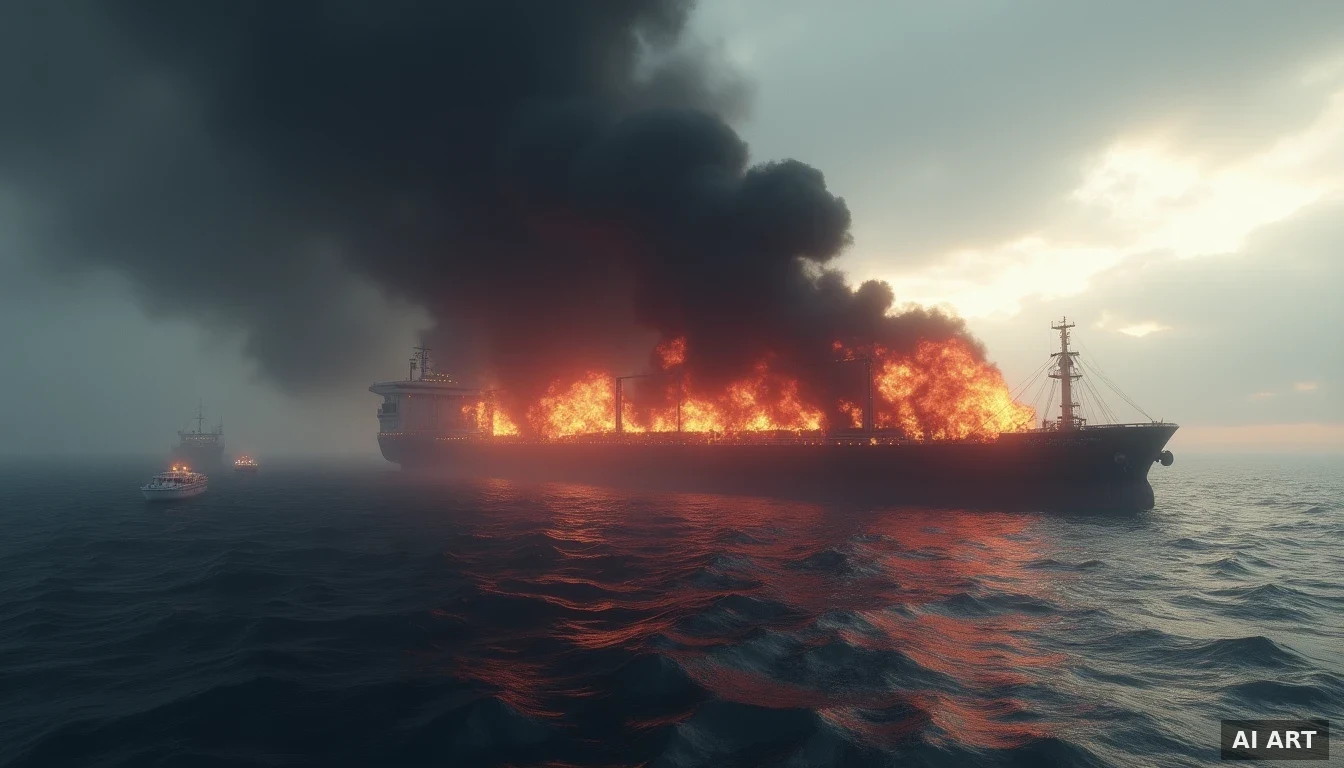
Ukrainian Drones Batter Russian Tanker Fleet in Azov as Trump Pledges Patriot Manufacturing License
Multi-perspective analysis. Each perspective deliberately argues one viewpoint; none represents the editorial position of qalarc.
Ukrainian drones struck roughly a dozen Russian tankers overnight in the Sea of Azov on July 9, 2026, setting two oil tankers ablaze, as part of a four-day campaign that Kyiv says targeted 36 vessels aimed at cutting fuel to occupied Crimea. Separately, at the NATO summit in Ankara on July 8, U.S. President Donald Trump told Ukrainian President Volodymyr Zelensky the United States would grant Ukraine a license to manufacture Patriot interceptors — a pledge analysts caution could take years to materialize.
What the terms mean (5)
- Sea of Azov — An inland sea north of the Black Sea, bordered by Ukraine and Russia, and a key route for supplying Russian-occupied Crimea.
- Shadow fleet — Aging, often opaquely-owned tankers Russia uses to transport oil while evading Western sanctions and price caps.
- Patriot interceptor — A US-made surface-to-air missile system used to shoot down aircraft, ballistic and cruise missiles; central to Ukraine's air defense.
- TCC (Territorial Recruitment Center) — Ukraine's local military draft and enlistment offices, whose officers have faced a rising number of attacks amid war fatigue.
- Mitsubishi Heavy Industries — A Japanese heavy-engineering firm that already produces Patriot missiles under US license, which Zelensky said Ukraine is interested in cooperating with.
The facts (8)
- Ukraine's military reported drones hit about a dozen more Russian tankers overnight in the Sea of Azov; Rostov Governor Yuri Slusar confirmed two oil tankers were set ablaze on July 9, 2026 [1][2].
- Ukraine's defense ministry said 36 vessels were targeted in the Sea of Azov and Black Sea over the four days ending July 9 — 32 'shadow fleet' tankers and two dry cargo ships — with the stated aim of cutting fuel supplies to occupied Crimea [3].
- The broader Ukrainian campaign struck Russian oil facilities including the Tver oil depot, Stavropol reservoirs and the Ufa pumping station, contributing to fuel shortages and rationing reported across Russia [2].
- At the NATO summit in Ankara on July 8, 2026, Trump told Zelensky the US would grant Ukraine a license to make Patriot interceptors, calling it a defensive weapon, while acknowledging the manufacturers — Lockheed Martin and RTX — had not yet been informed [4][5].
- Trump said the US has few Patriots to spare and that production 'won't be easy'; Bloomberg and other analysts note actual Ukrainian Patriot manufacturing could take years due to supply-chain and certification constraints [6][9][10].
- On July 9, Zelensky said Ukraine received a positive decision on the Patriot license and expressed interest in cooperating with Japan's Mitsubishi Heavy Industries — an existing licensed Patriot producer — though no partnership or contract has been signed [7][8].
- Attacks on Ukrainian Territorial Recruitment Center (TCC) officers have surged — 341 in 2025 and 620+ since February 2022 — with a TCC serviceman fatally wounded in Lviv on April 2, 2026, and a crowd overturning a TCC vehicle in Lviv on July 8, 2026 [11].
- Online discussion around the conflict included pro-Russia conspiracy framing about NATO and Israeli 'control' of Ukraine; such framing is not supported by mainstream reporting and reflects thread editorializing.
Context & background
Ukraine has escalated a sustained drone campaign against Russia's 'shadow fleet' — tankers Moscow uses to circumvent Western oil sanctions — and against domestic refining infrastructure, aiming to squeeze fuel supplies and export revenue. The Sea of Azov strikes are the latest in a series documented over 2025-2026 [3]. On the air-defense front, Patriot interceptors have been central to Ukraine's protection against Russian missile and drone barrages, and their scarcity has been a recurring point of friction. Trump's Ankara pledge to license domestic Ukrainian production is significant symbolically, but reporting stresses it is a licensing offer rather than an immediate transfer, with the manufacturers uninformed and years of lead time likely [5][10].
Still unresolved
- Whether the Patriot manufacturing license will translate into any actual production timeline, given that Lockheed Martin and RTX had not been consulted and analysts cite multi-year lead times.
- The full extent and cumulative economic impact of the tanker and refinery strikes on Russian fuel supply and 'shadow fleet' operations.
- The nature and organization behind attacks on Ukrainian recruitment officers — reporting describes largely spontaneous acts by draft-resisters and civilians, amplified by Russian disinformation, rather than any organized internal force.
The same story, argued three ways. Pick an angle — the facts above stay the same.
🧭 Cui bono — who benefits?
Beneficiaries
- U.S. defense contractors (Raytheon, Lockheed Martin) and Mitsubishi Heavy Industries — Expanded production contracts for Patriot missile systems and integration into long-term supply chains
via Trump administration commitment to domestic Patriot manufacturing creates multi-billion dollar orders; Mitsubishi partnership with Ukraine establishes new export market and regional production footprint, spreading R&D costs across larger production runs while creating dependency on maintenance contracts - Iran — Strategic positioning as U.S. faces two-theater resource strain and potential leverage via $300B debt claim
via U.S. commitment of advanced air-defense systems to Ukraine depletes inventory available for Middle East contingencies; parallel U.S.-Iran conflict (1,700+ civilian casualties) creates diplomatic isolation for Washington while Tehran frames itself as victim, potentially using alleged $300B debt as sanctions relief negotiating leverage - Saudi Arabia — Energy market leverage as Russian oil infrastructure faces sustained Ukrainian strikes
via Ukrainian drone campaigns against Russian tankers in Azov Sea and oil facilities constrain Russian export capacity, tightening global supply and supporting higher price floors that benefit Saudi crude; gives Riyadh options to modulate production for maximum revenue while positioning as 'reliable' supplier versus sanctioned/strike-vulnerable Russian sources - Chinese maritime and surveillance technology exporters — Increased demand for naval defense systems and anti-drone capabilities from Russian and aligned navies
via Demonstration of Ukrainian drone effectiveness against Russian vessels creates urgent procurement demand for countermeasures, with Western systems unavailable to sanctioned states; China fills gap with export-grade naval EW, point-defense, and maritime drone detection systems
Who loses
- Russian Black Sea/Azov naval and merchant fleet operators (material losses, rising insurance costs, constrained operations)
- Ukrainian conscripts and military recruiters (internal factional violence suggests domestic resistance to mobilization)
- Iranian civilian infrastructure and population (ongoing damage from U.S. strikes)
- European consumers facing sustained energy price volatility as Russian export routes remain under attack
Rivalry & conflicts of interest
- Russian oil export infrastructure and maritime logistics harmed → Saudi Arabia and other OPEC+ members with excess capacity gains
conflict of interest: U.S. diplomatic preference for Saudi cooperation on oil prices and regional security; Trump administration's historically close Saudi ties create alignment where Ukrainian strikes on Russian energy serve both Kyiv's military goals and Riyadh's market position - Russian naval and air-defense credibility (repeated successful Ukrainian strikes) harmed → Western defense contractors marketing competing systems (Patriot, NASAMS, Iron Dome) gains
conflict of interest: U.S. executive branch decision-makers including defense/state department officials routinely transition to defense contractor boards; Ukraine serves as live-fire demonstration theater for U.S. systems, generating export sales to allies observing Russian system failures - U.S. strategic flexibility (inventory depletion across two theaters) harmed → China (reduced U.S. capacity for simultaneous Pacific contingency) gains
conflict of interest: None directly evident in decision-making, but structural: defense contractors profit from depletion-driven restock orders regardless of strategic overextension risks
Ramifications (follow the chain)
- Patriot production commitment → multi-year contractor lock-in → Ukraine becomes dependent on U.S./Japanese supply chains for maintenance/munitions → permanent leverage point for Washington over Kyiv's negotiating position, while sustaining defense sector revenue post-conflict
- Sustained strikes on Russian oil infrastructure → higher long-term insurance/security costs for all Black Sea/Azov commerce → accelerates shift of energy routes toward pipelines through Turkey and LNG terminals → Turkey gains transit leverage, strengthening Ankara's position as infrastructure chokepoint
- Internal Ukrainian violence against recruiters → signals fragmenting domestic cohesion → accelerates external pressure for negotiated settlement while weakening Kyiv's bargaining position → benefits Russia and any mediators (potentially Saudi Arabia positioning for diplomatic role) who can claim credit for ending conflict
- U.S. two-theater engagement (Ukraine + Iran) → ammunition/missile inventory depletion → 2-3 year production ramp required to rebuild stocks → window of reduced U.S. deterrence credibility in Pacific, potentially emboldening Chinese action on Taiwan before reconstitution complete
intentional reading The Trump administration's simultaneous commitment to Ukrainian Patriot production and prosecution of strikes against Iran serves a dual defense-industrial agenda: (1) depleting existing stockpiles creates multi-year, politically insulated procurement budgets for contractors with deep administrative ties, and (2) Ukrainian strikes on Russian energy infrastructure—tacitly enabled by U.S. intelligence sharing—align with Saudi preferences for constrained Russian oil exports, generating reciprocal Saudi cooperation on regional security and oil price management. The Mitsubishi partnership exports production burden while locking allied supply chains into U.S. system architecture. Internal Ukrainian violence against recruiters may reflect factional resistance to policies perceived as externally driven, but serves Washington's interest by creating urgency for a settlement that leaves U.S.-dependent defense infrastructure in place.
structural reading No centralized coordination required: defense contractors profit from any conflict that depletes inventory, regardless of strategic outcome. Ukrainian strikes on Russian oil serve Kyiv's military objectives while automatically benefiting Saudi market position through supply constraint. U.S. two-theater posture emerges from bureaucratic path-dependence (existing commitments to Ukraine, Iran policy continuity) rather than grand strategy, but creates predictable depletion-restock cycles that sustain defense sector revenue. Mitsubishi seeks manufacturing partnerships to sustain heavy industry amid shrinking domestic Japanese demand. Iranian civilian casualties generate predictable diplomatic costs for Washington while Tehran leverages victim narrative for sanctions relief. Internal Ukrainian resistance to mobilization reflects normal friction in sustained conflict, amplified by social media visibility. Each actor pursues local incentives; systemic outcome is resource transfer to defense sector and energy producers, with peripheral states bearing humanitarian costs.
📊 Trading signals — winners & losers
Tradeable instruments most exposed to this story, inferred from the analysis above. Not financial advice — informational only, generated by AI from forum discussion and may be wrong.
📈 Likely winners
- ▲ LMTstockLockheed Martin$563.577d -5.8%✓ +11.4% since callPatriot missile production expansion and Trump manufacturing support pledge
- ▲ RTXstockRaytheon Technologies$209.917d -4.8%✓ +6.7% since callPatriot system co-producer benefiting from increased demand and contracts
- ▲ CLcommodityCrude Oil$85.607d +1.3%✓ +18.3% since callRussian oil infrastructure strikes tighten supply, boost energy prices
📉 Likely losers
- ▼ BZcommodityBrent Crude (supply volatility)$93.497d +2.9%✗ +22.0% since callEuropean energy price volatility from sustained Russian export disruptions
- ▼ ERUSETFRussian Equities ETF$8.06✓ +0.0% since callNaval losses, oil infrastructure damage, sustained operational constraints
📈 Call performance — day by day
| date | price | vs entry |
|---|---|---|
| 2026-08-11 | $603.16 | +19.2% |
| 2026-08-12 | $597.77 | +18.1% |
| 2026-08-13 | $606.72 | +19.9% |
| 2026-08-14 | $598.01 | +18.2% |
| 2026-08-15 | $598.01 | +18.2% |
| 2026-08-16 | $608.68 | +20.3% |
| 2026-08-17 | $608.68 | +20.3% |
| 2026-08-18 | $593.74 | +17.3% |
| 2026-08-19 | $604.37 | +19.4% |
| 2026-08-20 | $589.15 | +16.4% |
| 2026-08-21 | $571.48 | +12.9% |
| 2026-08-22 | $563.57 | +11.4% |
| 2026-08-23 | $563.57 | +11.4% |
| 2026-08-24 | $563.57 | +11.4% |
showing last 14 of 35 days
| date | price | vs entry |
|---|---|---|
| 2026-08-11 | $224.12 | +13.9% |
| 2026-08-12 | $223.86 | +13.8% |
| 2026-08-13 | $222.76 | +13.2% |
| 2026-08-14 | $220.48 | +12.0% |
| 2026-08-15 | $220.48 | +12.0% |
| 2026-08-16 | $222.97 | +13.3% |
| 2026-08-17 | $222.97 | +13.3% |
| 2026-08-18 | $221.64 | +12.6% |
| 2026-08-19 | $222.74 | +13.2% |
| 2026-08-20 | $220.35 | +12.0% |
| 2026-08-21 | $212.29 | +7.9% |
| 2026-08-22 | $209.91 | +6.7% |
| 2026-08-23 | $209.91 | +6.7% |
| 2026-08-24 | $209.91 | +6.7% |
showing last 14 of 35 days
| date | price | vs entry |
|---|---|---|
| 2026-08-11 | $82.21 | +13.6% |
| 2026-08-12 | $83.40 | +15.2% |
| 2026-08-13 | $82.77 | +14.4% |
| 2026-08-14 | $81.15 | +12.1% |
| 2026-08-15 | $81.41 | +12.5% |
| 2026-08-16 | $82.40 | +13.9% |
| 2026-08-17 | $82.40 | +13.9% |
| 2026-08-18 | $84.99 | +17.4% |
| 2026-08-19 | $84.54 | +16.8% |
| 2026-08-20 | $84.64 | +17.0% |
| 2026-08-21 | $86.52 | +19.6% |
| 2026-08-22 | $86.64 | +19.7% |
| 2026-08-23 | $87.06 | +20.3% |
| 2026-08-24 | $87.06 | +20.3% |
showing last 14 of 35 days
| date | price | vs entry |
|---|---|---|
| 2026-08-11 | $87.62 | +14.4% |
| 2026-08-12 | $89.44 | +16.7% |
| 2026-08-13 | $88.61 | +15.6% |
| 2026-08-14 | $86.55 | +13.0% |
| 2026-08-15 | $86.55 | +13.0% |
| 2026-08-16 | $88.52 | +15.5% |
| 2026-08-17 | $88.52 | +15.5% |
| 2026-08-18 | $90.85 | +18.6% |
| 2026-08-19 | $90.83 | +18.5% |
| 2026-08-20 | $91.63 | +19.6% |
| 2026-08-21 | $93.79 | +22.4% |
| 2026-08-22 | $93.94 | +22.6% |
| 2026-08-23 | $94.39 | +23.2% |
| 2026-08-24 | $93.45 | +22.0% |
showing last 14 of 35 days
| date | price | vs entry |
|---|---|---|
| 2026-08-11 | $8.06 | +0.0% |
| 2026-08-12 | $8.06 | +0.0% |
| 2026-08-13 | $8.06 | +0.0% |
| 2026-08-14 | $8.06 | +0.0% |
| 2026-08-15 | $8.06 | +0.0% |
| 2026-08-16 | $8.06 | +0.0% |
| 2026-08-17 | $8.06 | +0.0% |
| 2026-08-18 | $8.06 | +0.0% |
| 2026-08-19 | $8.06 | +0.0% |
| 2026-08-20 | $8.06 | +0.0% |
| 2026-08-21 | $8.06 | +0.0% |
| 2026-08-22 | $8.06 | +0.0% |
| 2026-08-23 | $8.06 | +0.0% |
| 2026-08-24 | $8.06 | +0.0% |
showing last 14 of 35 days
📊 See how every call has performed — the full scoreboard & API →
From the threads
The posts that drew the most replies in the source discussion — shown as posted. Reactions ranged across the spectrum; these are the ones people actually engaged with. Each quote links to its archived source thread so you can verify it; quotes we couldn't tie to a source thread are marked source unverified.
if you dont repost this image 15 times your mother will die in her sleep tonight. you have an hour
Previous: Timeline /tug/: https://files.catbox.moe/m97wmq.pdf ▶WARNING Be aware, any /chug/ thread that uses globohomo nuspeak wording in the OP (such as Kyiv) or cites UKROP sources (like video game footage) are fake shill threads. ▶Latest ▶/chug/ https://rentry.org/chug2024 ▶MEGA https://mega.nz/folder/MIVgzQDB#0Ic V1Tz3N8ivctg0ChCjfQ ▶Telegram Channels https://rentry.org/chug2024#telegra m-channels ▶Maps https://rentry.org/chug2024#maps ▶Video Archive https://rentry.org/chugvidz ▶Resources & misc links https://rentry.org/chug2024#linksre sources https://mega.nz/fm/FP0SBZAQ ▶Podcasts & Analy
Russia does not allow adoption into countries where children can change gender.
WHAT THE FUCK THAT IS IN THE UKRAINE????????????????? WHAT??????????
Links shared in the discussion
Primary sources the threads posted — verify independently. These sometimes point to leads other coverage misses.
- rentry.orgshared 3×
- rentry.orgshared 2×
- rentry.orgshared 2×
- rentry.org
- archive.today
- files.catbox.moe
- rentry.org
- mega.nz
- mega.nz
- rentry.org
Continue the discussion
Add your own take — replies are kept on this article and can be upvoted.
🔗 Related Analysis
- Iran war civilian casualty toll and infrastructure damage shared: iran
- Iran military gains assertion shared: iran
- Criticism of perceived ignorance about Iran among a demographic group shared: iran
- Satirical post impersonating Iranian demanding US money shared: iran
- Bomb detonated in Monaco shared: ukraine
References
- [1] Ukraine's drones are taking a bite out of Russia's tanker fleet — Detroit News
- [2] Ukrainian drones batter Russian oil facilities and set more oil tankers ablaze — Washington Times
- [3] ◎ Ukrainian attacks on the Russian shadow fleet — Wikipedia
- [4] ◎ US, Ukraine to co-produce Patriots — The Hill
- [5] Ukraine to get 'license' for making Patriot interceptors, Trump pledges — Defense News
- [6] ◎ Trump says he'll let Ukraine make Patriot missiles; it won't be easy — Bloomberg
- [7] Zelenskyy stated Ukraine's interest in cooperation with Mitsubishi on Patriot production — UNN
- [8] Zelenskyy: US recognizes Ukraine as country ready to produce Patriot — Interfax Ukraine
- [9] ◑ It could take years for Ukraine to produce Patriot missiles – Bloomberg — Ukrainska Pravda
- [10] Despite Trump's announcement, Patriot missile production in Ukraine may not start for years — Washington Times
- [11] Attacks on Ukraine draft officers soar as war fatigue deepens — Spokesman-Review
◖ supportive · ◗ critical · ◎ neutral wire · ◑ partisan · ⚑ state outlet
▾ Discussion
Select any text in the article to comment on that passage.